Nexus Magazine - Vol 22 #6, October-November 2015 by Nexus various
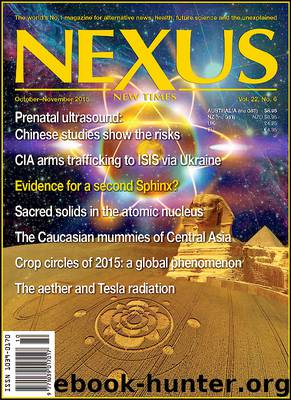
Author:Nexus various
Language: eng
Format: epub
Published: 2015-10-09T16:00:00+00:00
On the Structure of Matter
Figure 1 shows the modern periodic table of the elements. Each element is characterised by its atomic number, A, which counts the number of protons (positively charged particles) in its nucleus.
This number also indicates the number of electrons (negatively charged particles) that surround the nucleus when the element is in its stable, non-ionised state. Each element is also characterised by its mass number, Z, which takes into account the number, N, of neutrons (neutral particles) in the nucleus. Therefore, Z = A + N.
Depending on the number of neutrons in their nucleus, some elements have different variants known as isotopes, with the same atomic number but different mass number.
Some isotopes are non-stable and rapidly disintegrate. Among the stable isotopes of a given element, the periodic table depicts the atomic mass of the most abundant isotope in Nature. The mass number can be generally obtained by rounding the atomic mass to the nearest integer.
The highlighted elements in the table will be discussed in the next section.
What can be said about the internal structure of any of those particles?
For example, what is an electron?
Most physicists agree that it is an entity with the property of a quantum of charge, and that we cannot infer anything about its internal composition from experiments: we are only allowed to talk about the probability of finding an electron somewhere around the nucleus.
Fortunately, as mentioned in the introduction, according to the alternative interpretation of quantum mechanics originally suggested by Louis de Broglie in 1927, it does make sense to think of quantum particles as entities with internal structure that can move in some determined— although unknown—trajectories.8
As to the internal composition of an electron, according to the research conducted by biophysicist Dr Paulo Correa and his wife, Alexandra Correa, it consists of a quantum of circularised energy in a constant flow that defines a toroidal structure.9
Dr Vladimir B. Ginzburg has also developed a simple model of all elementary charged particles in the form of a torus of varying aspect ratio.10
And what do we know about the internal composition of a proton or a neutron? Physicists don't have a way of looking inside any such particle, but from experiments in particle colliders they agree that a proton (or a neutron) is composed of three more elementary units called quarks.
So, in the domain of nuclear physics it appears to make sense to talk about the structure of a particle (ha ha ha!). In fact, some experiments conducted at the Weizmann Institute of Science have shown that electric current is quantised in units of one-third of the quantum of charge.11
So it is likely that the electron is also composed of some elementary units, but at the moment science does not know this for certain. . .yet.
I suspect that both the proton and the electron have a common internal structure, and that they only differ in size and in their internal property of charge.
They could well be scaled versions of one another. In fact, physicists hold that beta
Download
This site does not store any files on its server. We only index and link to content provided by other sites. Please contact the content providers to delete copyright contents if any and email us, we'll remove relevant links or contents immediately.
Personalized inhaled bacteriophage therapy for treatment of multidrug-resistant Pseudomonas aeruginosa in cystic fibrosis by unknow(179499)
CONSORT 2025 statement: updated guideline for reporting randomized trials by unknow(88050)
Critical evaluation of the ProfiLER-02 study design and outcomes by Vivek Subbiah & Razelle Kurzrock(87606)
Cardiac gene therapy makes a comeback by Oliver J. Müller & Susanne Hille & Anca Kliesow Remes(87389)
Whisky: Malt Whiskies of Scotland (Collins Little Books) by dominic roskrow(74447)
Unveiling the design rules for tunable emission in graphene quantum dots: A high-throughput TDDFT and machine learning perspective by Şener Özönder & Mustafa Coşkun Özdemir & Caner Ünlü(50900)
A yeast-based oral therapeutic delivers immune checkpoint inhibitors to reduce intestinal tumor burden by unknow(40267)
Covalent hitchhikers guide proteins to the nucleus by Alexander F. Russell & Madeline F. Currie & Champak Chatterjee(40218)
Meet the Authors: Christopher R. Mansfield and Emily R. Derbyshire by Christopher R. Mansfield & Emily R. Derbyshire(40101)
Alkaline-earth metals promote propane dehydrogenation with carbon dioxide through geometric effects: Altering the reaction pathway by unknow(32738)
Induced iron vacancies boosting FeOOH loaded on sustainable Fenton-like collagen fiber membrane for efficient removal of emerging contaminants by unknow(32515)
Efficient electric-field-assisted photochemical conversion of methane to n-propanol exclusively over penetrated TiO2Ti hollow fibers by Guanghui Feng(32458)
Bi2SiO5 nanosheets as piezo-photocatalyst for efficient degradation of 2,4-Dichlorophenol by Hangyu Shi & Yifu Li & Lishan Zhang & Guoguan Liu & Qian Zhang & Xuan Ru & Shan Zhong(32395)
A novel NDIPTA organic heterojunction photocatalyst with built-in electric field for efficient hydrogen production by Jiahui Yang & Baojun Ma & Yongfa Zhu(32368)
Enhanced conversion of methane to liquid-phase oxygenates via hollow ferrite nanotube@horseradish peroxidase based photoenzymatic catalysis by Jun Duan & Shiying Fan & Xinyong Li & Shaomin Liu(32335)
Ordered macroporous superstructure of defective carbon adorned with tiny cobalt sulfide for selective electrocatalytic hydrogenation of cinnamaldehyde by Xiao-Shi Yuan & Sheng-Hua Zhou & San-Mei Wang & Wenbo Wei & Xiaofang Li & Xin-Tao Wu & Qi-Long Zhu(32261)
What's Done in Darkness by Kayla Perrin(27155)
Topological analysis of non-conjugated ethylene oxide cored dendrimers decorated with tetraphenylethylene: Insights from degree-based descriptors using the polynomial approach by A Theertha Nair & D Antony Xavier & Annmaria Baby & S Akhila(26536)
Investigation of mechanical and self-healing properties of hydroxyl-terminated polybutadiene functionalized with 2-ureido-4-pyrimidinone by Mohsen Kazazi & Mehran Hayaty & Ali Mousaviazar(26463)
