Nation, Empire, Decline by Nancy Shumate;
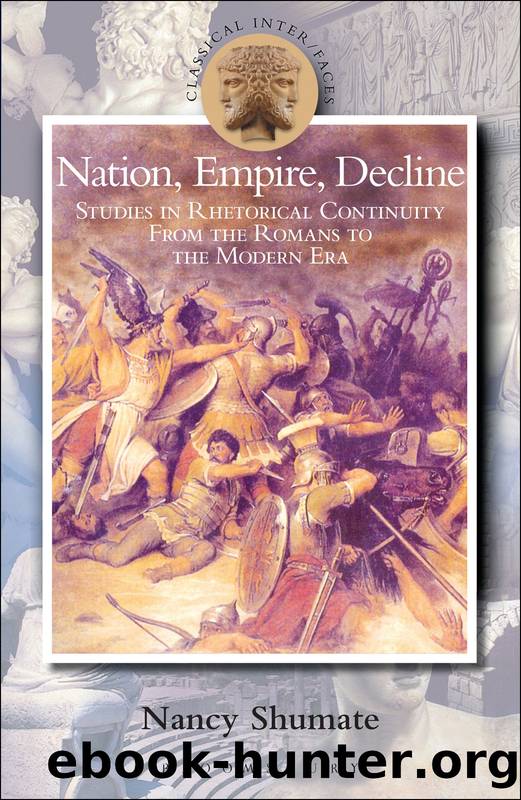
Author:Nancy Shumate;
Language: eng
Format: epub
Publisher: Bloomsbury UK
Published: 2006-01-15T00:00:00+00:00
Hybridity and its dangers
Colonial discourse offers a third model of native representation; there is another way of being a âgoodâ barbarian that further illustrates the zero-sum principles governing this representational system as well as the âno-winâ situation in which the colonized found himself trapped in both ancient and modern versions of the discourse. For if one path to approval in the eyes of the imperial power involved an innocence of civilizationâs taint, the other required the opposite course: domestication and acceptance of that powerâs authority and its ways. The figure of the assimilated, âgoodâ colonial subject who has successfully shaken off his or his peopleâs barbarian past appears frequently in Tacitus. Often this figure is schematically paired with a rebellious, incorrigibly debased âbadâ barbarian (where the lack of civilized constraint is constructed as a liability) so as to allow for no ambiguity about the position each figure is meant to occupy in the moral and cultural calculus.
Such a pair appears in Tacitusâ account of the Batavian revolt in AD 69-70, when a loose confederation of subjugated, semi-subjugated, and free Gallic and Germanic tribes exploited the political chaos that followed the death of Nero to launch (according to Tacitus) a rebellion against Roman hegemony in the region. At a point in the narrative when some of the rebels begin to lose resolve, Tacitus stages a council (H. 4.68-70) in which the main speakers are Gallic exempla of the âgoodâ and âbadâ subaltern in the senses just described. As their names indicate, the families of both had been Romanized in the long course of the occupation and transformation of Gaul; according to the Roman discourse of assimilation, they were no longer barbarians at all. But Tacitus suggests that in these cases the process has penetrated to different depths. Taking the conciliatory position, Julius Auspex calmly explains the benefits of a peace emanating from Rome and urges an attitude of respect and loyalty (reverentia and fides) to earlier agreements. The rebel leader Julius Valentinus on the other hand, his debased alterity breaking through, continues to foment rebellion, furiously hurling invective against the Romans and stirring up unruly passions in the others with his âcrazy eloquenceâ (vaecors facundia).
In the account of the earlier German campaigns during the principate of Tiberius in the Annals, the role of dangerous counter-type to the cooperative native is taken by Arminius, who also sloughs off his much thinner skin of Romanity without a second thought. A troublemaker (turbator) with a naturally violent temper (insita violentia), he kicks against the foils of Segestes (1.55-9) and Flavus (2.9-10), in his view acquiescent collaborators who happen to be his father-in-law and brother respectively. Segestes prides himself in the good faith and steadfastness (fides et constantia) that he has shown in his relations with the Romans and condemns Arminius as a treaty-breaker; the oppositional relationship of the two types is captured in a concise antithesis at 1.55: âeach of them [was] distinguished, the one for perfidy, the other for loyalty towards usâ (insignem utrumque perfidia in nos aut fide).
Download
This site does not store any files on its server. We only index and link to content provided by other sites. Please contact the content providers to delete copyright contents if any and email us, we'll remove relevant links or contents immediately.
Personalized inhaled bacteriophage therapy for treatment of multidrug-resistant Pseudomonas aeruginosa in cystic fibrosis by unknow(214525)
CONSORT 2025 statement: updated guideline for reporting randomized trials by unknow(102521)
Critical evaluation of the ProfiLER-02 study design and outcomes by Vivek Subbiah & Razelle Kurzrock(102044)
Cardiac gene therapy makes a comeback by Oliver J. Müller & Susanne Hille & Anca Kliesow Remes(101838)
Whisky: Malt Whiskies of Scotland (Collins Little Books) by dominic roskrow(74619)
Unveiling the design rules for tunable emission in graphene quantum dots: A high-throughput TDDFT and machine learning perspective by Şener Özönder & Mustafa Coşkun Özdemir & Caner Ünlü(51002)
A yeast-based oral therapeutic delivers immune checkpoint inhibitors to reduce intestinal tumor burden by unknow(40374)
Covalent hitchhikers guide proteins to the nucleus by Alexander F. Russell & Madeline F. Currie & Champak Chatterjee(40296)
Meet the Authors: Christopher R. Mansfield and Emily R. Derbyshire by Christopher R. Mansfield & Emily R. Derbyshire(40206)
Alkaline-earth metals promote propane dehydrogenation with carbon dioxide through geometric effects: Altering the reaction pathway by unknow(32814)
Induced iron vacancies boosting FeOOH loaded on sustainable Fenton-like collagen fiber membrane for efficient removal of emerging contaminants by unknow(32610)
Efficient electric-field-assisted photochemical conversion of methane to n-propanol exclusively over penetrated TiO2Ti hollow fibers by Guanghui Feng(32529)
Bi2SiO5 nanosheets as piezo-photocatalyst for efficient degradation of 2,4-Dichlorophenol by Hangyu Shi & Yifu Li & Lishan Zhang & Guoguan Liu & Qian Zhang & Xuan Ru & Shan Zhong(32468)
A novel NDIPTA organic heterojunction photocatalyst with built-in electric field for efficient hydrogen production by Jiahui Yang & Baojun Ma & Yongfa Zhu(32440)
Enhanced conversion of methane to liquid-phase oxygenates via hollow ferrite nanotube@horseradish peroxidase based photoenzymatic catalysis by Jun Duan & Shiying Fan & Xinyong Li & Shaomin Liu(32405)
Ordered macroporous superstructure of defective carbon adorned with tiny cobalt sulfide for selective electrocatalytic hydrogenation of cinnamaldehyde by Xiao-Shi Yuan & Sheng-Hua Zhou & San-Mei Wang & Wenbo Wei & Xiaofang Li & Xin-Tao Wu & Qi-Long Zhu(32335)
What's Done in Darkness by Kayla Perrin(27254)
Topological analysis of non-conjugated ethylene oxide cored dendrimers decorated with tetraphenylethylene: Insights from degree-based descriptors using the polynomial approach by A Theertha Nair & D Antony Xavier & Annmaria Baby & S Akhila(26631)
Investigation of mechanical and self-healing properties of hydroxyl-terminated polybutadiene functionalized with 2-ureido-4-pyrimidinone by Mohsen Kazazi & Mehran Hayaty & Ali Mousaviazar(26555)
