Manila And Santiago by Leeke Jim;
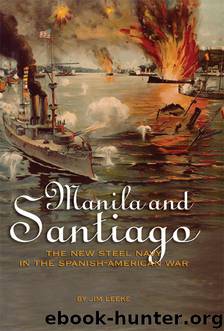
Author:Leeke, Jim; [Leeke, Jim]
Language: eng
Format: epub
Publisher: Naval Institute Press
Published: 0101-01-01T00:00:00+00:00
CHAPTER 14
The Crossing
ADMIRAL SAMPSON got word of the Spanish fleet’s departure from St. Vincent the following day, April 30, on the blockade line off Havana. He rightly surmised that Cervera was bound for Puerto Rico. “There he would be at home; only there could he hope to make repairs; and there he could be sure of more coal, so necessary to enable him to reach a port in Cuba.”1
Sampson steamed eastward to intercept on May 4. His force comprised the New York, Iowa, and Indiana, two cruisers, two monitors, a torpedo boat, and a tug. He hoped to see San Juan in four days, but received a mistaken report putting Cervera off Martinique on May 7. Sampson tried to confirm this at Haiti, delaying arrival at San Juan until May 12. This was four days past the earliest date the Navy calculated Cervera might arrive. “A glance,” Sampson recalled, “was sufficient to show that Cervera’s ships were not in port.”2
The Americans had no way of determining if they had missed Cervera, or indeed whether he had been in the port at all. He seemed maddeningly elusive. Before steaming off, Sampson shelled the Spanish batteries near the Morro. The return fire seemed to Evans “the best shooting I saw the Spanish artillery do during the war.”3 The squadron’s casualties were one sailor dead and seven wounded; most of them had come topside against orders to watch the action.
San Juan might easily have fallen right then. But as at Manila and Havana, no troops were available to take possession; also, the big ships weren’t to be endangered until Cervera was located. The value of the exchange, Sampson wrote, “lay not a little in the practice it gave the men under fire, and which, no doubt, had its effect in the battle of Santiago.”4
Sampson concluded that the Spanish fleet had reached some other anchorage in the West Indies. He lingered offshore until nightfall, then turned westward. He wanted to position his squadron to intercept if Cervera steamed toward Havana, which seemed a probable destination if the Spaniards had found coal elsewhere.
The American public, however, was perplexed by the whole affair. “With Dewey’s achievement fresh in its memory, it looked for fresh victories in the Atlantic,” Lieutenant Staunton recalled, “and was disappointed at what seemed to be a successful defence against its best fleet, especially as this fleet withdrew uninjured.”5 The public wasn’t alone in its doubts. Mahan considered the expedition “an eccentric movement,” while Secretary Long regarded it as “rather a failure.”6
...
Had even a single circumstance favored him, Cervera might have reached Puerto Rico in a week. The trial speed of his cruisers was twenty-one knots, extremely fast for the era. The Navy Department had assumed that the top speed he could maintain on a transatlantic voyage was 16 knots, the average perhaps 12 knots.7 But a fleet was only as fast as its slowest vessel and the foul-bottomed Vizcaya was slow indeed. Cervera made fewer than 200 nautical miles most days of the crossing, averaging just 6.
Download
This site does not store any files on its server. We only index and link to content provided by other sites. Please contact the content providers to delete copyright contents if any and email us, we'll remove relevant links or contents immediately.
| Africa | Americas |
| Arctic & Antarctica | Asia |
| Australia & Oceania | Europe |
| Middle East | Russia |
| United States | World |
| Ancient Civilizations | Military |
| Historical Study & Educational Resources |
The Innovators: How a Group of Hackers, Geniuses, and Geeks Created the Digital Revolution by Walter Isaacson(3473)
In Cold Blood by Truman Capote(3436)
Steve Jobs by Walter Isaacson(2947)
All the President's Men by Carl Bernstein & Bob Woodward(2408)
And the Band Played On by Randy Shilts(2266)
Lonely Planet New York City by Lonely Planet(2259)
Being George Washington by Beck Glenn(2203)
The Room Where It Happened by John Bolton;(2199)
The Poisoner's Handbook by Deborah Blum(2178)
The Innovators by Walter Isaacson(2148)
The Murder of Marilyn Monroe by Jay Margolis(2136)
Lincoln by David Herbert Donald(2030)
A Colony in a Nation by Chris Hayes(1965)
Under the Banner of Heaven: A Story of Violent Faith by Jon Krakauer(1842)
Dirt by Bill Buford(1732)
Amelia Earhart by Doris L. Rich(1721)
The Unsettlers by Mark Sundeen(1721)
Zeitoun by Dave Eggers(1698)
Birdmen by Lawrence Goldstone(1691)
