Laches and Charmides by Plato
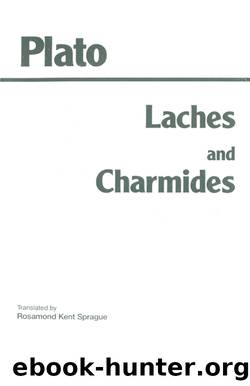
Author:Plato [Sprague, Rosamond Kent]
Language: eng
Format: epub
ISBN: 978-1-62466-078-8
Publisher: Hackett Publishing Company, Inc.
Published: 1992-03-15T00:00:00+00:00
Charmides
Introduction
Although the Charmides, with its inquiry into the nature of a single virtue, temperance, has obvious affinities with the Laches and with other early dialogues, the complexities of its latter pages bear more resemblance to the aridities of the Theaetetus and Parmenides than to dialogues of the early group. Nevertheless, the main theme, the connection between virtue and knowledge, is the same as that of the Laches. And, as courage in the Laches tended to remove itself from what I call the first-order level of the various arts and techniques such as flute playing or medicine, so temperance in the Charmides does the same thing. Plato has come to realize that to state this point more decisively is also to state it more subtly. By associating virtue with knowledge he has involved himself in the mechanics of the term âknowledgeâ as well as in the question of defining the various virtues. âKnowledgeâ (or âscienceâ) is in fact a tinos-word. To use it is to raise the question âknowledge of what?â On the first-order level, the answer to this is easyâmedicine is knowledge of health, and cobbling, of shoes. But it always remains possible for these techniques to be misused, or, to put it another way, efficiency is not always goodness. How is Plato, with his concern for good government, to assure that the first-order arts are regularly employed for good ends? His answer is basically simple: by having them ruled over by a second-order art that is in itself an art of goodness. (Later, in the Republic, he will express the same thought by stipulating that in the good state the philosopher shall be king.) But his way of presenting this answer is not simple. True to the Socratic procedure, he forces the reader to reach the solution himself. So he hammers away at the analogy of the art of temperance (a science of sciences, the knowledge of good and evil) with the first-order arts, in the hope that by so doing he will demonstrate both its likeness to them (both are âofâ something) and its difference from them (temperance is a second-order art ruling over arts of the first order). Plato has no desire to make a total separation between the two kinds of art. Not only will there always be a close relationship between ruler and ruled, but he still cherishes the notion that somehow there should be teachers of good and evil in the same way that there are teachers of cobbling and carpentry. When Socrates went about Athens looking for someone wiser than himself, he admired the craftsmen most (Apology 22D). The method of teaching first and second-order arts cannot be the same (we can see this by imagining a University course in first-year Goodness), but he clings to the notion that any form of genuine knowledge must be teachable. If we think again of his preoccupation with good government (which is really the problem of producing good men), we can see that for him the problem becomes acute.
Download
This site does not store any files on its server. We only index and link to content provided by other sites. Please contact the content providers to delete copyright contents if any and email us, we'll remove relevant links or contents immediately.
Personalized inhaled bacteriophage therapy for treatment of multidrug-resistant Pseudomonas aeruginosa in cystic fibrosis by unknow(214303)
CONSORT 2025 statement: updated guideline for reporting randomized trials by unknow(102519)
Critical evaluation of the ProfiLER-02 study design and outcomes by Vivek Subbiah & Razelle Kurzrock(102042)
Cardiac gene therapy makes a comeback by Oliver J. Müller & Susanne Hille & Anca Kliesow Remes(101837)
Whisky: Malt Whiskies of Scotland (Collins Little Books) by dominic roskrow(74618)
Unveiling the design rules for tunable emission in graphene quantum dots: A high-throughput TDDFT and machine learning perspective by Şener Özönder & Mustafa Coşkun Özdemir & Caner Ünlü(51000)
A yeast-based oral therapeutic delivers immune checkpoint inhibitors to reduce intestinal tumor burden by unknow(40371)
Covalent hitchhikers guide proteins to the nucleus by Alexander F. Russell & Madeline F. Currie & Champak Chatterjee(40295)
Meet the Authors: Christopher R. Mansfield and Emily R. Derbyshire by Christopher R. Mansfield & Emily R. Derbyshire(40204)
Alkaline-earth metals promote propane dehydrogenation with carbon dioxide through geometric effects: Altering the reaction pathway by unknow(32813)
Induced iron vacancies boosting FeOOH loaded on sustainable Fenton-like collagen fiber membrane for efficient removal of emerging contaminants by unknow(32609)
Efficient electric-field-assisted photochemical conversion of methane to n-propanol exclusively over penetrated TiO2Ti hollow fibers by Guanghui Feng(32528)
Bi2SiO5 nanosheets as piezo-photocatalyst for efficient degradation of 2,4-Dichlorophenol by Hangyu Shi & Yifu Li & Lishan Zhang & Guoguan Liu & Qian Zhang & Xuan Ru & Shan Zhong(32465)
A novel NDIPTA organic heterojunction photocatalyst with built-in electric field for efficient hydrogen production by Jiahui Yang & Baojun Ma & Yongfa Zhu(32438)
Enhanced conversion of methane to liquid-phase oxygenates via hollow ferrite nanotube@horseradish peroxidase based photoenzymatic catalysis by Jun Duan & Shiying Fan & Xinyong Li & Shaomin Liu(32404)
Ordered macroporous superstructure of defective carbon adorned with tiny cobalt sulfide for selective electrocatalytic hydrogenation of cinnamaldehyde by Xiao-Shi Yuan & Sheng-Hua Zhou & San-Mei Wang & Wenbo Wei & Xiaofang Li & Xin-Tao Wu & Qi-Long Zhu(32333)
What's Done in Darkness by Kayla Perrin(27248)
Topological analysis of non-conjugated ethylene oxide cored dendrimers decorated with tetraphenylethylene: Insights from degree-based descriptors using the polynomial approach by A Theertha Nair & D Antony Xavier & Annmaria Baby & S Akhila(26628)
Investigation of mechanical and self-healing properties of hydroxyl-terminated polybutadiene functionalized with 2-ureido-4-pyrimidinone by Mohsen Kazazi & Mehran Hayaty & Ali Mousaviazar(26554)
