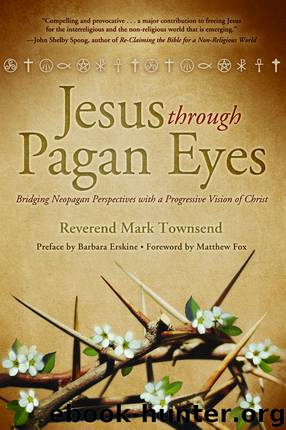
Jesus Through Pagan Eyes by Mark Townsend
Author:Mark Townsend
Language: eng
Format: epub
Tags: Jesus, religion, Pagan, Paganism, Christian, Christianity, Townsend, Reverend Mark Townsend
Publisher: Llewellyn Worldwide, LTD.
Published: 2012-04-12T04:00:00+00:00
[contents]
Eighteen
Jesus, Horse of God
by Diana L. Paxson
In early Christian iconography, Jesus was called the Lamb of God. But an examination of his story from the perspective of Afro-Diasporic and other possessory traditions suggests comparison to something else entirely. When Maya Deren titled her book on Haitian Voudou Divine Horsemen, she was referring to the use of the term “mount” or “horse” for someone possessed by a loa. In those traditions it is also customary to refer to someone who has been initiated to a particular deity as the “child” of the loa. When I began to work with these traditions, it occurred to me that not only was Jesus the “son” of the Hebrew god in the sense that he was dedicated to him, but many of the incidents in his biography can be explained by the suggestion that he spent parts of his life and most of his ministry possessed by a particularly beneficent aspect of his god.
I should probably begin by explaining that by “possession,” I mean an altered state of consciousness in which there is a dissociation of personality, the ordinary human persona being replaced to some degree by that of a spirit or god.
In an article titled “Cultural Variations in Multiple Personality Disorder,” Deborah Golub discusses the phenomenon of possessory experience within the context of personality dissociation in general.
The ability to dissociate appears to be a fundamental, ancient, and universal pyschobiological capacity of human beings that is necessary for their healthy functioning, and multiplicity a normal condition present in all people (Beahrs 1982, Kripner 1987, Lampl-de Groot 1981, Ross 1991a). This ubiquitous “genetic endowment” (Goodman 1988) allows some members of all cultures to embody alternative identities (Mulhern 1991); themes of fragmentation of self and transformation of identity can be traced throughout history
—(Golub, 285)
Possessory trance was certainly known in the ancient world. Most of the ancient oracles gave their prophecies as mouthpieces of Apollo. It is also possible that incidents such as the one in the Odyssey in which Athena takes the form of Mentor in order to advise Telemachus was actually a temporary possession, in which the presence of the deity was only recognized after she had gone.
The fourth-century Pagan mystic Iamblichus, analyzing the different varieties of religious inspiration in his book on the Mysteries, states that
There are, therefore, many species of divine possession, and divine inspiration is multifariously excited; thence, also, the signs of it are many and different. For either the gods are different, by whom we are inspired, and thus produce a different inspiration, or the mode of enthusiasms being various, produces a different afflatus. For either divinity possesses us or we give ourselves up wholly to divinity, or we have a common energy with him. And sometimes, indeed, we participate of the last power of divinity, sometimes of his middle, and sometimes of his first power. Sometimes, also, there is a participation only, at other times, communion likewise, and sometimes a union of these divine inspirations. Again, either the soul alone enjoys
Download
This site does not store any files on its server. We only index and link to content provided by other sites. Please contact the content providers to delete copyright contents if any and email us, we'll remove relevant links or contents immediately.
Becoming Supernatural by Dr. Joe Dispenza(8223)
Crystal Healing for Women by Mariah K. Lyons(7933)
The Witchcraft of Salem Village by Shirley Jackson(7277)
Inner Engineering: A Yogi's Guide to Joy by Sadhguru(6798)
The Four Agreements by Don Miguel Ruiz(6767)
The Power of Now: A Guide to Spiritual Enlightenment by Eckhart Tolle(5788)
Secrets of Antigravity Propulsion: Tesla, UFOs, and Classified Aerospace Technology by Ph.D. Paul A. Laviolette(5373)
The Wisdom of Sundays by Oprah Winfrey(5165)
Room 212 by Kate Stewart(5129)
Pale Blue Dot by Carl Sagan(5012)
Fear by Osho(4741)
The David Icke Guide to the Global Conspiracy (and how to end it) by David Icke(4721)
Animal Frequency by Melissa Alvarez(4475)
Rising Strong by Brene Brown(4465)
How to Change Your Mind by Michael Pollan(4358)
Sigil Witchery by Laura Tempest Zakroff(4248)
Man and His Symbols by Carl Gustav Jung(4138)
The Art of Happiness by The Dalai Lama(4132)
Real Magic by Dean Radin PhD(4131)
