Four Ways to Forgiveness by Ursula K. le Guin
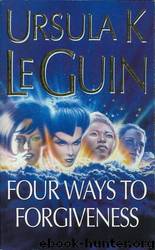
Author:Ursula K. le Guin [Guin, Ursula K. le]
Language: eng
Format: epub, pdf
Tags: Science Fiction
ISBN: 9780575108264
Google: DqMVdZgmTvMC
Publisher: Orion
Published: 2011-05-25T22:00:00+00:00
“It is education, ma’am.”
The gate stood open in its massive frame; there were no walls.
“In the time of the Colony,” the Elder said, “this gate was opened twice in the day: to let the people out to work in the morning, to let the people in from work in the evening. At all other times it was locked and barred.” He displayed the great broken lock that hung on the outer face of the gate, the massive bolts rusted in their hasps. His gesture was solemn, measured, like his words, and again Havzhiva admired the dignity these people had kept in degradation, the stateliness they had maintained in, or against, their enslavement. He had begun to appreciate the immense influence of their sacred text, the Arkamye, preserved in oral tradition. “This was what we had. This was our belonging,” an old man in the city had told him, touching the book which, at sixty-five or seventy, he was learning to read.
Havzhiva himself had begun to read the book in its original language. He read it slowly, trying to understand how this tale of fierce courage and abnegation had for three millennia informed and nourished the minds of people in bondage. Often he heard in its cadences the voices he had heard speak that day.
He was staying for a month in Hayawa Tribal Village, which had been the first slave compound of the Agricultural Plantation Corporation of Yeowe in Yotebber, three hundred fifty years ago. In this immense, remote region of the eastern coast, much of the society and culture of plantation slavery had been preserved. Yeron and other women of the Liberation Movement had told him that to know who the Yeowans were he must know the plantations and the tribes.
He knew that the compounds had for the first century been a domain of men without women and without children. They had developed an internal government, a strict hierarchy of force and favoritism. Power was won by tests and ordeals and kept by a nimble balancing of independence and collusion. When women slaves were brought in at last, they entered this rigid system as the slaves of slaves. By bondsmen as by Bosses, they were used as servants and sexual outlets. Sexual loyalty and partnership continued to be recognized only between men, a nexus of passion, negotiation, status, and tribal politics. During the next centuries the presence of children in the compounds had altered and enriched tribal customs, but the system of male dominance, so entirely advantageous to the slaveowners, had not essentially changed.
“We hope to have your presence at the initiation tomorrow,” the Elder said in his grave way, and Havzhiva assured him that nothing could please or honor him more than attendance at a ceremony of such importance. The Elder was sedately but visibly gratified. He was a man over fifty, which meant he had been born a slave and had lived as a boy and man through the years of the Liberation. Havzhiva looked for scars, remembering
Download
Four Ways to Forgiveness by Ursula K. le Guin.pdf
This site does not store any files on its server. We only index and link to content provided by other sites. Please contact the content providers to delete copyright contents if any and email us, we'll remove relevant links or contents immediately.
The Universe of Us by Lang Leav(15195)
The Sun and Her Flowers by Rupi Kaur(14653)
Adultolescence by Gabbie Hanna(9026)
Whiskey Words & a Shovel II by r.h. Sin(8093)
Love Her Wild by Atticus(7847)
Smoke & Mirrors by Michael Faudet(6307)
Wiseguy by Nicholas Pileggi(5951)
The Princess Saves Herself in This One by Amanda Lovelace(5047)
Love & Misadventure by Lang Leav(4925)
Memories by Lang Leav(4912)
Milk and Honey by Rupi Kaur(4851)
Bluets by Maggie Nelson(4696)
Too Much and Not the Mood by Durga Chew-Bose(4464)
Pillow Thoughts by Courtney Peppernell(4411)
Good morning to Goodnight by Eleni Kaur(4297)
The Poetry of Pablo Neruda by Pablo Neruda(4243)
Algedonic by r.h. Sin(4165)
HER II by Pierre Alex Jeanty(3691)
Stuff I've Been Feeling Lately by Alicia Cook(3544)
