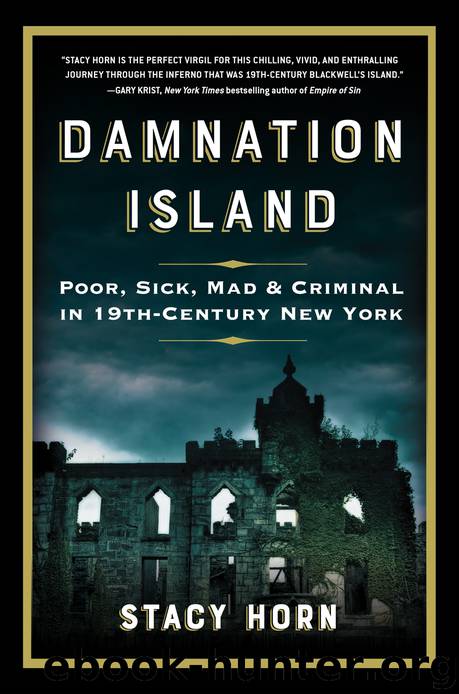
Damnation Island: Poor, Sick, Mad, and Criminal in 19th-Century New York by Stacy Horn
Author:Stacy Horn [Horn, Stacy]
Language: eng
Format: epub
Tags: 19th Century, History, Medical, Mental Health, Psychology, United States
ISBN: 9781616208288
Google: GZ00DwAAQBAJ
Amazon: B075G4VWLC
Publisher: Algonquin Books
Published: 2018-05-15T03:00:00+00:00
IV
The Hospitals for the Poor
In operation beginning 1832, to serve the sick people of New York City, and the inmates of the Penitentiary, Workhouse, and Almshouse
Penitentiary Hospital aka Island Hospital aka Charity Hospital aka City Hospital
It started out as the Penitentiary Hospital, but it wasn’t an actual hospital. It was a room on the top floor of the Penitentiary, and it eventually took over the whole floor. Hundreds of men, most of them suffering from various stages of syphilis, from initial genital ulcers to large and putrid abscesses all over their bodies, were packed into one barred room, without access to a bathroom. Years later it hadn’t improved. “I defy the stoutest-hearted layman to go through the wards of this hospital,” a New York Times reporter wrote, “without fairly growing sick at the stomach.”
The women had it better. They were housed in two pavilions at the southern tip of the Island. According to the commissioner overseeing the institution, the location had the “advantage of good air, affording a very necessary element in the cure of the almost special disease here treated.” Syphilis had no truly effective treatment at the time, but that didn’t stop the commissioner from proudly proclaiming in 1847 that “the Penitentiary Hospital is the Venereal Hospital of the City” (italics, in both cases, his). It was also, for the poor, the only venereal hospital in the city, and in order to be treated there you had to go to prison first.
Like the Almshouse, the process began at the office of the Superintendent of Outdoor Poor. If sick people couldn’t afford a private hospital they would fill out an application to receive medical care at the city hospital, which in the early history of New York meant Bellevue. While they were examined by a physician, someone else was making sure the applicant was truly destitute, with no friends or family who could pay their bills. If everything checked out, they were admitted, but if they had syphilis or another venereal disease, they were turned away and sent instead to police court. The only way for them to get treatment, such as it was before the discovery of antibiotics, was to voluntarily commit themselves to the Penitentiary for vagrancy, where they would eventually be transferred to the top floor.
The new prisoners/patients had to wear prison stripes, and were treated like any other convict at the Penitentiary. Even though they’d committed themselves, the length of their sentence, usually one to six months, was assigned at the whim of the police justice.
Dr. William W. Sanger, who was put in charge of the hospital in 1846, objected. Not everyone who gets syphilis is a criminal, he argued. “A poor woman, without crime or fault on her own part,” could contract syphilis from a drunken, philandering husband. A laborer who’d never committed a crime in his life might get drunk one night and catch the disease from a prostitute. “When he comes out of the Hospital, where he has been associated ‘with thieves,
Download
This site does not store any files on its server. We only index and link to content provided by other sites. Please contact the content providers to delete copyright contents if any and email us, we'll remove relevant links or contents immediately.
Personalized inhaled bacteriophage therapy for treatment of multidrug-resistant Pseudomonas aeruginosa in cystic fibrosis by unknow(182198)
CONSORT 2025 statement: updated guideline for reporting randomized trials by unknow(90601)
Critical evaluation of the ProfiLER-02 study design and outcomes by Vivek Subbiah & Razelle Kurzrock(90178)
Cardiac gene therapy makes a comeback by Oliver J. Müller & Susanne Hille & Anca Kliesow Remes(89951)
Whisky: Malt Whiskies of Scotland (Collins Little Books) by dominic roskrow(74458)
Unveiling the design rules for tunable emission in graphene quantum dots: A high-throughput TDDFT and machine learning perspective by Şener Özönder & Mustafa Coşkun Özdemir & Caner Ünlü(50910)
A yeast-based oral therapeutic delivers immune checkpoint inhibitors to reduce intestinal tumor burden by unknow(40282)
Covalent hitchhikers guide proteins to the nucleus by Alexander F. Russell & Madeline F. Currie & Champak Chatterjee(40221)
Meet the Authors: Christopher R. Mansfield and Emily R. Derbyshire by Christopher R. Mansfield & Emily R. Derbyshire(40106)
Alkaline-earth metals promote propane dehydrogenation with carbon dioxide through geometric effects: Altering the reaction pathway by unknow(32749)
Induced iron vacancies boosting FeOOH loaded on sustainable Fenton-like collagen fiber membrane for efficient removal of emerging contaminants by unknow(32529)
Efficient electric-field-assisted photochemical conversion of methane to n-propanol exclusively over penetrated TiO2Ti hollow fibers by Guanghui Feng(32464)
Bi2SiO5 nanosheets as piezo-photocatalyst for efficient degradation of 2,4-Dichlorophenol by Hangyu Shi & Yifu Li & Lishan Zhang & Guoguan Liu & Qian Zhang & Xuan Ru & Shan Zhong(32404)
A novel NDIPTA organic heterojunction photocatalyst with built-in electric field for efficient hydrogen production by Jiahui Yang & Baojun Ma & Yongfa Zhu(32374)
Enhanced conversion of methane to liquid-phase oxygenates via hollow ferrite nanotube@horseradish peroxidase based photoenzymatic catalysis by Jun Duan & Shiying Fan & Xinyong Li & Shaomin Liu(32344)
Ordered macroporous superstructure of defective carbon adorned with tiny cobalt sulfide for selective electrocatalytic hydrogenation of cinnamaldehyde by Xiao-Shi Yuan & Sheng-Hua Zhou & San-Mei Wang & Wenbo Wei & Xiaofang Li & Xin-Tao Wu & Qi-Long Zhu(32267)
What's Done in Darkness by Kayla Perrin(27159)
Topological analysis of non-conjugated ethylene oxide cored dendrimers decorated with tetraphenylethylene: Insights from degree-based descriptors using the polynomial approach by A Theertha Nair & D Antony Xavier & Annmaria Baby & S Akhila(26548)
Investigation of mechanical and self-healing properties of hydroxyl-terminated polybutadiene functionalized with 2-ureido-4-pyrimidinone by Mohsen Kazazi & Mehran Hayaty & Ali Mousaviazar(26477)
