Can the Mind Be Quiet? by Jiddu Krishnamurti
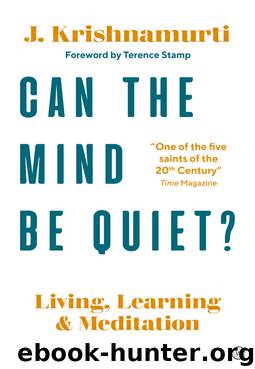
Author:Jiddu Krishnamurti
Language: eng
Format: epub
Publisher: Watkins Media
32
TO LEARN COOPERATION IS PART OF EDUCATION
To an old Mughal garden with ancient tombs a man on a bicycle came every day at the same hour. He would lean his bicycle against a tree and with his back against the same tree, facing one of the tombs, he would sit on the dusty grass, cross-legged with a straight back and closed eyes. He would be very quiet, his body motionless, and would repeat some chant. The green parrots had their homes in the little crevices in the dome over the tombs. There must have been thousands of them and they were noisy in the evening coming back home. There were crows and mynah birds, all of them making much noise in that quiet garden, and the man with the bicycle would sit there. When one had walked for half an hour or more around the tombs, among the trees and in the walled rose garden, the lights would come on in the streets and he would still be there. He was probably a clerk; he was a poor man and wore a dirty coat. He would say that he was meditating or saying his prayers. He didn’t expect anything from this world except perhaps a few rupees, but he came there every evening after office hours. He must have been looking forward to it through the day. Children played around him and neighbouring servants would sit further away on the lawn, playing cards. He never seemed to pay attention to all this. He was used to the beauty of the dome, its blue tiles, the arch and the smell of the jasmine. During that hour or more he never opened his eyes; he was completely withdrawn, motionless. Only his lips moved and presently they too would be still. He would call himself a religious man. He kept his bicycle very clean and polished.
Is meditation an escape from daily life, from the monotony and boredom of it? Is it a further form of pleasure, an expansion of one’s craving? Is it a projection of one’s own desires contrary to one’s own despair? Is it self-hypnosis, a vision of one’s own conclusion, a longing symbolised in an image of the mind or of the hand? Is it an enchanting vision that one has conjured up from the past? Is it a conflict to hold wandering thought? Or is it an effortless deep quietness where thought has no place, though thought can function from it? Is it a silence which has no measure, neither height nor depth, a silence in which there is no centre as the thinker, the experiencer? It is a silence that can never be a result of control, of imitation, of effort.
Would the man with the bicycle understand all this? He had a very simple mind; he didn’t want any of the complexities and subtleties of meditation. He had found a way of sitting quietly and repeating words that gave him tremendous satisfaction, a comfort he couldn’t find in life.
Download
This site does not store any files on its server. We only index and link to content provided by other sites. Please contact the content providers to delete copyright contents if any and email us, we'll remove relevant links or contents immediately.
| Acupuncture & Acupressure | Aromatherapy |
| Ayurveda | Chelation |
| Chinese Medicine | Energy Healing |
| Healing | Herbal Remedies |
| Holistic | Homeopathy |
| Hypnotherapy | Massage |
| Meditation | Naturopathy |
| Reference |
Inner Engineering: A Yogi's Guide to Joy by Sadhguru(6785)
The Power of Now: A Guide to Spiritual Enlightenment by Eckhart Tolle(5761)
Fear by Osho(4728)
Ikigai by Héctor García & Francesc Miralles(4249)
The Art of Happiness by The Dalai Lama(4125)
The Ultimate Bodybuilding Cookbook by Kendall Lou Schmidt(3940)
Yoga Therapy by Mark Stephens(3742)
The Little Book of Hygge by Meik Wiking(3687)
The Healing Self by Deepak Chopra(3568)
Why Buddhism is True by Robert Wright(3447)
The Hatha Yoga Pradipika (Translated) by Svatmarama(3329)
Being Aware of Being Aware by Rupert Spira(3272)
Shift into Freedom by Loch Kelly(3194)
Wild Words from Wild Women by Stephens Autumn(3150)
Work Clean by Dan Charnas(3116)
Happiness by Matthieu Ricard(3040)
More Language of Letting Go: 366 New Daily Meditations by Melody Beattie(3024)
Yoga Body & Mind Handbook by Jasmine Tarkeshi(2875)
Why I Am Not a Feminist by Jessa Crispin(2748)
