Before Harlem: The Black Experience in New York City Before World War I by By Marcy S. Sacks
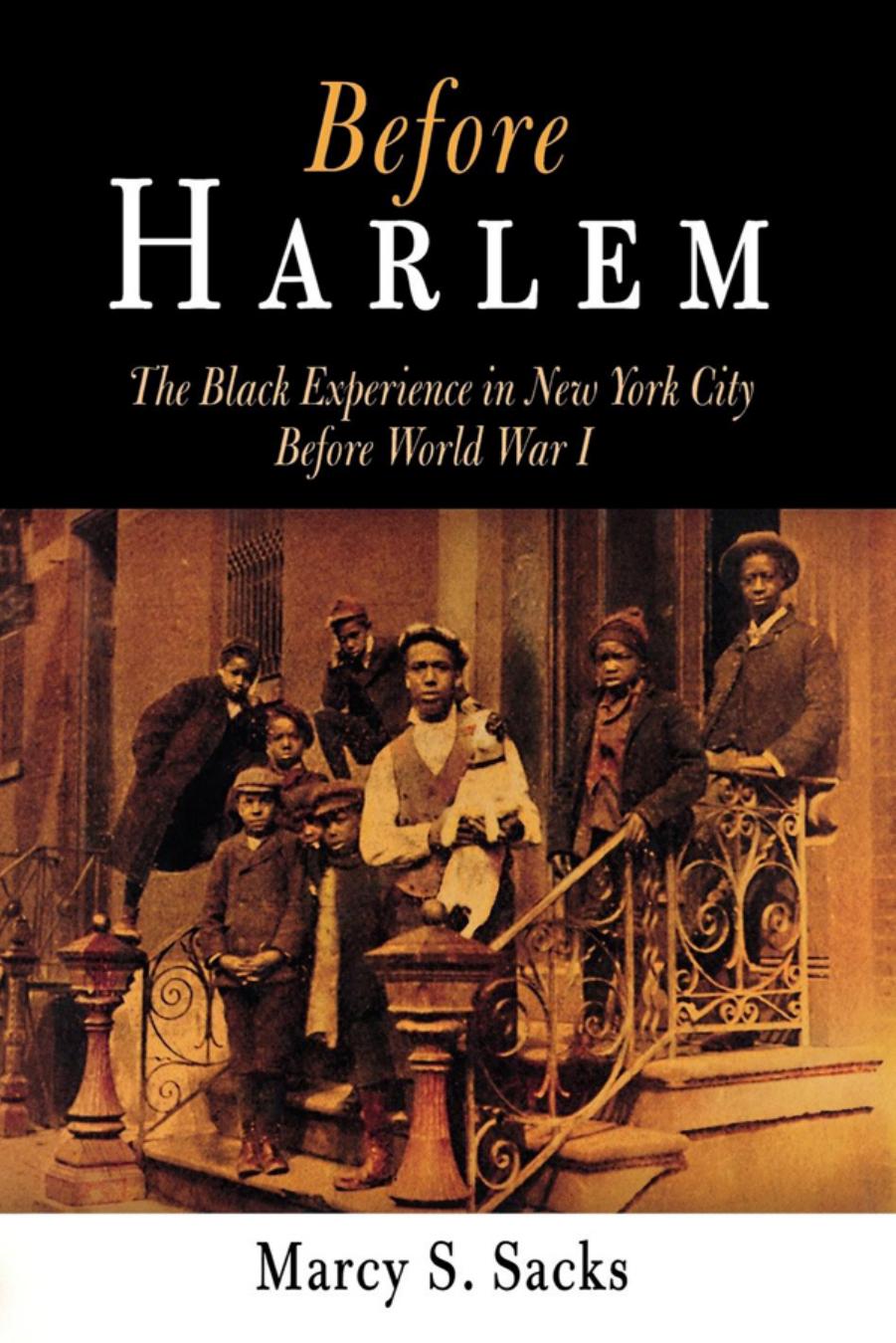
Author:By Marcy S. Sacks
Format: pdf
Tags: In the years between 1880 and 1915, New York City and its environs underwent a tremendous demographic transformation with the arrival of millions of European immigrants, native whites from the rural countryside, and people of African descent from both the American South and the Caribbean. While all groups faced challenges in their adjustment to the city, hardening racial prejudices set the black experience apart from that of other newcomers. Through encounters with each other, blacks and whites, both together and in opposition, forged the contours of race relations that would affect the city for decades to come.Before Harlem reveals how black migrants and immigrants to New York entered a world far less welcoming than the one they had expected to find. White police officers, urban reformers, and neighbors faced off in a hostile environment that threatened black families in multiple ways. Unlike European immigrants, who typically struggled with low-paying jobs but who often saw their children move up the economic ladder, black people had limited employment opportunities that left them with almost no prospects of upward mobility. Their poverty and the vagaries of a restrictive job market forced unprecedented numbers of black women into the labor force, fundamentally affecting child-rearing practices and marital relationships.Despite hostile conditions, black people nevertheless claimed New York City as their own. Within their neighborhoods and their churches, their night clubs and their fraternal organizations, they forged discrete ethnic, regional, and religious communities. Diverse in their backgrounds, languages, and customs, black New Yorkers cultivated connections to others similar to themselves, forming organizations, support networks, and bonds of friendship with former strangers. In doing so, Marcy S. Sacks argues, they established a dynamic world that eventually sparked the Harlem Renaissance. By the 1920s, Harlem had become both a tragedy and a triumph—undeniably a ghetto replete with problems of poverty, overcrowding, and crime, but also a refuge and a haven, a physical place whose very name became legendary., Publisher:University of Pennsylvania Press, Published:2011, Related ISBN:9780812239614, Language:English, OCLC:859161019
Download
This site does not store any files on its server. We only index and link to content provided by other sites. Please contact the content providers to delete copyright contents if any and email us, we'll remove relevant links or contents immediately.
Personalized inhaled bacteriophage therapy for treatment of multidrug-resistant Pseudomonas aeruginosa in cystic fibrosis by unknow(181299)
CONSORT 2025 statement: updated guideline for reporting randomized trials by unknow(89750)
Critical evaluation of the ProfiLER-02 study design and outcomes by Vivek Subbiah & Razelle Kurzrock(89378)
Cardiac gene therapy makes a comeback by Oliver J. Müller & Susanne Hille & Anca Kliesow Remes(89125)
Whisky: Malt Whiskies of Scotland (Collins Little Books) by dominic roskrow(74452)
Unveiling the design rules for tunable emission in graphene quantum dots: A high-throughput TDDFT and machine learning perspective by Şener Özönder & Mustafa Coşkun Özdemir & Caner Ünlü(50905)
A yeast-based oral therapeutic delivers immune checkpoint inhibitors to reduce intestinal tumor burden by unknow(40275)
Covalent hitchhikers guide proteins to the nucleus by Alexander F. Russell & Madeline F. Currie & Champak Chatterjee(40220)
Meet the Authors: Christopher R. Mansfield and Emily R. Derbyshire by Christopher R. Mansfield & Emily R. Derbyshire(40104)
Alkaline-earth metals promote propane dehydrogenation with carbon dioxide through geometric effects: Altering the reaction pathway by unknow(32741)
Induced iron vacancies boosting FeOOH loaded on sustainable Fenton-like collagen fiber membrane for efficient removal of emerging contaminants by unknow(32522)
Efficient electric-field-assisted photochemical conversion of methane to n-propanol exclusively over penetrated TiO2Ti hollow fibers by Guanghui Feng(32460)
Bi2SiO5 nanosheets as piezo-photocatalyst for efficient degradation of 2,4-Dichlorophenol by Hangyu Shi & Yifu Li & Lishan Zhang & Guoguan Liu & Qian Zhang & Xuan Ru & Shan Zhong(32400)
A novel NDIPTA organic heterojunction photocatalyst with built-in electric field for efficient hydrogen production by Jiahui Yang & Baojun Ma & Yongfa Zhu(32371)
Enhanced conversion of methane to liquid-phase oxygenates via hollow ferrite nanotube@horseradish peroxidase based photoenzymatic catalysis by Jun Duan & Shiying Fan & Xinyong Li & Shaomin Liu(32337)
Ordered macroporous superstructure of defective carbon adorned with tiny cobalt sulfide for selective electrocatalytic hydrogenation of cinnamaldehyde by Xiao-Shi Yuan & Sheng-Hua Zhou & San-Mei Wang & Wenbo Wei & Xiaofang Li & Xin-Tao Wu & Qi-Long Zhu(32263)
What's Done in Darkness by Kayla Perrin(27155)
Topological analysis of non-conjugated ethylene oxide cored dendrimers decorated with tetraphenylethylene: Insights from degree-based descriptors using the polynomial approach by A Theertha Nair & D Antony Xavier & Annmaria Baby & S Akhila(26542)
Investigation of mechanical and self-healing properties of hydroxyl-terminated polybutadiene functionalized with 2-ureido-4-pyrimidinone by Mohsen Kazazi & Mehran Hayaty & Ali Mousaviazar(26468)
