Battle of Britain by Simon Pearson & Ed Gorman
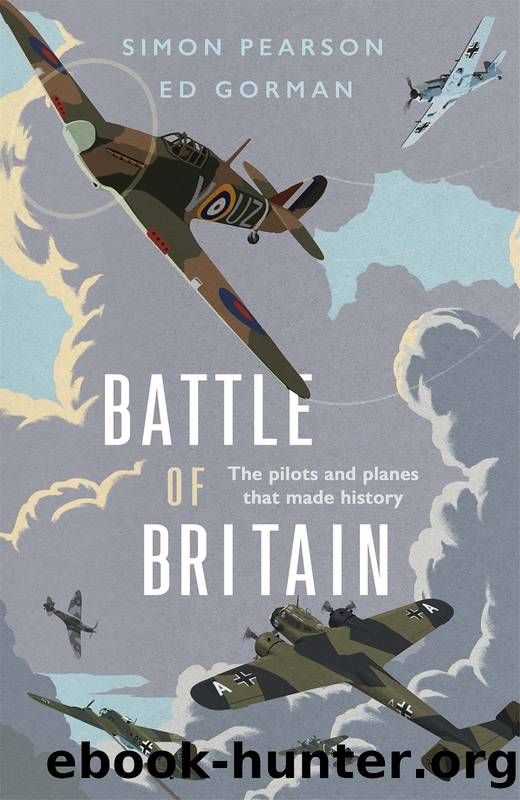
Author:Simon Pearson & Ed Gorman [Simon Pearson and Ed Gorman]
Language: eng
Format: epub
Publisher: Hodder and Stoughton
Published: 2020-05-13T16:00:00+00:00
A portrait of Franz von Werra, who flew the Messerschmitt Bf 109, which was the perfect plane for a self-confident, swashbuckling fighter pilot. He was embraced by the Nazi propaganda machine
11
First Lieutenant Baron Franz von Werra
Messerschmitt Bf 109E Single-Engine Fighter
5 September 1940
He was good-looking, arrogant and not averse
to portraying himself in a heroic light.
UNFORTUNATELY FOR FIGHTER Command, 5 September provided perfect conditions for aerial combat; the Allied leaders had been praying for low-level clouds and rain to give Britain’s defences and its exhausted pilots a breathing space from the relentless onslaught by the Luftwaffe.
High in the sky over London, German bombers and fighter escorts were making their way up the Thames estuary in formation. Their target was Biggin Hill aerodrome and their attack was preceded by a diversionary move against Croydon airfield that the Luftwaffe hoped would entice RAF fighters away from Biggin Hill. The ruse did not work, however, and fighters from 79 Squadron attacked the bombers as they approached Biggin Hill, as a result of which many of the German munitions fell wide of the mark.
Among the German aircraft flying home from Kent was a Messerschmitt Bf 109 flown by Baron Franz von Werra – one of thirty fighter escorts for the bombers. It was the start of a great odyssey for the Swiss pilot.
Alongside the Hawker Hurricane and the Supermarine Spitfire on the Allied side, the Messerschmitt Bf 109 is the most widely known of the aircraft that took part in the Battle of Britain, reflecting its key role for the Luftwaffe as a fighter escort for German bombers trying to destroy Britain’s airfields, aircraft and cities.
The Bf 109 was the Luftwaffe’s only single-engine fighter and it was a remarkably successful flying machine, becoming the most prolific attack aircraft in history, with 33,984 airframes built between 1936 and April 1945. In some conditions the Messerschmitt could outmanoeuvre not only the Hurricane but also the Spitfire, and its pilots were responsible for the majority of the 1,172 aircraft lost by RAF Fighter Command between July and October 1940. Over the same period 610 of the German planes were lost.
Like the Spitfire, the Messerschmitt was based on a finely designed, all-metal monocoque with only the movable control surfaces and flaps covered by fabric. Powered by a V12 aero engine, it was fast, agile and armed with a combination of cannon and machine guns that could destroy Hurricanes and Spitfires with two short bursts of fire at close range.
One big advantage that it held over its British-built equivalents was its direct fuel injection engine. This meant that its pilots could dive from level flight without any interruption to the fuel supply caused by negative gravitational force. By contrast the Spitfire’s carburettor engine would momentarily stop in a steep dive, losing its pilots precious seconds in a dogfight.
Adolf Galland, one of the most famous aces who flew the Bf 109 throughout the Battle of Britain, amassing fifty-seven kills by the end of 1940, remarked on this in his 1953 memoir, The First and the Last.
Download
This site does not store any files on its server. We only index and link to content provided by other sites. Please contact the content providers to delete copyright contents if any and email us, we'll remove relevant links or contents immediately.
Personalized inhaled bacteriophage therapy for treatment of multidrug-resistant Pseudomonas aeruginosa in cystic fibrosis by unknow(180714)
CONSORT 2025 statement: updated guideline for reporting randomized trials by unknow(89179)
Critical evaluation of the ProfiLER-02 study design and outcomes by Vivek Subbiah & Razelle Kurzrock(88776)
Cardiac gene therapy makes a comeback by Oliver J. Müller & Susanne Hille & Anca Kliesow Remes(88537)
Whisky: Malt Whiskies of Scotland (Collins Little Books) by dominic roskrow(74451)
Unveiling the design rules for tunable emission in graphene quantum dots: A high-throughput TDDFT and machine learning perspective by Şener Özönder & Mustafa Coşkun Özdemir & Caner Ünlü(50904)
A yeast-based oral therapeutic delivers immune checkpoint inhibitors to reduce intestinal tumor burden by unknow(40273)
Covalent hitchhikers guide proteins to the nucleus by Alexander F. Russell & Madeline F. Currie & Champak Chatterjee(40219)
Meet the Authors: Christopher R. Mansfield and Emily R. Derbyshire by Christopher R. Mansfield & Emily R. Derbyshire(40102)
Alkaline-earth metals promote propane dehydrogenation with carbon dioxide through geometric effects: Altering the reaction pathway by unknow(32740)
Induced iron vacancies boosting FeOOH loaded on sustainable Fenton-like collagen fiber membrane for efficient removal of emerging contaminants by unknow(32521)
Efficient electric-field-assisted photochemical conversion of methane to n-propanol exclusively over penetrated TiO2Ti hollow fibers by Guanghui Feng(32460)
Bi2SiO5 nanosheets as piezo-photocatalyst for efficient degradation of 2,4-Dichlorophenol by Hangyu Shi & Yifu Li & Lishan Zhang & Guoguan Liu & Qian Zhang & Xuan Ru & Shan Zhong(32400)
A novel NDIPTA organic heterojunction photocatalyst with built-in electric field for efficient hydrogen production by Jiahui Yang & Baojun Ma & Yongfa Zhu(32370)
Enhanced conversion of methane to liquid-phase oxygenates via hollow ferrite nanotube@horseradish peroxidase based photoenzymatic catalysis by Jun Duan & Shiying Fan & Xinyong Li & Shaomin Liu(32337)
Ordered macroporous superstructure of defective carbon adorned with tiny cobalt sulfide for selective electrocatalytic hydrogenation of cinnamaldehyde by Xiao-Shi Yuan & Sheng-Hua Zhou & San-Mei Wang & Wenbo Wei & Xiaofang Li & Xin-Tao Wu & Qi-Long Zhu(32262)
What's Done in Darkness by Kayla Perrin(27155)
Topological analysis of non-conjugated ethylene oxide cored dendrimers decorated with tetraphenylethylene: Insights from degree-based descriptors using the polynomial approach by A Theertha Nair & D Antony Xavier & Annmaria Baby & S Akhila(26539)
Investigation of mechanical and self-healing properties of hydroxyl-terminated polybutadiene functionalized with 2-ureido-4-pyrimidinone by Mohsen Kazazi & Mehran Hayaty & Ali Mousaviazar(26467)
