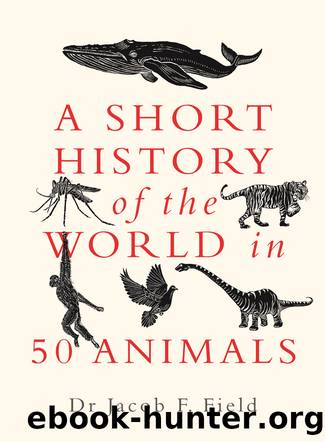
A Short History of the World in 50 Animals by Dr Jacob F. Field
Author:Dr Jacob F. Field
Language: eng
Format: epub
Publisher: Michael O’Mara Books Limited
The link between feasting on blood and bats is not wholly fallacious. There was some element of truth to it: three species of bat are indeed sanguivorous (blood-sucking). Vampire bats, named after the figure in folklore, are all native to Latin America. They feed on sleeping mammals, biting them using their sharp incisor teeth; their saliva includes a strong anticoagulant that stops the blood from clotting, allowing them to lap it up. As the vampire batâs bite is shallow, its prey remains asleep throughout the feeding, which takes up to thirty minutes. They seldom feed on humans but their bites provide egg-laying sites for parasites and they sometimes spread diseases like rabies.
In Mesoamerica, the region extending from central Mexico to northern Costa Rica, bats are frequently tied to death, sacrifice and destruction. This may reflect the direct experience of these peoples living with vampire bats and incidents of them feeding on humans. In Mesoamerican art, bats are often depicted with human bones and sometimes have snouts shaped like sacrificial knives. In the mythology of the Maya, an ancient Mesoamerican civilization that emerged in modern-day Guatemala, northern Belize and southern Mexico, one of their gods is called Camazotz (âdeath batâ) who is a cave-dwelling creature that drinks human blood. Camazotz is also the name of monstrous bats that feature in the Popul Vuh, a collection of epic myths of the Quiché, who are one of the Maya peoples. Two of the main characters are Hunahpu and Xbalanque, the âHero Twinsâ who travel to Xibalba (the Maya underworld) to fight its gods. On their journey they are subjected to a number of trials, including spending a night in the House of Bats. To escape being attacked by Camazotz, the twins shrink themselves into their blowguns but disaster strikes when Hunahpu sticks his head out and is decapitated. Fortunately, his brother Xbalanque fashions a new head out of a squash and together they ultimately defeat the lords of the underworld. Eventually, Hunahpu and Xbalanque become the moon and sun, respectively, and their story represents the triumph of light over dark. Even so, Camazotz remained feared, and the Maya would plant their corn at the time of year when he descended into Xibalba, so he would not interfere.
Bats are not always viewed negatively. The ancient Egyptians believed they would ward away ailments such as poor eyesight, toothache, fever and even baldness, and in Poland they are a symbol of luck. But it is in China that bats have the most positive associations; they are linked to happiness and good fortune, while five of them together symbolizes the wufu, the âfive blessingsâ of virtue, long life, wealth, health and a natural death. This favourable view of bats echoes the many benefits they have for humans. As the vast majority of bats are insect eaters, they play a vital role in controlling their numbers, particularly for species like the mosquito. In addition, the bats who eat pollen and nectar are essential to the propagation of numerous species of plant, including the banana and the agave (the source of tequila).
Download
This site does not store any files on its server. We only index and link to content provided by other sites. Please contact the content providers to delete copyright contents if any and email us, we'll remove relevant links or contents immediately.
Personalized inhaled bacteriophage therapy for treatment of multidrug-resistant Pseudomonas aeruginosa in cystic fibrosis by unknow(181722)
CONSORT 2025 statement: updated guideline for reporting randomized trials by unknow(90149)
Critical evaluation of the ProfiLER-02 study design and outcomes by Vivek Subbiah & Razelle Kurzrock(89754)
Cardiac gene therapy makes a comeback by Oliver J. Müller & Susanne Hille & Anca Kliesow Remes(89514)
Whisky: Malt Whiskies of Scotland (Collins Little Books) by dominic roskrow(74454)
Unveiling the design rules for tunable emission in graphene quantum dots: A high-throughput TDDFT and machine learning perspective by Şener Özönder & Mustafa Coşkun Özdemir & Caner Ünlü(50908)
A yeast-based oral therapeutic delivers immune checkpoint inhibitors to reduce intestinal tumor burden by unknow(40280)
Covalent hitchhikers guide proteins to the nucleus by Alexander F. Russell & Madeline F. Currie & Champak Chatterjee(40220)
Meet the Authors: Christopher R. Mansfield and Emily R. Derbyshire by Christopher R. Mansfield & Emily R. Derbyshire(40104)
Alkaline-earth metals promote propane dehydrogenation with carbon dioxide through geometric effects: Altering the reaction pathway by unknow(32747)
Induced iron vacancies boosting FeOOH loaded on sustainable Fenton-like collagen fiber membrane for efficient removal of emerging contaminants by unknow(32524)
Efficient electric-field-assisted photochemical conversion of methane to n-propanol exclusively over penetrated TiO2Ti hollow fibers by Guanghui Feng(32462)
Bi2SiO5 nanosheets as piezo-photocatalyst for efficient degradation of 2,4-Dichlorophenol by Hangyu Shi & Yifu Li & Lishan Zhang & Guoguan Liu & Qian Zhang & Xuan Ru & Shan Zhong(32401)
A novel NDIPTA organic heterojunction photocatalyst with built-in electric field for efficient hydrogen production by Jiahui Yang & Baojun Ma & Yongfa Zhu(32373)
Enhanced conversion of methane to liquid-phase oxygenates via hollow ferrite nanotube@horseradish peroxidase based photoenzymatic catalysis by Jun Duan & Shiying Fan & Xinyong Li & Shaomin Liu(32340)
Ordered macroporous superstructure of defective carbon adorned with tiny cobalt sulfide for selective electrocatalytic hydrogenation of cinnamaldehyde by Xiao-Shi Yuan & Sheng-Hua Zhou & San-Mei Wang & Wenbo Wei & Xiaofang Li & Xin-Tao Wu & Qi-Long Zhu(32263)
What's Done in Darkness by Kayla Perrin(27157)
Topological analysis of non-conjugated ethylene oxide cored dendrimers decorated with tetraphenylethylene: Insights from degree-based descriptors using the polynomial approach by A Theertha Nair & D Antony Xavier & Annmaria Baby & S Akhila(26545)
Investigation of mechanical and self-healing properties of hydroxyl-terminated polybutadiene functionalized with 2-ureido-4-pyrimidinone by Mohsen Kazazi & Mehran Hayaty & Ali Mousaviazar(26471)
