The Worst Is Over: What To Say When Every Moment Counts (Revised Edition) by Judith Acosta LISW CCH & Judith Prager PhD
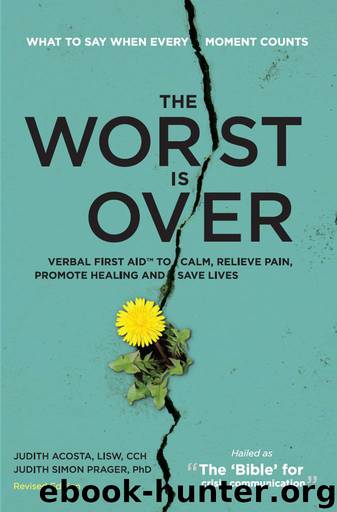
Author:Judith Acosta LISW CCH & Judith Prager PhD [Acosta LISW CCH, Judith]
Language: eng
Format: azw3
Published: 2014-04-07T04:00:00+00:00
Displacement
No one would mind having a disease quite so much if they didn’t have to have any of the symptoms and would never have to know it was there. The same holds true for pain. If we could only have as much pain as we absolutely needed in order to properly care for ourselves (so we don’t lean up against hot stoves and burn ourselves to the bone) but no more, or could limit it to one part of our body so it was manageable, most of us would agree that would be satisfactory. Displacement works with that agreement.
Displacement takes the pain from one area, where it has caused undue distress and interrupted our lives, and puts it in another area, so we can feel more comfortable and go about our business. One man experienced such terrible back pain, he walked practically doubled. During the time when the origins of the pain were being explored both medically and psychologically, he was out of work, the sole supporter of his family and desperate to get back to the job. We asked, “Would it be all right if the pain continued in another part of you? In a part of you large enough to remind you of the work you need to do with yourself, but small enough to allow you to get back to the job and make a living?” He agreed to it and it worked.
Another person had migraine headaches which kept him from accomplishing much in his life. But he was so identified with the headaches that he could hardly imagine life without them! Who would he be if he didn’t have to arrange his schedule around this limitation. Yet he knew that he wanted to be free of them most of the time. When it was suggested to him that he could “store the migraines in his pocket and have them when he felt he had the time for them,” he nodded slowly. He felt them sit in the palm of his hand, as if they were a live, throbbing little being, and put his hand in his pocket. Then he knew it was there if he still needed to identify with it. This is a combination of Object Metamorphosis and Displacement, as you concretize it and change its form, place, and timing.
A kinesthetic way of achieving displacement is by asking people to clasp their hands together very tightly so that attention is focused on the sensations generated there, rather than in the more grievously affected parts. Some clinicians use this technique in childbirth, asking patients to squeeze their hands or some object as tightly as they can with every contraction. Attention gradually shifts from the more painful contractions in the abdomen to the less difficult sensations in the hands.
Download
This site does not store any files on its server. We only index and link to content provided by other sites. Please contact the content providers to delete copyright contents if any and email us, we'll remove relevant links or contents immediately.
Becoming Supernatural by Dr. Joe Dispenza(8223)
Crystal Healing for Women by Mariah K. Lyons(7932)
The Witchcraft of Salem Village by Shirley Jackson(7277)
Inner Engineering: A Yogi's Guide to Joy by Sadhguru(6798)
The Four Agreements by Don Miguel Ruiz(6767)
The Power of Now: A Guide to Spiritual Enlightenment by Eckhart Tolle(5788)
Secrets of Antigravity Propulsion: Tesla, UFOs, and Classified Aerospace Technology by Ph.D. Paul A. Laviolette(5373)
The Wisdom of Sundays by Oprah Winfrey(5165)
Room 212 by Kate Stewart(5129)
Pale Blue Dot by Carl Sagan(5012)
Fear by Osho(4741)
The David Icke Guide to the Global Conspiracy (and how to end it) by David Icke(4721)
Animal Frequency by Melissa Alvarez(4474)
Rising Strong by Brene Brown(4465)
How to Change Your Mind by Michael Pollan(4358)
Sigil Witchery by Laura Tempest Zakroff(4248)
Man and His Symbols by Carl Gustav Jung(4138)
The Art of Happiness by The Dalai Lama(4132)
Real Magic by Dean Radin PhD(4129)
