The Pattern of Communist Revolution: A Historical Analysis by Hugh Seton-watson
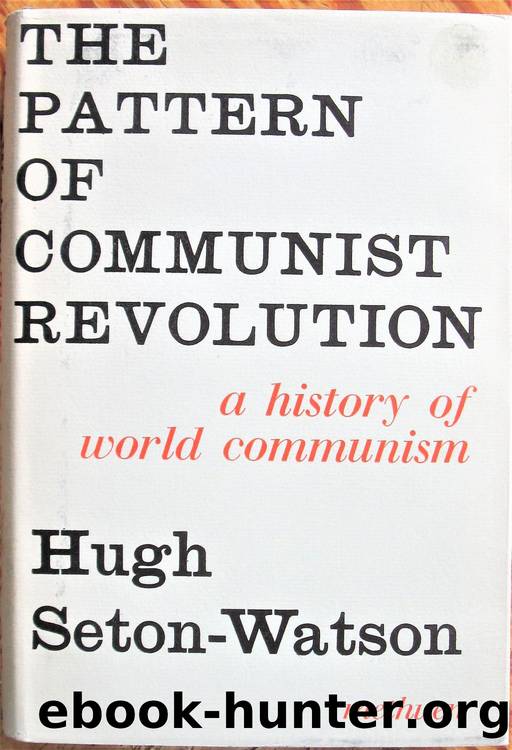
Author:Hugh Seton-watson [Seton-watson, Hugh]
Language: eng
Format: epub
ISBN: 9781014083579
Google: fbYiAAAAMAAJ
Publisher: Methuen
Published: 1953-01-15T12:00:55+00:00
France And Italy
In Western Europe powerful resistance movements developed in France and Italy, in which communists played an important part. Good communications and scarcity of remote mountainous or forest terrain favoured the invaders, and made guerrilla action less easy than in the Balkans or Asia. Instead sabotage, espionage and subversive propaganda were well used. The political results of the resistance movements were not the same as in the Balkans, as both France and Italy were liberated not by Soviet but by Anglo-Saxon armies, which required them as bases from which to pursue the Germans in the later stages of the war.
In France several conspiratorial groups were formed early in 1941, both in the zone of German occupation and in Vichy territory. These established contact with General de Gaulleâs Free French Committee in London, though their relations with it were not always smooth.4 It was not until the German invasion of Russia that the communists became active resisters. The prestige of the Soviet Union made the party once more attractive to the workers, and it was able to enlist recruits. The communists participated in other organisations, but kept their cadres distinct from those of their allies. The most important body which came under communist control was the Front National. This included individuals of conservative opinions and bourgeois social origin as well as workers and men of the left, but it was created on communist initiative, and the key positions in it were held by communists. Its main strength was in the zone of German occupation. Its military organisation was called Francs-Tireurs et Partisans, and in it the communist control was still stricter than in the Front. On Vichy territory too the communists entered the existing resistance groups.
1 The âpeopleâs governmentâ of 1918 was headed by the veteran Galician socialist, Ignacy DaszyÅski. It was replaced, after discussions with Pibudski, by the more moderate government of Moraczewski. See above, p. 65.
2 See above, p. 73.
3 The most authoritative work on the Polish resistance movement is General BÏr-Komarowski, Secret Army, 1950.
4 There is a brief account of the early stage of the resistance movement in H. Michel, Histoire de la resistance, Paris, 1950.
The communists and the F.T.P. were not content with mere underground organisation and preparation for action in the future when military circumstances would be favourable, which had been the policy of the older resistance movements: they urged immediate military action against the invaders on as large a scale as possible. This of course corresponded to the communist tactic in the Balkans. It could be expected to draw into the struggle large numbers of more or less non-political persons, who could be captured for the Communist Party by patriotic slogans. It would lead to reprisals and atrocities which would embitter all patriots and create an extremist mentality. It would drive the conservative and the propertied into collaboration with the Germans, or at least with Vichy, and so facilitate the communistsâ aim of identifying national liberation with social revolution. Finally it would increase German military commitments in the West, and so relieve pressure on the Soviet Union.
Download
This site does not store any files on its server. We only index and link to content provided by other sites. Please contact the content providers to delete copyright contents if any and email us, we'll remove relevant links or contents immediately.
Personalized inhaled bacteriophage therapy for treatment of multidrug-resistant Pseudomonas aeruginosa in cystic fibrosis by unknow(213137)
CONSORT 2025 statement: updated guideline for reporting randomized trials by unknow(102511)
Critical evaluation of the ProfiLER-02 study design and outcomes by Vivek Subbiah & Razelle Kurzrock(102038)
Cardiac gene therapy makes a comeback by Oliver J. Müller & Susanne Hille & Anca Kliesow Remes(101830)
Whisky: Malt Whiskies of Scotland (Collins Little Books) by dominic roskrow(74615)
Unveiling the design rules for tunable emission in graphene quantum dots: A high-throughput TDDFT and machine learning perspective by Şener Özönder & Mustafa Coşkun Özdemir & Caner Ünlü(50995)
A yeast-based oral therapeutic delivers immune checkpoint inhibitors to reduce intestinal tumor burden by unknow(40370)
Covalent hitchhikers guide proteins to the nucleus by Alexander F. Russell & Madeline F. Currie & Champak Chatterjee(40294)
Meet the Authors: Christopher R. Mansfield and Emily R. Derbyshire by Christopher R. Mansfield & Emily R. Derbyshire(40204)
Alkaline-earth metals promote propane dehydrogenation with carbon dioxide through geometric effects: Altering the reaction pathway by unknow(32812)
Induced iron vacancies boosting FeOOH loaded on sustainable Fenton-like collagen fiber membrane for efficient removal of emerging contaminants by unknow(32607)
Efficient electric-field-assisted photochemical conversion of methane to n-propanol exclusively over penetrated TiO2Ti hollow fibers by Guanghui Feng(32527)
Bi2SiO5 nanosheets as piezo-photocatalyst for efficient degradation of 2,4-Dichlorophenol by Hangyu Shi & Yifu Li & Lishan Zhang & Guoguan Liu & Qian Zhang & Xuan Ru & Shan Zhong(32463)
A novel NDIPTA organic heterojunction photocatalyst with built-in electric field for efficient hydrogen production by Jiahui Yang & Baojun Ma & Yongfa Zhu(32437)
Enhanced conversion of methane to liquid-phase oxygenates via hollow ferrite nanotube@horseradish peroxidase based photoenzymatic catalysis by Jun Duan & Shiying Fan & Xinyong Li & Shaomin Liu(32401)
Ordered macroporous superstructure of defective carbon adorned with tiny cobalt sulfide for selective electrocatalytic hydrogenation of cinnamaldehyde by Xiao-Shi Yuan & Sheng-Hua Zhou & San-Mei Wang & Wenbo Wei & Xiaofang Li & Xin-Tao Wu & Qi-Long Zhu(32330)
What's Done in Darkness by Kayla Perrin(27245)
Topological analysis of non-conjugated ethylene oxide cored dendrimers decorated with tetraphenylethylene: Insights from degree-based descriptors using the polynomial approach by A Theertha Nair & D Antony Xavier & Annmaria Baby & S Akhila(26627)
Investigation of mechanical and self-healing properties of hydroxyl-terminated polybutadiene functionalized with 2-ureido-4-pyrimidinone by Mohsen Kazazi & Mehran Hayaty & Ali Mousaviazar(26552)
