The History of Chivalry and Armour by F. Kottenkamp
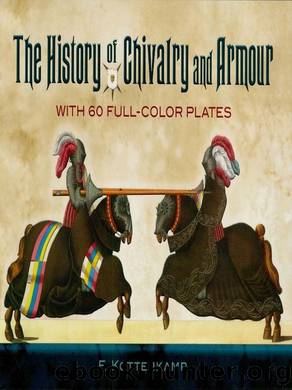
Author:F. Kottenkamp [Kottenkamp, F.]
Language: eng
Format: epub
Tags: History, Reference, Military, Pictorial
ISBN: 9780486137414
Google: YCDc1lpZotwC
Publisher: Courier Corporation
Published: 2013-02-06T01:09:17+00:00
SPEARS, LANCES, HALBERTS, AND PARTIZANS.
Plates 8, 9, 10, 11.
The spear being the simplest weapon of attack, was known to most of the barbarous nations. Tacitus mentions it under the name of framea, as the principal weapon of the Germans. The name of lance occurs in ancient German dialects, and like the majority of armorial terms, it has been introduced into the Romanesque languages. Roman authors, whose writings treat of the subversion of their country, allude to the spear, as one of the principal weapons of the Germans. It appears that the spear was then, no longer hurled from a distance, but merely thrust in closer conflict. The javelin, which was much lighter, belongs to a later period. It very likely originated in the East, and was, through the medium of the Spaniards, communicated to the western nations. Among the feudal nobles, the lance was considered as one of the most dignified weapons, and its use was denied to plebeians. William the Conqueror granted to his feudal nobles, the privilege of using the lance. In France, during the time of St. Louis, commoners were only, on some special occasions, permitted to carry the spear of the heavy-armed warriors, which was then generally designated as a lance. Weapons of this kind were then exceedingly long and heavy. The shafts were made of the wood of the aspen, lime, pine, sycamore, or ash trees. The gripes of lances were occasionally hollow, and covered with expensive woven material. Meyrick describes a lance, which was covered with crimson velvet. The iron blade generally was blunt, rather ponderous, and broad. That writer also mentions a lance-head, made in the time of William the Conqueror, which is 8 inches broad, and from 12 to 14 inches long.
Spears and Lances,
Below the head of the lance, a flag, the Gonfanon, was fixed, which indicated the rank of the bearer, and also contributed to terrify the horses of the adversaries. In the Bayeux , tapestry, William the Conqueror is represented with a small red and blue flag, which terminates in three indentations, At a later time, the Bannerets (Chevaliers Bannerets) carried a square banner under their lances. A small round conical shield of iron, termed vamplate, was screwed above the gripe of the lance, for the protection of the hand. During the tournament the lance-head was removed and replaced by the so-called crown, which consisted of three short and blunt iron staves. These were placed in divergent directions, and projected from a small iron-plate.
Gonfanon.
The Chronicles of the ages of chivalry compute the strength of an army by the number of knightsâ lances. The Romance of Parthenopex, moreover, informs us, that lances, fixed in the ground, before the camp-tents of knights, indicated the rank of their owners.
The spear had a symbolical signification. Being contrasted with the spindle and distaff, it represented the male sex. Kings symbols, gave a spear to their heirs, as a sign of the transfer of power. According to Gregory of Tours, King Gunthram, handed one to his son, Childebert, telling him that thereby, he conferred upon him the dominion of the whole empire.
Download
This site does not store any files on its server. We only index and link to content provided by other sites. Please contact the content providers to delete copyright contents if any and email us, we'll remove relevant links or contents immediately.
Personalized inhaled bacteriophage therapy for treatment of multidrug-resistant Pseudomonas aeruginosa in cystic fibrosis by unknow(182573)
CONSORT 2025 statement: updated guideline for reporting randomized trials by unknow(90912)
Critical evaluation of the ProfiLER-02 study design and outcomes by Vivek Subbiah & Razelle Kurzrock(90510)
Cardiac gene therapy makes a comeback by Oliver J. Müller & Susanne Hille & Anca Kliesow Remes(90282)
Whisky: Malt Whiskies of Scotland (Collins Little Books) by dominic roskrow(74461)
Unveiling the design rules for tunable emission in graphene quantum dots: A high-throughput TDDFT and machine learning perspective by Şener Özönder & Mustafa Coşkun Özdemir & Caner Ünlü(50911)
A yeast-based oral therapeutic delivers immune checkpoint inhibitors to reduce intestinal tumor burden by unknow(40283)
Covalent hitchhikers guide proteins to the nucleus by Alexander F. Russell & Madeline F. Currie & Champak Chatterjee(40223)
Meet the Authors: Christopher R. Mansfield and Emily R. Derbyshire by Christopher R. Mansfield & Emily R. Derbyshire(40110)
Alkaline-earth metals promote propane dehydrogenation with carbon dioxide through geometric effects: Altering the reaction pathway by unknow(32751)
Induced iron vacancies boosting FeOOH loaded on sustainable Fenton-like collagen fiber membrane for efficient removal of emerging contaminants by unknow(32534)
Efficient electric-field-assisted photochemical conversion of methane to n-propanol exclusively over penetrated TiO2Ti hollow fibers by Guanghui Feng(32468)
Bi2SiO5 nanosheets as piezo-photocatalyst for efficient degradation of 2,4-Dichlorophenol by Hangyu Shi & Yifu Li & Lishan Zhang & Guoguan Liu & Qian Zhang & Xuan Ru & Shan Zhong(32405)
A novel NDIPTA organic heterojunction photocatalyst with built-in electric field for efficient hydrogen production by Jiahui Yang & Baojun Ma & Yongfa Zhu(32379)
Enhanced conversion of methane to liquid-phase oxygenates via hollow ferrite nanotube@horseradish peroxidase based photoenzymatic catalysis by Jun Duan & Shiying Fan & Xinyong Li & Shaomin Liu(32346)
Ordered macroporous superstructure of defective carbon adorned with tiny cobalt sulfide for selective electrocatalytic hydrogenation of cinnamaldehyde by Xiao-Shi Yuan & Sheng-Hua Zhou & San-Mei Wang & Wenbo Wei & Xiaofang Li & Xin-Tao Wu & Qi-Long Zhu(32268)
What's Done in Darkness by Kayla Perrin(27162)
Topological analysis of non-conjugated ethylene oxide cored dendrimers decorated with tetraphenylethylene: Insights from degree-based descriptors using the polynomial approach by A Theertha Nair & D Antony Xavier & Annmaria Baby & S Akhila(26551)
Investigation of mechanical and self-healing properties of hydroxyl-terminated polybutadiene functionalized with 2-ureido-4-pyrimidinone by Mohsen Kazazi & Mehran Hayaty & Ali Mousaviazar(26481)
