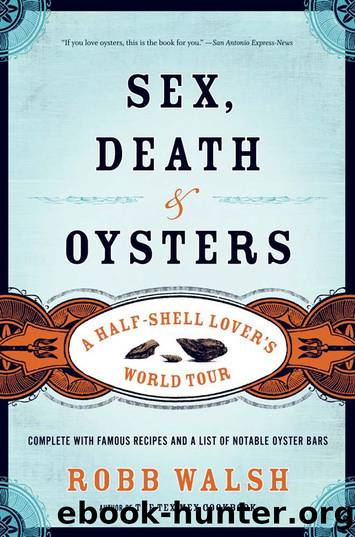
Sex, Death and Oysters by Robb Walsh
Author:Robb Walsh
Language: eng
Format: epub
ISBN: 9781582436500
Publisher: Counterpoint
Published: 2018-05-16T00:00:00+00:00
The mystery of why oysters disappeared from England was addressed a few years ago by a retired Cambridge economics professor named Robert Neild. Intrigued by the abundance of oysters in France and their scarcity in the United Kingdom, Neild submerged himself in the sort of statistical research that economists love and food writers loathe.
The result was a wonderful book called The English, the French and the Oyster that was published in 1995. In the book, Neild follows the government responses in both countries to the crisis in the oyster industry that occurred around 1850. Oysters were dying off in both places, but the two governments took a radically different approach to the problem.
An English commission created to study the failure of the oyster harvest concluded that there was a bad spat set and no evidence of overfishing. Their recommendation was to suspend all local and national government regulations that might limit oystering, so that individuals would have economic incentives to restock the oyster beds. The fishery recovered for a while and then failed.
Across the English Channel, facing the same dilemma in the mid- 1800s, Napoleon III slapped a ban on fishing until the oyster population could recover, strictly regulated the season afterward, directed government development of oyster parks in the intertidal areas for use by oystermen big and small, and had scientists begin research that would lead to a national system of oyster farming.
In 1902, when people started falling sick and dying because English oysters were contaminated with sewage, the British government responded to the public outcry with investigations and reports, but little in the way of real action. The result was a steady decline in oyster sales. The oyster, which was considered the most common food of the poor in the time of Dickens, completely disappeared from English food culture. As I discovered in Colchester, most English people donât even consider oysters edible anymore.
In 1915, the French created sanitary commissions that inspected oysters and oyster beds to prevent unhealthy oysters from getting onto the market. In 1930, the first steps were taken to stop pollution that might affect oyster beds. A comprehensive national system to ensure the purity of French oysters was established in 1939 and became the model for the E.U. regulations that were enacted in 1993. Today French people of all economic classes enjoy oystersâmost often in their homes.
The English laissez-faire economic system, which relied on market forces and individual initiative, functioned beautifully during the Industrial Revolution. The French mercantile economic system, in which government intervened on behalf of key industries, was arguably less successful in the nineteenth century. But in the particular case of oysters, a resource which requires some management, government regulation proved good for business.
In the mid-1800s, England and France both produced around 500 million oysters a year. Today England produces around 10 million oysters a year and France produces 2 billion oysters a year. History has proven that the French approach was the right one.
âBut the main point that stands out in a
Download
This site does not store any files on its server. We only index and link to content provided by other sites. Please contact the content providers to delete copyright contents if any and email us, we'll remove relevant links or contents immediately.
Personalized inhaled bacteriophage therapy for treatment of multidrug-resistant Pseudomonas aeruginosa in cystic fibrosis by unknow(182454)
CONSORT 2025 statement: updated guideline for reporting randomized trials by unknow(90823)
Critical evaluation of the ProfiLER-02 study design and outcomes by Vivek Subbiah & Razelle Kurzrock(90407)
Cardiac gene therapy makes a comeback by Oliver J. Müller & Susanne Hille & Anca Kliesow Remes(90176)
Whisky: Malt Whiskies of Scotland (Collins Little Books) by dominic roskrow(74459)
Unveiling the design rules for tunable emission in graphene quantum dots: A high-throughput TDDFT and machine learning perspective by Şener Özönder & Mustafa Coşkun Özdemir & Caner Ünlü(50911)
A yeast-based oral therapeutic delivers immune checkpoint inhibitors to reduce intestinal tumor burden by unknow(40283)
Covalent hitchhikers guide proteins to the nucleus by Alexander F. Russell & Madeline F. Currie & Champak Chatterjee(40223)
Meet the Authors: Christopher R. Mansfield and Emily R. Derbyshire by Christopher R. Mansfield & Emily R. Derbyshire(40109)
Alkaline-earth metals promote propane dehydrogenation with carbon dioxide through geometric effects: Altering the reaction pathway by unknow(32751)
Induced iron vacancies boosting FeOOH loaded on sustainable Fenton-like collagen fiber membrane for efficient removal of emerging contaminants by unknow(32534)
Efficient electric-field-assisted photochemical conversion of methane to n-propanol exclusively over penetrated TiO2Ti hollow fibers by Guanghui Feng(32467)
Bi2SiO5 nanosheets as piezo-photocatalyst for efficient degradation of 2,4-Dichlorophenol by Hangyu Shi & Yifu Li & Lishan Zhang & Guoguan Liu & Qian Zhang & Xuan Ru & Shan Zhong(32405)
A novel NDIPTA organic heterojunction photocatalyst with built-in electric field for efficient hydrogen production by Jiahui Yang & Baojun Ma & Yongfa Zhu(32378)
Enhanced conversion of methane to liquid-phase oxygenates via hollow ferrite nanotube@horseradish peroxidase based photoenzymatic catalysis by Jun Duan & Shiying Fan & Xinyong Li & Shaomin Liu(32346)
Ordered macroporous superstructure of defective carbon adorned with tiny cobalt sulfide for selective electrocatalytic hydrogenation of cinnamaldehyde by Xiao-Shi Yuan & Sheng-Hua Zhou & San-Mei Wang & Wenbo Wei & Xiaofang Li & Xin-Tao Wu & Qi-Long Zhu(32268)
What's Done in Darkness by Kayla Perrin(27162)
Topological analysis of non-conjugated ethylene oxide cored dendrimers decorated with tetraphenylethylene: Insights from degree-based descriptors using the polynomial approach by A Theertha Nair & D Antony Xavier & Annmaria Baby & S Akhila(26550)
Investigation of mechanical and self-healing properties of hydroxyl-terminated polybutadiene functionalized with 2-ureido-4-pyrimidinone by Mohsen Kazazi & Mehran Hayaty & Ali Mousaviazar(26481)
