Oklahoma by H Wayne Morgan
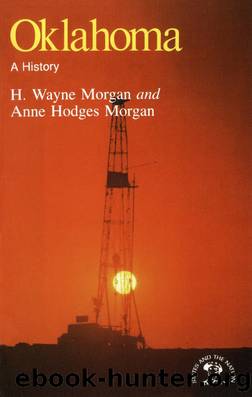
Author:H Wayne Morgan
Language: eng
Format: epub
ISBN: 9780393348637
Publisher: W. W. Norton & Company
6
The Politics of Modernization: From the 1920s to the 1960s
THE record of the first fifteen years of statehood disappointed those who thought that they were establishing truly democratic government in 1907. In spite of Oklahomansâ persistent idealistic belief in manâs goodness, old injustices remained. From the first, the combination of an unwieldy constitution and an exploitative political system rooted in the frontier ethic of grab-and-run shaped the merry-go-round quality of Sooner party politics and state government.
The basic constitutional provision forbidding the governor and other elected officials from succeeding themselves was designed to prevent the courthouse gangs so familiar in American political history. In practice, it promoted a spoils system. Ambitious men learned to exchange offices and support each otherâs campaigns. âSwapping keys,â as the practice was called, gave the state some honest and experienced administrators, but it also left a large number of corrupt or incompetent officials undisturbed.
The number of candidates the system generated thwarted the progressive idea that elected rather than appointed officials best represented the votersâ wishes. Confronted with a bedsheet ballot, most people voted âby guess or by God,â ignorant of the candidatesâ abilities. In the 1930s, numerous candidates with famous names compounded the problem of voter recognition. In 1932 a public school teacher from Moore named Will Rogers capitalized on his namesakeâs popularity and won election to Congress. Illustrious names appeared regularly on Oklahoma ballots after that. Mae West, a telephone switchboard operator from Oklahoma City, received more than 65,000 votes for Commissioner of Charities and Corrections in 1938. Oliver Cromwell, Daniel Boone, Brigham Young, Joe E. Brown, and Patrick Henry vied for other offices.
The cynical held that anyone who ran for office was probably a scoundrel, anyway; voting him in and then driving him out of office might warn others of like mind. Incessant bickering over patronage within state government and pressures from without prevented many conscientious officials from doing their jobs. Oklahomans were not unique in their disenchantment with politics after World War I, but wide swings of public mood made any real political stability difficult.
Just as national attention focused on the president, so local voters looked to the governor for leadership. After the near-civil war of the Walton episode in the 1920s, Oklahomans were ready for the respite of Martin E. Trappâs interim administration. Lieutenant governor under three different chief executives, Trapp was the epitome of the professional politician. An able administrator, accustomed to working with a touchy legislature, he provided peaceful leadership. It seemed ironic that more or less by chance the state had acquired an able man as governor during a critical period of transition.
To many, it looked as if the querulous politics of the statehood era were over. And as the 1926 election approached, many Democrats hoped that Trapp could be a candidate, since, technically, he had thus far served only as âacting governor.â Popular with the voters and acceptable to the faction-ridden Democratic party, Trapp probably would have won election. But the state supreme court upheld the constitutional provision of one term per governor, and the prospect of a stable administration faded.
Download
This site does not store any files on its server. We only index and link to content provided by other sites. Please contact the content providers to delete copyright contents if any and email us, we'll remove relevant links or contents immediately.
Personalized inhaled bacteriophage therapy for treatment of multidrug-resistant Pseudomonas aeruginosa in cystic fibrosis by unknow(213360)
CONSORT 2025 statement: updated guideline for reporting randomized trials by unknow(102512)
Critical evaluation of the ProfiLER-02 study design and outcomes by Vivek Subbiah & Razelle Kurzrock(102039)
Cardiac gene therapy makes a comeback by Oliver J. Müller & Susanne Hille & Anca Kliesow Remes(101832)
Whisky: Malt Whiskies of Scotland (Collins Little Books) by dominic roskrow(74615)
Unveiling the design rules for tunable emission in graphene quantum dots: A high-throughput TDDFT and machine learning perspective by Şener Özönder & Mustafa Coşkun Özdemir & Caner Ünlü(50995)
A yeast-based oral therapeutic delivers immune checkpoint inhibitors to reduce intestinal tumor burden by unknow(40370)
Covalent hitchhikers guide proteins to the nucleus by Alexander F. Russell & Madeline F. Currie & Champak Chatterjee(40294)
Meet the Authors: Christopher R. Mansfield and Emily R. Derbyshire by Christopher R. Mansfield & Emily R. Derbyshire(40204)
Alkaline-earth metals promote propane dehydrogenation with carbon dioxide through geometric effects: Altering the reaction pathway by unknow(32812)
Induced iron vacancies boosting FeOOH loaded on sustainable Fenton-like collagen fiber membrane for efficient removal of emerging contaminants by unknow(32607)
Efficient electric-field-assisted photochemical conversion of methane to n-propanol exclusively over penetrated TiO2Ti hollow fibers by Guanghui Feng(32527)
Bi2SiO5 nanosheets as piezo-photocatalyst for efficient degradation of 2,4-Dichlorophenol by Hangyu Shi & Yifu Li & Lishan Zhang & Guoguan Liu & Qian Zhang & Xuan Ru & Shan Zhong(32463)
A novel NDIPTA organic heterojunction photocatalyst with built-in electric field for efficient hydrogen production by Jiahui Yang & Baojun Ma & Yongfa Zhu(32437)
Enhanced conversion of methane to liquid-phase oxygenates via hollow ferrite nanotube@horseradish peroxidase based photoenzymatic catalysis by Jun Duan & Shiying Fan & Xinyong Li & Shaomin Liu(32403)
Ordered macroporous superstructure of defective carbon adorned with tiny cobalt sulfide for selective electrocatalytic hydrogenation of cinnamaldehyde by Xiao-Shi Yuan & Sheng-Hua Zhou & San-Mei Wang & Wenbo Wei & Xiaofang Li & Xin-Tao Wu & Qi-Long Zhu(32330)
What's Done in Darkness by Kayla Perrin(27245)
Topological analysis of non-conjugated ethylene oxide cored dendrimers decorated with tetraphenylethylene: Insights from degree-based descriptors using the polynomial approach by A Theertha Nair & D Antony Xavier & Annmaria Baby & S Akhila(26627)
Investigation of mechanical and self-healing properties of hydroxyl-terminated polybutadiene functionalized with 2-ureido-4-pyrimidinone by Mohsen Kazazi & Mehran Hayaty & Ali Mousaviazar(26553)
