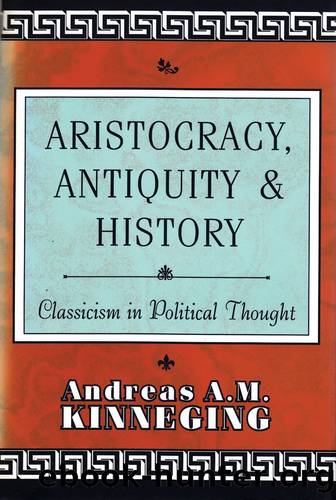
Aristocracy, Antiquity and History: Classicism in Political Thought by Andreas Kinneging
Author:Andreas Kinneging [Kinneging, Andreas]
Language: eng
Format: epub
Tags: Political Science, General, History & Theory
ISBN: 9781000659047
Google: qIBPEAAAQBAJ
Goodreads: 59447863
Publisher: Routledge
Published: 1997-01-01T00:00:00+00:00
1.2. The rural bias
What were its main features? An appropriate place to start looking for an answer to this question is De Agri Cultura,13 the earliest extant Latin prose work we possess, and the sole surviving text of Cato the Elder (234-149 B.C), the embodiment of Roman virtue. This ârole-modelâ asserts right at the beginning of that treatise that âwhen (the ancestors) were trying to praise a good man they called him a good farmer and a good tiller of the soil, and the one who received this compliment was considered to have received the highest praise. (..) It is from among the farmers that the bravest men and the sturdiest soldiers come, and the gain they make is the most blameless of all, the most secure, and the least provocative of envy, and the men engaged in this pursuit are least given to disaffectionâ.14 Panegyrics like this, celebrating the virtues of the farmer and healthy, rustic life on the farm can be reproduced ad nauseam.15
It would be quite off the mark, however, to conclude that Roman literature exhibits a proto-romantic idealization of the peasant world.16 In fact, its general spirit and outlook are overwhelmingly aristocratic, and deeply contemptuous of the common people, the vulgus, including the peasantry.17 The praise of farmers one finds scattered through Roman literature signifies something else. The farmer stands for life in the country -rus-, as opposed to life in the city -urbs.
The Roman bias in favor of rural life comes to the fore quite blatantly in the composition of the two most important republican assemblies, the comitia centuriata and the comitia tributa. In both assemblies voting took place on the basis of originally territorial tribus, i.e districts or constituencies. From 241 B.C. on there were thirty-five of such tribes, four tribus urbanae and thirty-one tribus rusticae. (Within each tribe individual suffrage was the rule, a simple majority being decisive, and no minimum quorum being required.) In both comitiae every tribe had one single vote. This by itself conferred a huge numerical advantage on the rural tribes. But what made the inequality really glaring was the fact that the four urban tribes were each much larger than the rural tribes, and contained most of the âsecond-rateâ citizens, so to speak, i.e. the proletarii, the freedmen, and many of the allies.18 How to make sense of this bias?
âThe city creates luxury, from which avarice inevitably springs, while from avarice audacity breaks forth, the source of all crimes and misdeeds. On the other hand, this country life (..) teaches thrift, carefulness, and justiceâ, Cicero proclaimed in his Pro Roscio.19 And Varro, in his treatise on agriculture, argued that âit was not without reason that those great men, our ancestors, put the Romans who lived in the country ahead of those who lived in the city. For as in the country those who live in the villa are lazier than those who are engaged in carrying out the work on the land, so they thought that those who settled in town were more indolent than those who dwelt in the country.
Download
This site does not store any files on its server. We only index and link to content provided by other sites. Please contact the content providers to delete copyright contents if any and email us, we'll remove relevant links or contents immediately.
Personalized inhaled bacteriophage therapy for treatment of multidrug-resistant Pseudomonas aeruginosa in cystic fibrosis by unknow(183828)
CONSORT 2025 statement: updated guideline for reporting randomized trials by unknow(92119)
Critical evaluation of the ProfiLER-02 study design and outcomes by Vivek Subbiah & Razelle Kurzrock(91816)
Cardiac gene therapy makes a comeback by Oliver J. Müller & Susanne Hille & Anca Kliesow Remes(91491)
Whisky: Malt Whiskies of Scotland (Collins Little Books) by dominic roskrow(74468)
Unveiling the design rules for tunable emission in graphene quantum dots: A high-throughput TDDFT and machine learning perspective by Şener Özönder & Mustafa Coşkun Özdemir & Caner Ünlü(50912)
A yeast-based oral therapeutic delivers immune checkpoint inhibitors to reduce intestinal tumor burden by unknow(40289)
Covalent hitchhikers guide proteins to the nucleus by Alexander F. Russell & Madeline F. Currie & Champak Chatterjee(40228)
Meet the Authors: Christopher R. Mansfield and Emily R. Derbyshire by Christopher R. Mansfield & Emily R. Derbyshire(40115)
Alkaline-earth metals promote propane dehydrogenation with carbon dioxide through geometric effects: Altering the reaction pathway by unknow(32756)
Induced iron vacancies boosting FeOOH loaded on sustainable Fenton-like collagen fiber membrane for efficient removal of emerging contaminants by unknow(32538)
Efficient electric-field-assisted photochemical conversion of methane to n-propanol exclusively over penetrated TiO2Ti hollow fibers by Guanghui Feng(32473)
Bi2SiO5 nanosheets as piezo-photocatalyst for efficient degradation of 2,4-Dichlorophenol by Hangyu Shi & Yifu Li & Lishan Zhang & Guoguan Liu & Qian Zhang & Xuan Ru & Shan Zhong(32409)
A novel NDIPTA organic heterojunction photocatalyst with built-in electric field for efficient hydrogen production by Jiahui Yang & Baojun Ma & Yongfa Zhu(32382)
Enhanced conversion of methane to liquid-phase oxygenates via hollow ferrite nanotube@horseradish peroxidase based photoenzymatic catalysis by Jun Duan & Shiying Fan & Xinyong Li & Shaomin Liu(32348)
Ordered macroporous superstructure of defective carbon adorned with tiny cobalt sulfide for selective electrocatalytic hydrogenation of cinnamaldehyde by Xiao-Shi Yuan & Sheng-Hua Zhou & San-Mei Wang & Wenbo Wei & Xiaofang Li & Xin-Tao Wu & Qi-Long Zhu(32269)
What's Done in Darkness by Kayla Perrin(27165)
Topological analysis of non-conjugated ethylene oxide cored dendrimers decorated with tetraphenylethylene: Insights from degree-based descriptors using the polynomial approach by A Theertha Nair & D Antony Xavier & Annmaria Baby & S Akhila(26555)
Investigation of mechanical and self-healing properties of hydroxyl-terminated polybutadiene functionalized with 2-ureido-4-pyrimidinone by Mohsen Kazazi & Mehran Hayaty & Ali Mousaviazar(26486)
