A Short History of the Irish Revolution, 1912 to 1927 by Richard Killeen
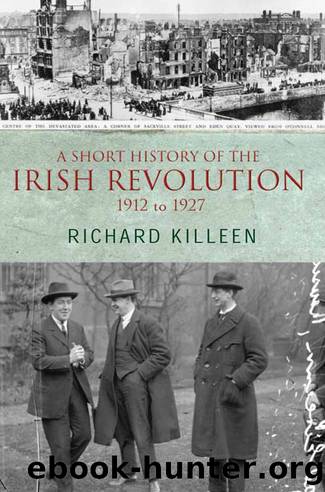
Author:Richard Killeen
Language: eng
Format: epub
Publisher: Gill & Macmillan
The change of mood anticipated by James Stephens was not long in making itself felt. Both Redmond and Dillon spoke in the House against the policy of executing the leaders of the Rising. Whatever misgivings the government may have had, they effectively left the matter to General Maxwell, the military commander on the ground in Dublin. It is all too easy to characterise Maxwell as a standard-issue military dolt, indifferent to the nuances of politics. His imposition of martial law and his policy of executing the leaders of the Rising were certainly politically inept, but from a soldier’s perspective they made perfect sense. The rebels had invoked the assistance of Britain’s principal enemy in the middle of the biggest war of modern times, this at a moment when the struggle at the front was at a desperate and uncertain stage. He may have considered that the political repercussions were nothing to do with him. But they certainly had to do with the government. And the government supported him.
Dillon, in particular, understood the effect that the executions might have on nationalist public opinion. His condemnation of the policy in the Commons was especially robust. He told the House that ‘it would have been a damned good thing for you if your soldiers were able to put up as good a fight as did these men in Dublin’. Suddenly, for Dillon at least, the army on the Western Front was ‘your army’. So who constituted ‘our army’ in Dillon’s eyes? And were not the IPP horribly compromised by their pro-recruiting calls for ‘your army’ over the previous two years?
At least as significant as Dillon’s outburst was the response of Bishop Edward O’Dwyer of Limerick to General Maxwell. The general had requested the bishop to discipline two of his priests who had publicly expressed republican views. The bishop let Maxwell have it: ‘You took good care that no plea for mercy should interpose on behalf of the poor young fellows who surrendered to you in Dublin…. Personally, I regard your action with horror and I believe that it has outraged the conscience of the country.’ The bishops and the Party had been like an arse and a shirt since the 1880s. O’Dwyer’s robust language was the first sign of a shift in episcopal support from the IPP to Sinn Féin, which was to be complete by 1918.
The IPP did not implode immediately. It continued to win by-elections in the period after the Rising. But it also began to lose them, as a new force began to take shape. The original Sinn Féin had been part of the nationalist fringe in the era prior to the Rising: the name had denoted a mood as much as a series of policies. Insofar as the policies themselves went, they included a monarchist constitutional arrangement along Habsburg lines. Yet the name Sinn Féin came to be a shorthand for all the radical nationalist movements, including the republicans. The British insisted on referring to Easter Week as the Sinn Féin Rebellion, although Sinn Féin had nothing whatever to do with it.
Download
This site does not store any files on its server. We only index and link to content provided by other sites. Please contact the content providers to delete copyright contents if any and email us, we'll remove relevant links or contents immediately.
Personalized inhaled bacteriophage therapy for treatment of multidrug-resistant Pseudomonas aeruginosa in cystic fibrosis by unknow(183629)
CONSORT 2025 statement: updated guideline for reporting randomized trials by unknow(91924)
Critical evaluation of the ProfiLER-02 study design and outcomes by Vivek Subbiah & Razelle Kurzrock(91606)
Cardiac gene therapy makes a comeback by Oliver J. Müller & Susanne Hille & Anca Kliesow Remes(91290)
Whisky: Malt Whiskies of Scotland (Collins Little Books) by dominic roskrow(74468)
Unveiling the design rules for tunable emission in graphene quantum dots: A high-throughput TDDFT and machine learning perspective by Şener Özönder & Mustafa Coşkun Özdemir & Caner Ünlü(50912)
A yeast-based oral therapeutic delivers immune checkpoint inhibitors to reduce intestinal tumor burden by unknow(40287)
Covalent hitchhikers guide proteins to the nucleus by Alexander F. Russell & Madeline F. Currie & Champak Chatterjee(40227)
Meet the Authors: Christopher R. Mansfield and Emily R. Derbyshire by Christopher R. Mansfield & Emily R. Derbyshire(40114)
Alkaline-earth metals promote propane dehydrogenation with carbon dioxide through geometric effects: Altering the reaction pathway by unknow(32754)
Induced iron vacancies boosting FeOOH loaded on sustainable Fenton-like collagen fiber membrane for efficient removal of emerging contaminants by unknow(32538)
Efficient electric-field-assisted photochemical conversion of methane to n-propanol exclusively over penetrated TiO2Ti hollow fibers by Guanghui Feng(32473)
Bi2SiO5 nanosheets as piezo-photocatalyst for efficient degradation of 2,4-Dichlorophenol by Hangyu Shi & Yifu Li & Lishan Zhang & Guoguan Liu & Qian Zhang & Xuan Ru & Shan Zhong(32409)
A novel NDIPTA organic heterojunction photocatalyst with built-in electric field for efficient hydrogen production by Jiahui Yang & Baojun Ma & Yongfa Zhu(32382)
Enhanced conversion of methane to liquid-phase oxygenates via hollow ferrite nanotube@horseradish peroxidase based photoenzymatic catalysis by Jun Duan & Shiying Fan & Xinyong Li & Shaomin Liu(32348)
Ordered macroporous superstructure of defective carbon adorned with tiny cobalt sulfide for selective electrocatalytic hydrogenation of cinnamaldehyde by Xiao-Shi Yuan & Sheng-Hua Zhou & San-Mei Wang & Wenbo Wei & Xiaofang Li & Xin-Tao Wu & Qi-Long Zhu(32269)
What's Done in Darkness by Kayla Perrin(27163)
Topological analysis of non-conjugated ethylene oxide cored dendrimers decorated with tetraphenylethylene: Insights from degree-based descriptors using the polynomial approach by A Theertha Nair & D Antony Xavier & Annmaria Baby & S Akhila(26554)
Investigation of mechanical and self-healing properties of hydroxyl-terminated polybutadiene functionalized with 2-ureido-4-pyrimidinone by Mohsen Kazazi & Mehran Hayaty & Ali Mousaviazar(26486)
