Why is There Something Rather Than Nothing? by Leszek Kolakowski
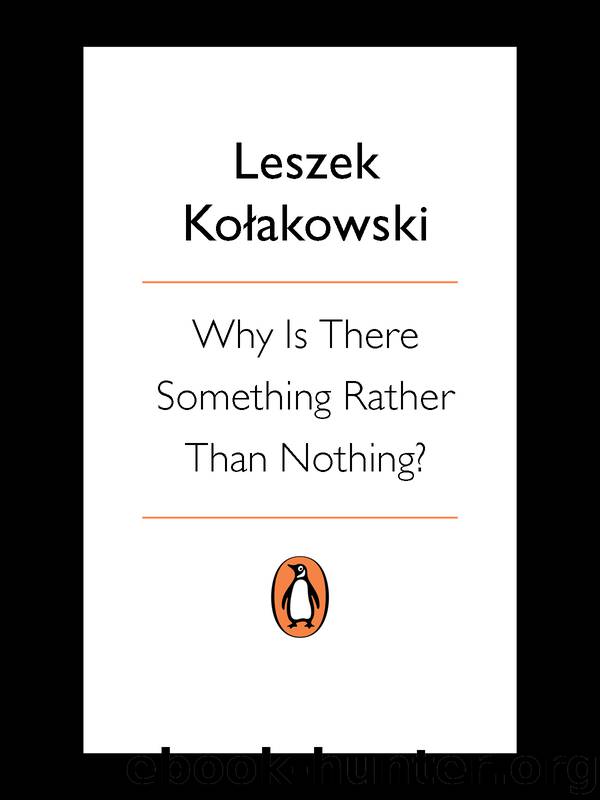
Author:Leszek Kolakowski
Language: eng
Format: epub
ISBN: 9780141919522
Publisher: Penguin Books Ltd
Published: 2017-02-16T05:00:00+00:00
Faith: Why should we believe?
BLAISE PASCAL
1623–62
Pascal did not want to be a philosopher. He did not think of himself as one, and it is probably fair to say that he wasn’t one, at least not in the sense in which the term was used in his day. He had only scorn for philosophy and philosophers, and expected nothing useful to come from their disputes. Nor was he a theologian, in the sense that he did not engage in natural theology (which was actually a branch of philosophy, concerned with demonstrating theological truths through the use of reason). But no overview of European philosophy, however brief, could omit him. He died before he reached the age of forty. His most important work, known as the Pensées and published posthumously, might seem to be no more than a chaotic collection of notes and aphorisms – but they are aphorisms from which European readers have been fishing out brilliant aperçus for almost three and a half centuries.
His interest lay in two quite distinct – though not, in his view, mutually contradictory – domains. One was mathematics and theoretical physics, the other faith and human destiny, both seen through faith and as it is without faith.
He was a first-rate mathematician and genuinely loved the craft – for that was what he thought mathematics was: a craft; the most splendid craft to have been created by the human mind, but a craft none the less, and of no use when it comes to the things that matter most in our lives. As a mathematician and a physicist he respected the modern rigorous rules of his craft; he had little use for the philosophical speculations of Aristotelians, with the aid of which semi-educated scholastics thought they could solve the problems of physics. He also decried appeals to religion in questions of reason or fact, and considered that the most flagrant example of such abuse in his own century was the condemnation of Galileo by the Catholic Church; do what you will, he said, the earth will continue to turn around the sun, and you with it.
But he considered the opposite manoeuvre – the attempt to demonstrate religious truths by arguments from observation – equally illegitimate and vain. Pascal was a man of unwavering faith; faith was for him the most important thing in human life. But he knew that the alleged proofs of God’s existence derived from natural phenomena were worthless; he knew there was no reliable way from birds, stars and the heavens to God the Creator. Nor can mathematical proofs help us in our suffering and misfortune; above all, they are powerless to teach us anything about our fate and its meaning, or about death. Human fate, he wrote, is like the fate of a gang of chained prisoners who must look on as their companions are put to death one by one, and know that they will be next, and that it will be soon; and when we realize that this is our
Download
This site does not store any files on its server. We only index and link to content provided by other sites. Please contact the content providers to delete copyright contents if any and email us, we'll remove relevant links or contents immediately.
| Anthropology | Archaeology |
| Philosophy | Politics & Government |
| Social Sciences | Sociology |
| Women's Studies |
The remains of the day by Kazuo Ishiguro(9002)
Tools of Titans by Timothy Ferriss(8402)
Giovanni's Room by James Baldwin(7351)
The Black Swan by Nassim Nicholas Taleb(7136)
Inner Engineering: A Yogi's Guide to Joy by Sadhguru(6798)
The Way of Zen by Alan W. Watts(6620)
The Power of Now: A Guide to Spiritual Enlightenment by Eckhart Tolle(5788)
Asking the Right Questions: A Guide to Critical Thinking by M. Neil Browne & Stuart M. Keeley(5778)
The Six Wives Of Henry VIII (WOMEN IN HISTORY) by Fraser Antonia(5518)
Astrophysics for People in a Hurry by Neil DeGrasse Tyson(5194)
Housekeeping by Marilynne Robinson(4453)
12 Rules for Life by Jordan B. Peterson(4308)
Ikigai by Héctor García & Francesc Miralles(4277)
Double Down (Diary of a Wimpy Kid Book 11) by Jeff Kinney(4276)
The Ethical Slut by Janet W. Hardy(4261)
Skin in the Game by Nassim Nicholas Taleb(4255)
The Art of Happiness by The Dalai Lama(4132)
Skin in the Game: Hidden Asymmetries in Daily Life by Nassim Nicholas Taleb(4011)
Walking by Henry David Thoreau(3966)
