What Should I Believe?: Why Our Beliefs about the Nature of Death and the Purpose of Life Dominate Our Lives by Dorothy Rowe
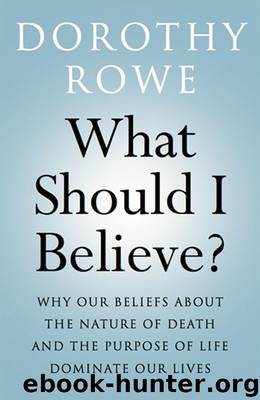
Author:Dorothy Rowe [Rowe, Dorothy]
Language: eng
Format: epub, mobi, azw3
Publisher: Taylor and Francis
Published: 2012-05-22T22:00:00+00:00
Chapter 5
Being Good and the Just World
I was waiting to reverse my car out of its parking space in the car park of a shopping centre. Through the rear window I could see a ramp for pedestrians leading down to the entrance road of the car park. A young woman with a little boy of about four was coming down the ramp. The boy broke away from the woman and ran across the road. She caught up with him beside the driver’s door of my car. All I could see was the little boy’s arm in the grip of an adult hand. The other adult hand came down hard in three smacks on his upper arm. A woman’s voice said, ‘You are a bad boy.’
Welcome to the world of good and evil.
This was not the woman’s intention, I am sure. Her sudden fear at the peril the little boy had put himself in turned to anger, and so she smacked him. Had she been less fearful, and thus less angry, she might have remembered to say, ‘That was a bad thing you did.’ Then she would have given him the chance to think about what he had done and resolve never to do that again. But she did not, and instead presented him with the idea that he was, in essence, bad.
If this proved to be the only occasion on which the boy was told he was bad, the incident would very likely fade from his memory, but, if his relatives and teachers repeatedly said to him, ‘You are a bad boy’, he would come to believe that, just as he was a boy and he had blue eyes, unchangeable characteristics with which he was born, so he was bad and he could not change. If he was sent regularly to church, synagogue or mosque the message that he was a sinner would have been impressed on him with great authority. At a Buddhist shrine or a Hindu temple a child might not be told that he was a sinner, but he would be told that he was inadequate and ignorant, and he had much to learn. Whatever the religion, the child is told that his task in life is to become and remain good. It may be that he is taught that it is within his power to become good; or that good works alone will not save him if he does not have faith; or that, no matter how intensely he believes and prays, his essential wickedness remains and that the gates of Hell are always gaping wide to receive the unwary sinner. It may be that the child is taught that, no matter how much he strives to be good, he can never be sure that he has reached the standard of goodness required to be born into a better life.
If children were presented with just one definition of ‘good’, their task of learning to be good would be hard enough, but between and within religions there
Download
What Should I Believe?: Why Our Beliefs about the Nature of Death and the Purpose of Life Dominate Our Lives by Dorothy Rowe.mobi
What Should I Believe?: Why Our Beliefs about the Nature of Death and the Purpose of Life Dominate Our Lives by Dorothy Rowe.azw3
This site does not store any files on its server. We only index and link to content provided by other sites. Please contact the content providers to delete copyright contents if any and email us, we'll remove relevant links or contents immediately.
| Anthropology | Archaeology |
| Philosophy | Politics & Government |
| Social Sciences | Sociology |
| Women's Studies |
The remains of the day by Kazuo Ishiguro(9131)
Tools of Titans by Timothy Ferriss(8535)
Giovanni's Room by James Baldwin(7478)
The Black Swan by Nassim Nicholas Taleb(7230)
Inner Engineering: A Yogi's Guide to Joy by Sadhguru(6856)
The Way of Zen by Alan W. Watts(6698)
The Power of Now: A Guide to Spiritual Enlightenment by Eckhart Tolle(5886)
Asking the Right Questions: A Guide to Critical Thinking by M. Neil Browne & Stuart M. Keeley(5860)
The Six Wives Of Henry VIII (WOMEN IN HISTORY) by Fraser Antonia(5582)
Astrophysics for People in a Hurry by Neil DeGrasse Tyson(5249)
Housekeeping by Marilynne Robinson(4525)
Double Down (Diary of a Wimpy Kid Book 11) by Jeff Kinney(4361)
12 Rules for Life by Jordan B. Peterson(4357)
Ikigai by Héctor García & Francesc Miralles(4350)
Skin in the Game by Nassim Nicholas Taleb(4338)
The Ethical Slut by Janet W. Hardy(4326)
The Art of Happiness by The Dalai Lama(4197)
Skin in the Game: Hidden Asymmetries in Daily Life by Nassim Nicholas Taleb(4080)
Walking by Henry David Thoreau(4036)
