Unbalanced by Stephen Roach
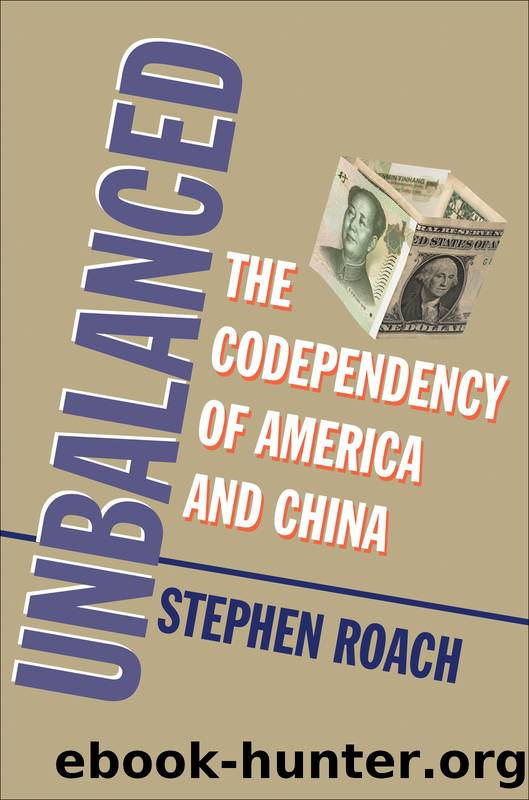
Author:Stephen Roach
Language: eng
Format: epub
Publisher: Yale University Press
Published: 2014-11-15T00:00:00+00:00
So Whatâs Really the Gripe?
China is far from perfectâespecially in the eyes of those in American academic, policy, and business circles who view the Chinese economy as a threat to American renewal and prosperity. Struggling middle-class American workers also increasingly look at the Chinese growth juggernaut with considerable trepidation. But there is a difference between concerns and complaints. The trick is in the important distinction between legitimate gripes and misperceptions.
Misperceptions of China stem from the confluence of two things: the problems of the U.S. economy and the sharp contrasts between the two systems. The blended Chinese modelâthe socialist market economyâoperates by a different set of rules from the market-based system that underpins the U.S. economy. The disparities are many: standards of living, political systems, the roles of strategy and planning, demographic constraints, urbanization, stability mandates, and saving imbalances, just to name a few. Sometimes these contrasts work to the advantage of codependencyâeach economy offers something the other is missingâbut not always. A tough economic climate in the United States is especially likely to bring out conflict.
The China Gripe arises out of this combination of difficult times and contrasts between the two systems. History is also a factorâespecially the disturbing imagery of a militaristic Red China of the 1950s and 1960s. Out of this combination of context, contrasts, and history, the China Gripe has been a dark cloud looming over the nationâs codependent relationship with the United States.
While there is clear legitimacy to many of the concerns embedded in the gripe, there is also considerable exaggeration. Chinaâs foreign exchange rate is managed in order to maintain stability, not manipulated to inflict damage on the United States. China has indeed used industrial policy in ways that disadvantage other nations, but WTO membership is forcing it to conform to global norms in tradable goods and in the protection of intellectual property rights. Its violations are far from trivial on both counts, but research shows that a relatively small portion of cross-border trade between the two economies has been adversely affected. Nor is the Chinese economy facing the imminent crisis that many fear. Neither property bubbles nor the banking system nor corruption threatens an imminent collapse. Of all the concerns that have given rise to the Gripe, charges of cyberterrorism are the most disconcertingâbut they raise serious questions about the trustworthiness of both Americaâs and Chinaâs engagement with the rapidly shifting technologies of Globalization 2.0. They must be taken seriouslyâboth by Chinaâs new leadership and by senior government officials in the United States and elsewhere in the world.
As with any economy, there are, of course, many other things that can go wrong in China or that Americans can find distasteful about China. Human rights issues, environmental degradation and pollution, and widening income inequalities are just a few of the issues that have gotten considerable attention both inside and outside of China. These are all serious problems that pose immense challenges to China and its system of governance. In particular, history does not look kindly on regimes that have ignored human rights and corruption.
Download
This site does not store any files on its server. We only index and link to content provided by other sites. Please contact the content providers to delete copyright contents if any and email us, we'll remove relevant links or contents immediately.
| Anthropology | Archaeology |
| Philosophy | Politics & Government |
| Social Sciences | Sociology |
| Women's Studies |
The remains of the day by Kazuo Ishiguro(9016)
Tools of Titans by Timothy Ferriss(8418)
Giovanni's Room by James Baldwin(7362)
The Black Swan by Nassim Nicholas Taleb(7145)
Inner Engineering: A Yogi's Guide to Joy by Sadhguru(6805)
The Way of Zen by Alan W. Watts(6624)
The Power of Now: A Guide to Spiritual Enlightenment by Eckhart Tolle(5802)
Asking the Right Questions: A Guide to Critical Thinking by M. Neil Browne & Stuart M. Keeley(5789)
The Six Wives Of Henry VIII (WOMEN IN HISTORY) by Fraser Antonia(5523)
Astrophysics for People in a Hurry by Neil DeGrasse Tyson(5197)
Housekeeping by Marilynne Robinson(4462)
12 Rules for Life by Jordan B. Peterson(4316)
Ikigai by Héctor García & Francesc Miralles(4286)
Double Down (Diary of a Wimpy Kid Book 11) by Jeff Kinney(4284)
The Ethical Slut by Janet W. Hardy(4271)
Skin in the Game by Nassim Nicholas Taleb(4264)
The Art of Happiness by The Dalai Lama(4137)
Skin in the Game: Hidden Asymmetries in Daily Life by Nassim Nicholas Taleb(4019)
Walking by Henry David Thoreau(3973)
