The Virtues of Mendacity by Martin; Jay
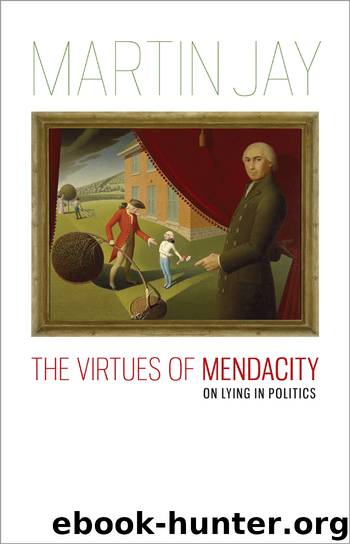
Author:Martin; Jay [Jay, Martin;]
Language: eng
Format: mobi
Publisher: University of Virginia Press
Published: 0101-01-01T00:00:00+00:00
The gains to be made by calling the overall institution of society “the political” are hard to see, the damages are obvious. Either, in calling “the political” that which everybody would naturally call the institution of society, one merely attempts a change in vocabulary without substantive content … or one attempts to preserve in this substitution the connotations linked with the word “political” since its creation by the Greeks, that is, whatever pertains to explicit and at least partially reflective decisions concerning the fate of the collectivity; but then, through a strange reversal, language, economy, religion, representation of the world, family, etc., have to be said to depend upon political decisions in a way that would win the approval of Charles Maurras as well as Pol Pot. “Everything is political” either means nothing, or it means: everything ought to be political, ought to flow from an explicit decision of the Sovereign.172
That is, as the totalitarian experiments of the twentieth century made manifestly clear, entirely effacing the boundary between “the political” and its others, demanding that private life be conflated with public, and expecting absolute transparency of citizens who have to reveal their actions, even confess their innermost thoughts, can be a recipe for disaster. As the political theorist Michael Halberstam notes, “Totalitarianism confronts liberalism with the challenge to individual autonomy that the artificial construction of meaning harbors…. The distinction between the political and the nonpolitical is undermined where the possibility of an artificial construction of shared meanings is granted.”173 However much the “personal is the political” could be understood as a liberating slogan in the struggle to take seriously the ways in which power relations invade everyday life, it could also function as a license to abolish the protections provided by keeping up the wall, however porous, between personal and political realms. Even if the space of the political—or more precisely, if Lefort is right, the space of the modern political sovereign—is an empty space, which is filled at our peril, it may be wise to maintain the distinction between the void and what surrounds it.
To conclude this chapter with a salient example of the ways in which maintaining that boundary has been a mark of democratic polities, let me refer to a critical passage in the American Constitution. Article I, Section 6 says of senators and representatives: “They shall in all Cases, except Treason, Felony and Breach of the Peace, be privileged from Arrest during their Attendance at the Session of their respective Houses, and in going to and returning from the same; and for any Speech or Debate in either House, they shall not be questioned in any other Place.” The purpose of this clause seems to have been to assure unfettered political debate without fear of lawsuits, to effect in other words that separation of the political from the legal whose absolute difference we have seen is so hard to maintain.
It has also had another, perhaps unintended consequence, which the liberal journalist Eric Alterman has noted in
Download
This site does not store any files on its server. We only index and link to content provided by other sites. Please contact the content providers to delete copyright contents if any and email us, we'll remove relevant links or contents immediately.
| Anthropology | Archaeology |
| Philosophy | Politics & Government |
| Social Sciences | Sociology |
| Women's Studies |
The remains of the day by Kazuo Ishiguro(9004)
Tools of Titans by Timothy Ferriss(8403)
Giovanni's Room by James Baldwin(7352)
The Black Swan by Nassim Nicholas Taleb(7137)
Inner Engineering: A Yogi's Guide to Joy by Sadhguru(6798)
The Way of Zen by Alan W. Watts(6621)
The Power of Now: A Guide to Spiritual Enlightenment by Eckhart Tolle(5788)
Asking the Right Questions: A Guide to Critical Thinking by M. Neil Browne & Stuart M. Keeley(5779)
The Six Wives Of Henry VIII (WOMEN IN HISTORY) by Fraser Antonia(5518)
Astrophysics for People in a Hurry by Neil DeGrasse Tyson(5195)
Housekeeping by Marilynne Robinson(4455)
12 Rules for Life by Jordan B. Peterson(4308)
Double Down (Diary of a Wimpy Kid Book 11) by Jeff Kinney(4277)
Ikigai by Héctor García & Francesc Miralles(4277)
The Ethical Slut by Janet W. Hardy(4261)
Skin in the Game by Nassim Nicholas Taleb(4256)
The Art of Happiness by The Dalai Lama(4132)
Skin in the Game: Hidden Asymmetries in Daily Life by Nassim Nicholas Taleb(4012)
Walking by Henry David Thoreau(3966)
