The Politics of Logic by Livingston Paul;
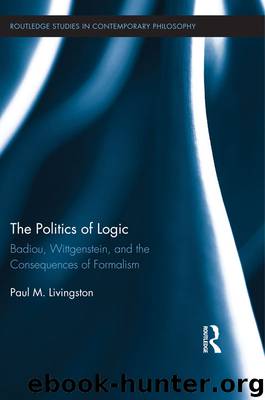
Author:Livingston, Paul;
Language: eng
Format: epub
Publisher: Routledge
Published: 2018-02-26T16:00:00+00:00
The Many Worlds of Badiou
On the basis of Logics of Worlds’ complex formal and structural analysis of the possibilities of change and transformation, we can now add one more distinction to those summarized in the table of contrasts above (p. 181). For since the theory of Logics of Worlds formalizes the possibilities of evental change as inherently situated and always operative within particular, local worlds of appearance, it maintains a fundamental commitment to the multiplicity of worlds and the diversity of their structures. This commitment is intimately connected to Badiou’s subordination of logic to mathematics, which allows him, by means of the device of Heyting algebras, to present the specific structures of the various worlds—up to what is linguistically expressible in each—as each characterized by a specific “logic” grounded in the larger category-theoretical (i.e., mathematical) structure. Thus Badiou’s theory in Logics of Worlds makes all the more explicit the commitment already present in Being and Event. This is a fundamental commitment to the unity of consistent mathematics and the plurality of worlds and logics.
By stark contrast, as we may already suspect and will have the occasion to verify in the following, for the formal thought underlying paradoxico-criticism, whatever may be the diversity of existing languages and cultures, there is but one world and but one logic. The “ontological” attitude of paradoxico-criticism is thus not that (as Badiou holds) “ontology is mathematics,” but rather that “ontology is logic,” and that mathematics is to be reduced to logic rather than the other way around.69 Accordingly, the critical consequences of formalism are here to be traced in the implications of the problematic reflection of the totality of the (one) world into itself by means of the (single) structure of logic, or language as such. This is what Lacan called lalangue, and for paradoxico-criticism, its “virtual” or “ideal” status does not at all prevent the consequences of its existence from being structurally and indelibly inscribed in every moment of ordinary reflexive linguistic praxis. These consequences may indeed yield paradoxes and contradictions but they do not require or suggest, as Badiou consistently does, the fundamental formal splitting of the world of appearance and effective change into an irreducible plurality.
The irreducible multiplicity of worlds in Logics of Worlds again follows directly from Badiou’s interpretation of the implications of Russell’s paradox, which we have already investigated above. In Book II of Logics of Worlds, Badiou again considers the inconsistency of the Russell set—what he here calls the “Chimera”—to demand the non-existence of a Whole, or a set of all sets. For, he says:
Since the Chimera can be neither reflexive nor non-reflexive, and since this partition admits of no remainder, we must conclude that the Chimera is not. But its being followed necessarily from the being that was ascribed to the Whole. Therefore, the Whole has no being.70
With this decision, Badiou unilaterally excludes the possibility, decisive for the paradoxico-critical orientation, that the Russell set instead is to be treated as a set that, inconsistently and paradoxically, both is
Download
This site does not store any files on its server. We only index and link to content provided by other sites. Please contact the content providers to delete copyright contents if any and email us, we'll remove relevant links or contents immediately.
| Anthropology | Archaeology |
| Philosophy | Politics & Government |
| Social Sciences | Sociology |
| Women's Studies |
The remains of the day by Kazuo Ishiguro(9125)
Tools of Titans by Timothy Ferriss(8531)
Giovanni's Room by James Baldwin(7477)
The Black Swan by Nassim Nicholas Taleb(7229)
Inner Engineering: A Yogi's Guide to Joy by Sadhguru(6856)
The Way of Zen by Alan W. Watts(6698)
The Power of Now: A Guide to Spiritual Enlightenment by Eckhart Tolle(5883)
Asking the Right Questions: A Guide to Critical Thinking by M. Neil Browne & Stuart M. Keeley(5860)
The Six Wives Of Henry VIII (WOMEN IN HISTORY) by Fraser Antonia(5574)
Astrophysics for People in a Hurry by Neil DeGrasse Tyson(5249)
Housekeeping by Marilynne Robinson(4525)
Double Down (Diary of a Wimpy Kid Book 11) by Jeff Kinney(4357)
12 Rules for Life by Jordan B. Peterson(4356)
Ikigai by Héctor García & Francesc Miralles(4349)
Skin in the Game by Nassim Nicholas Taleb(4335)
The Ethical Slut by Janet W. Hardy(4325)
The Art of Happiness by The Dalai Lama(4195)
Skin in the Game: Hidden Asymmetries in Daily Life by Nassim Nicholas Taleb(4075)
Walking by Henry David Thoreau(4036)
