The Political Humanism of Hannah Arendt by McCarthy Michael H.;
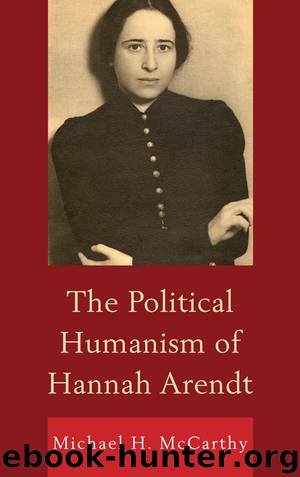
Author:McCarthy, Michael H.;
Language: eng
Format: epub
Tags: undefined
Publisher: Lexington Books
Published: 2012-09-25T16:00:00+00:00
Ruling and Being Ruled
Greek political philosophy is largely based on the description and appraisal of the Athenian polis. Athens provides the dramatic setting for nearly all of Plato’s dialogues and serves as an important model for Aristotle’s portrait of the ancient city. Arendt accused Plato and Aristotle of misrepresenting the polis’s character by substituting pre-political or nonpolitical experiences for traditional Athenian practices. She pressed this criticism with three examples: the replacement of praxis with poiesis; the substitution of political authority and command for rhetorical persuasion; the abandonment of public debate and argument for the rule of experts.
Arendt’s depiction of the ancient city is a study in contrasts. She sharply divides its spatial arrangements into two opposing spheres: the private realm of the household (the oikos) that is organized for the preservation of life, and the public realm of the polis that is deliberately designed for greatness and glory. In the darkness of the household inequality prevails. Slaves and women labor to meet the requirements of biological necessity under the rule of the household master. In the brightly lit public realm, liberated male citizens are equal and free. Liberated from the coercion and necessity of the oikos, they freely engage with their civic peers in the agonal competition for political excellence.
Arendt insists that the pattern of relationships in the classical household was explicitly pre-political. A threefold inequality obtained in the oikos, separating masters from slaves, parents from children and husbands from wives. The governance of the oikos was based upon rule, which, according to Arendt, was a structure of discipline explicitly confined to the private realm. There were two distinct types of household rule corresponding to the household’s disparate inequalities. Masters ruled despotically over slaves, resorting to violence and coercion against them as circumstances required. The rule over family members, by contrast, was royal or authoritative in nature and intended for their benefit and wellbeing. Given the oikos’ structure of inequality, freedom was absent from the classical household, because public freedom in the ancient city depended on the presence of recognized peers with whom one could liberally speak and act.[125]
There was a separate sphere of authority outside the canons of the oikos and the polis. This was the authority belonging to the realm of learning, teaching and knowledge. Epistemic authority governed the relations between masters and apprentices in the arts and between teachers and students in the theoretical disciplines of mathematics and physics. In the educational realm, as opposed to the household, the relevant inequalities were not based on strength, age and gender but on mutually recognized differences in knowledge and skill.[126] Both education and family life stand in marked contrast to the bios politikos. In the public space of civic equality, of isonomia, the household heads meet one another as peers.[127] Within this restricted domain of shared citizenship, all forms of rule are deliberately excluded. The equality of citizens is based upon mutual agreement. Free citizens consent to live together as equals and to conduct their public affairs in a uniquely political way.
Download
This site does not store any files on its server. We only index and link to content provided by other sites. Please contact the content providers to delete copyright contents if any and email us, we'll remove relevant links or contents immediately.
| Anthropology | Archaeology |
| Philosophy | Politics & Government |
| Social Sciences | Sociology |
| Women's Studies |
The remains of the day by Kazuo Ishiguro(8975)
Tools of Titans by Timothy Ferriss(8365)
Giovanni's Room by James Baldwin(7329)
The Black Swan by Nassim Nicholas Taleb(7107)
Inner Engineering: A Yogi's Guide to Joy by Sadhguru(6785)
The Way of Zen by Alan W. Watts(6601)
Asking the Right Questions: A Guide to Critical Thinking by M. Neil Browne & Stuart M. Keeley(5759)
The Power of Now: A Guide to Spiritual Enlightenment by Eckhart Tolle(5753)
The Six Wives Of Henry VIII (WOMEN IN HISTORY) by Fraser Antonia(5498)
Astrophysics for People in a Hurry by Neil DeGrasse Tyson(5182)
Housekeeping by Marilynne Robinson(4436)
12 Rules for Life by Jordan B. Peterson(4299)
Double Down (Diary of a Wimpy Kid Book 11) by Jeff Kinney(4261)
Ikigai by Héctor García & Francesc Miralles(4246)
The Ethical Slut by Janet W. Hardy(4242)
Skin in the Game by Nassim Nicholas Taleb(4239)
The Art of Happiness by The Dalai Lama(4125)
Skin in the Game: Hidden Asymmetries in Daily Life by Nassim Nicholas Taleb(3991)
Walking by Henry David Thoreau(3953)
