The Philosophy of Nietzsche by Welson Rex;
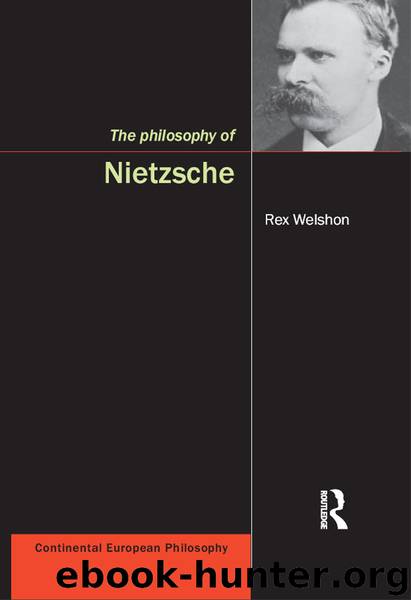
Author:Welson, Rex;
Language: eng
Format: epub
ISBN: 1900094
Publisher: Taylor and Francis
Logic
Nietzsche’s criticisms of logic are so strongly worded that some think he advocates rejecting it completely. This is an attractive view for those who find in logic a rigidity that precludes creativity; the field of imagination supposedly opened up as a result of rejecting logic might be liberating. As we have already seen, this view is bad interpretation of Nietzsche, and otherwise absurd. It is mistaken when applied to Nietzsche because he nowhere advocates abandoning logic. He criticizes certain claims of logic, but that is typical for him: he is critical of many things. However, he no more abandons logic than he abandons the will, power, morality, truth, knowledge or any of the other things he has, on occasion, been thought to eliminate. And it is absurd because, as Nietzsche himself recognizes, rationality is in some ways essential to thinking. Although we usually think without the more sophisticated branches of logic (how many people routinely think using the insights of second-order intensional logic?) and although we certainly think illogically, we cannot think all the time without any logic of any kind. That is not liberation; it is insanity.
In Human, All Too Human, Nietzsche announces that “logic … rests on assumptions that do not correspond to anything in the real world, e.g., on the assumption of the equality of things, the identity of the same thing at different points in time” (HAH 11). In Twilight of the Idols, we find a related view:
science of formulæ, sign-systems: such as logic and that applied logic, mathematics. In these reality does not appear at all, not even as a problem; just as little as does the question what value a system of conventional signs such as constitutes logic can possibly possess.
(TI III 3)
Of course, he also insists that “schooling has no more important task than to teach rigorous thinking, careful judgment, logical conclusions” (HAH 256), a sentiment echoed in Twilight of the Idols, where he insults German universities on the grounds that “even among students of philosophy themselves, the theory, the practice, the vocation of logic is beginning to die out” (TI VIII 7). Indeed, he actually claims that “without accepting the fictions of logic … man could not live” (BGE 4). If so, logic, although a fiction, is not only not opposed to life, it is actually a necessary condition for our kind of thinking life. So, as much as it may appear that Nietzsche denigrates logic, he is not generally sceptical about the importance of logic to our way of living.
Still, there are plenty of specific claims in logic about which Nietzsche is sceptical. One such feature of logic is its dependence upon identity. In Beyond Good and Evil, he says that the self-identical is part of a “purely invented world” (BGE 4). In The Gay Science, he suggests that the origin of logic itself is rooted in a desire to posit different things as being identical (GS 111), and he declares that the equation of unequal things is an “erroneous article of faith” (GS 110).
Download
This site does not store any files on its server. We only index and link to content provided by other sites. Please contact the content providers to delete copyright contents if any and email us, we'll remove relevant links or contents immediately.
| Anthropology | Archaeology |
| Philosophy | Politics & Government |
| Social Sciences | Sociology |
| Women's Studies |
The remains of the day by Kazuo Ishiguro(9228)
Tools of Titans by Timothy Ferriss(8605)
Giovanni's Room by James Baldwin(7576)
The Black Swan by Nassim Nicholas Taleb(7285)
Inner Engineering: A Yogi's Guide to Joy by Sadhguru(6907)
The Way of Zen by Alan W. Watts(6735)
The Power of Now: A Guide to Spiritual Enlightenment by Eckhart Tolle(5931)
Asking the Right Questions: A Guide to Critical Thinking by M. Neil Browne & Stuart M. Keeley(5901)
The Six Wives Of Henry VIII (WOMEN IN HISTORY) by Fraser Antonia(5613)
Astrophysics for People in a Hurry by Neil DeGrasse Tyson(5280)
Housekeeping by Marilynne Robinson(4605)
Double Down (Diary of a Wimpy Kid Book 11) by Jeff Kinney(4413)
Ikigai by Héctor García & Francesc Miralles(4400)
Skin in the Game by Nassim Nicholas Taleb(4394)
12 Rules for Life by Jordan B. Peterson(4387)
The Ethical Slut by Janet W. Hardy(4362)
The Art of Happiness by The Dalai Lama(4239)
Skin in the Game: Hidden Asymmetries in Daily Life by Nassim Nicholas Taleb(4130)
Walking by Henry David Thoreau(4085)
