The Emotions: A Philosophical Exploration by Peter Goldie
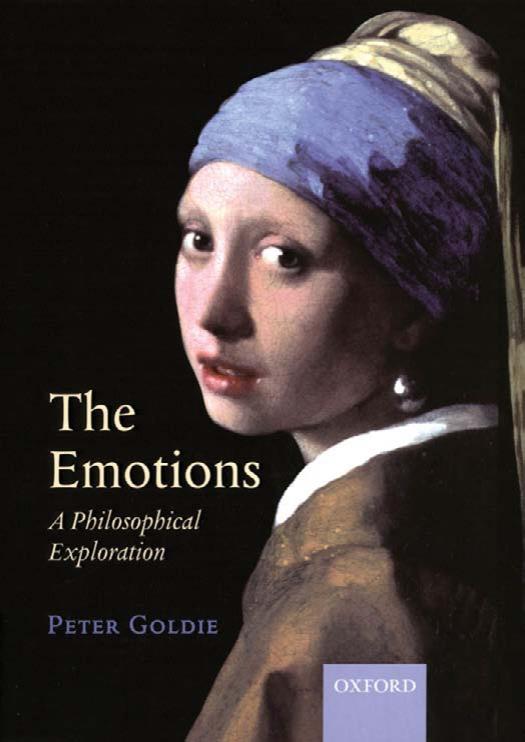
Author:Peter Goldie [Goldie, Peter]
Language: eng
Format: epub, pdf
ISBN: 0199253048
end p.118
be strong-willed), and, ultimately and ideally, to eliminate them (and thus to have no further need of strength of will). Realizing that the aetiology (the remote explanation) of your liking for salt is what it is, you see how little authority this liking ought to have over your own reasons for action; you like it because substantial salt intake was adaptive for your remote ancestors, but it is not adaptive for you, given the sedentary life you lead. Similarly, it is perhaps helpful to have an appreciation of the aetiology of why I want to do terrible things to people when I am angry or sexually jealous. Thus, knowledge of evolutionary explanations can help in health education and in moral education.
Aristotle thought that the fully virtuous person will never be akratic, because his non-rational desires will always be fully consonant with rational desire; he does not even need the 'executive virtue' of strength of will. But most of us are not fully virtuous, and so we do sometimes act akratically because our emotional capabilities are not fully trained, and not under our control. We thus begin to see that the process of education of the emotions put forward with such sensitivity by Aristotle takes on a darker tone: emotional capabilities need to be controlled in upbringing as well as simply exploited. As Freud said in his New Introductory Lectures in Psychoanalysis: We realised that the difficulties of childhood lie in the fact that in a short span of time a child has to appropriate the results of a cultural evolution which stretches over thousands of years, including the acquisition of control over his drives and adaptation to society—or at least the first beginnings of these two. He can only achieve a part of this modification through his own development; much must be imposed on him by education. [As the translators point out, Freud's term, Erziehung, has a wider meaning than 'education', including 'upbringing' in a general sense.] We are not surprised that children often carry out this task very imperfectly. [And, two pages later:] let us be clear as to what the first task of education is. The child must learn to control his drives.9 (no. 32, PFL ii. 182)
Download
The Emotions: A Philosophical Exploration by Peter Goldie.pdf
This site does not store any files on its server. We only index and link to content provided by other sites. Please contact the content providers to delete copyright contents if any and email us, we'll remove relevant links or contents immediately.
| Anthropology | Archaeology |
| Philosophy | Politics & Government |
| Social Sciences | Sociology |
| Women's Studies |
The remains of the day by Kazuo Ishiguro(9229)
Tools of Titans by Timothy Ferriss(8605)
Giovanni's Room by James Baldwin(7578)
The Black Swan by Nassim Nicholas Taleb(7289)
Inner Engineering: A Yogi's Guide to Joy by Sadhguru(6907)
The Way of Zen by Alan W. Watts(6737)
The Power of Now: A Guide to Spiritual Enlightenment by Eckhart Tolle(5932)
Asking the Right Questions: A Guide to Critical Thinking by M. Neil Browne & Stuart M. Keeley(5902)
The Six Wives Of Henry VIII (WOMEN IN HISTORY) by Fraser Antonia(5613)
Astrophysics for People in a Hurry by Neil DeGrasse Tyson(5282)
Housekeeping by Marilynne Robinson(4606)
Double Down (Diary of a Wimpy Kid Book 11) by Jeff Kinney(4416)
Skin in the Game by Nassim Nicholas Taleb(4406)
Ikigai by Héctor García & Francesc Miralles(4405)
12 Rules for Life by Jordan B. Peterson(4388)
The Ethical Slut by Janet W. Hardy(4364)
The Art of Happiness by The Dalai Lama(4241)
Skin in the Game: Hidden Asymmetries in Daily Life by Nassim Nicholas Taleb(4130)
Walking by Henry David Thoreau(4085)
