Republic (Hackett Classics) by Plato
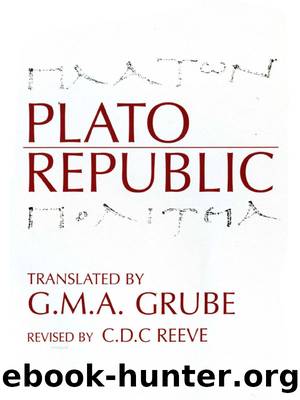
Author:Plato [Plato]
Language: eng
Format: epub
Tags: ebook, book
Publisher: Hackett Publishing Company, Inc.
Published: 1992-11-15T05:00:00+00:00
1. This task is taken up in Book VIII.
2. See 423eâ424a.
3. Literally: to refine gold. A proverbial expression applied to those who neglect the task at hand for some more fascinating but less profitable pursuit. Thrasymachus seems to be reminding Socrates of his own words at 336e.
4. Adrasteia was a kind of Nemesis, a punisher of pride and proud words. The âbow to Adrasteiaâ is therefore a kind of apology for the kind of act or statement that might otherwise spur her to take action.
5. See Plato, Laws 869e.
6. This may be an allusion to the mimes of Sophron of Syracuse (c. 470â400 B.C.), which were classified as male mimes and female mimes, because males were represented in the former, females in the latter.
7. It is useful to contrast Platoâs views on women with those of his contemporaries in Athens. The most reliable brief discussion of the latter is John Gould, âLaw, Custom and Myth: Aspects of the Social Position of Women in Classical Athens,â Journal of Hellenic Studies 100 (1980): 38â59.
8. A palestra is a wrestling school and training ground.
9. See Herodotus, Histories 1.23â24 for the story of Arionâs rescue by the dolphin.
10. Plato is here adapting a phrase of Pindar, âplucking the unripe fruit of wisdom.â
11. See 382c ff. and 414b ff.
12. There can be no doubt that Plato is recommending infanticide by exposure for these babies, a practice which was quite common in ancient Greece as a method of birth control.
13. The priestess of Apollo at Delphi.
14. The Athenian democracy had nine archontes, or rulers, in Platoâs time. These included the chief magistrates, the chief military leader, and an important authority in religious matters.
15. See 429c.
16. See 416d ff.
17. See 419a ff.
18. Works and Days 40.
19. Iliad 7.321.
20. Iliad 8.162.
21. Works and Days 122. On daimons, see 382e n.23.
22. Apollo. See 427b.
23. Greek views on pollution, which is now a foreign concept to us, are discussed in R. Parker, Miasma (Oxford: Clarendon Press, 1983).
24. See 414e.
25. See 369aâc.
26. Socrates here seems to be applying the principle he introduced at 438aâb. See 475c.
27. See 596a ff.
28. A poem is fashioned out of sounds and a painting out of colors and shapes. See 600eâ601b.
29. Socrates may be referring here either to particular things that are beautiful or to the various beauties in them, which are properties or universals. The same is true later when Socrates speaks of âthe many just things,â âthe many doubles,â and the rest.
30. It is important to note that the argument that follows is intended to convince the lovers of sights and crafts that they have opinion rather than knowledge. Since these people are defined as being unable to countenance forms, the argument cannot achieve its purpose if it simply presupposes that there are forms or draws on the theory of forms, for the lovers of sight and crafts will not be convinced by an argument which appeals to something they are unable to accept.
31. Because of the ambiguity of the verb einai (âto beâ),
Download
This site does not store any files on its server. We only index and link to content provided by other sites. Please contact the content providers to delete copyright contents if any and email us, we'll remove relevant links or contents immediately.
The remains of the day by Kazuo Ishiguro(9085)
Tools of Titans by Timothy Ferriss(8492)
Giovanni's Room by James Baldwin(7436)
The Black Swan by Nassim Nicholas Taleb(7195)
Inner Engineering: A Yogi's Guide to Joy by Sadhguru(6836)
The Way of Zen by Alan W. Watts(6671)
The Power of Now: A Guide to Spiritual Enlightenment by Eckhart Tolle(5854)
Asking the Right Questions: A Guide to Critical Thinking by M. Neil Browne & Stuart M. Keeley(5832)
The Six Wives Of Henry VIII (WOMEN IN HISTORY) by Fraser Antonia(5558)
Astrophysics for People in a Hurry by Neil DeGrasse Tyson(5224)
Housekeeping by Marilynne Robinson(4504)
Double Down (Diary of a Wimpy Kid Book 11) by Jeff Kinney(4334)
12 Rules for Life by Jordan B. Peterson(4331)
Ikigai by Héctor García & Francesc Miralles(4311)
The Ethical Slut by Janet W. Hardy(4308)
Skin in the Game by Nassim Nicholas Taleb(4306)
The Art of Happiness by The Dalai Lama(4169)
Skin in the Game: Hidden Asymmetries in Daily Life by Nassim Nicholas Taleb(4051)
Walking by Henry David Thoreau(4000)
