Plato versus Parmenides by Roecklein Robert J.;
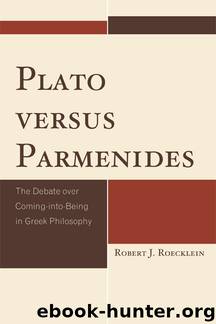
Author:Roecklein, Robert J.;
Language: eng
Format: epub
Publisher: Lexington Books
THE CRATYLUS ON NAMES
There is then a great deal at stake in our discussion of the nature of names as Plato’s Socrates appraises them. The Cratylus is the dialogue of Plato’s preeminently focused on the significance and origin of names. Plato presents, in the Cratylus, a theory of names along the lines set forth previously. However, the commentators seem determined to rediscover Parmenides, Protagoras, or Frege and Wittgenstein in the arguments presented in this dialogue. Plato in this work rebukes the theory of language advanced by Protagoras, and indicates the nature of the intelligence operative in the ordinary use of names. In the secondary literature, however, Plato is all too frequently depicted as if had sympathy, mysteriously, with the Protagorean point of view.
A prominent view among the commentators is that, according to Plato, names are not an imitation of the nature of the objects that they are intended to indicate. Richard Ketchum says that “the point is that what accounts for the fact that a word means such and such is just the fact that it has a particular use” (141). “Two words have the same meaning if they have the same use” (141).[27] “No passage unambiguously asserts that the object named is identical to what is signified by that name,” he concludes about the Cratylus (147). A. Silverman argues that Plato believes that “in order for a speaker to use a name in this way he must associate a description with the name. The reason a description is necessary is that the speaker must use a description associated with the name on all occasions of its use by any speaker” (28). “I shall argue that, for Plato, nature and convention amount to two different ways in which speakers might use a name” (29). “What distinguishes the natural from the conventional uses is the description associated with that name” (29).[28]
By “natural” language, we may understand the view put forward by Socrates in the Cratylus: that names are an imitation of objects and actions. The name, in this case, would have a fixed meaning. By “conventional” language, the true signification of a name would be determined by the “use” which a particular statement sought to impose upon it. Malcolm Schofield has recognized the two theories of language just set out from the Cratylus. In Schofield’s view, Socrates in that dialogue is moving away from a naturalist view of language, and toward a conventionalist theory. “Socrates contrives convincingly to suggest that the difficulties he raises for Cratylus’ extreme position necessitate outright abandonment of naturalism in favor of the conventionalist theory of names.”[29] The issue concerns what the names signify or indicate: in the view of Schofield, Plato has rejected the view that names are properly seen as imitations of the objects and actions which they point out.
Plato’s Socrates makes exactly the opposite argument. First, for Socrates, names are names of something. They do not exist in their own right. Alphabets and vocabularies must be created by human beings. Human beings create languages
Download
This site does not store any files on its server. We only index and link to content provided by other sites. Please contact the content providers to delete copyright contents if any and email us, we'll remove relevant links or contents immediately.
| Anthropology | Archaeology |
| Philosophy | Politics & Government |
| Social Sciences | Sociology |
| Women's Studies |
The remains of the day by Kazuo Ishiguro(9094)
Tools of Titans by Timothy Ferriss(8501)
Giovanni's Room by James Baldwin(7441)
The Black Swan by Nassim Nicholas Taleb(7202)
Inner Engineering: A Yogi's Guide to Joy by Sadhguru(6839)
The Way of Zen by Alan W. Watts(6675)
The Power of Now: A Guide to Spiritual Enlightenment by Eckhart Tolle(5856)
Asking the Right Questions: A Guide to Critical Thinking by M. Neil Browne & Stuart M. Keeley(5839)
The Six Wives Of Henry VIII (WOMEN IN HISTORY) by Fraser Antonia(5560)
Astrophysics for People in a Hurry by Neil DeGrasse Tyson(5227)
Housekeeping by Marilynne Robinson(4508)
Double Down (Diary of a Wimpy Kid Book 11) by Jeff Kinney(4340)
12 Rules for Life by Jordan B. Peterson(4333)
Ikigai by Héctor García & Francesc Miralles(4314)
The Ethical Slut by Janet W. Hardy(4312)
Skin in the Game by Nassim Nicholas Taleb(4311)
The Art of Happiness by The Dalai Lama(4170)
Skin in the Game: Hidden Asymmetries in Daily Life by Nassim Nicholas Taleb(4053)
Walking by Henry David Thoreau(4006)
