Philosophical Myths of the Fall by Mulhall Stephen;
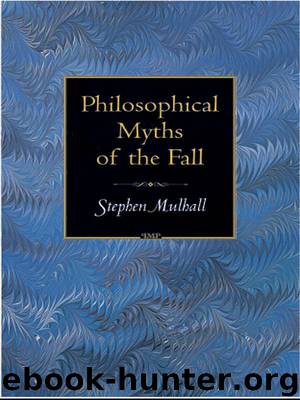
Author:Mulhall, Stephen;
Language: eng
Format: epub
Publisher: Princeton University Press
Published: 2008-04-09T04:00:00+00:00
3. HUMANITY AS ANIMALITY
One standard criticism of that Christian myth is that, in apparently conceiving of the familiar facets of embodiment (desire, labour, survival and reproduction, death) as manifestations of the Fall, of our falling away from our paradisal selves, it constitutes a libel against the body. It has also long been a commonplace of criticism about Heidegger’s Being and Time that its existential analytic of Dasein overlooks or represses, let us say closes its eyes to, the embodiedness of human existence. We are repeatedly told that, in the whole of Being and Time “one cannot find . . . six lines on the problem of the body”—that, even at those places in Heidegger’s analysis where one might expect to find a more detailed confrontation with the issue, it is avoided. And more recently, this putative omission has been linked with another popular criticism of Heidegger’s work—its tendency to overlook, repress, or directly deny any essential connection between human existence and the modes of being of nonhuman animals. Against this background, Heidegger’s supposed avoidance of human embodiedness appears as a compulsive or anxious aversion from that which most obviously indicates the undeniable animality of human being. So, can we conclude that this is another respect in which Heidegger’s work has failed to distinguish itself sufficiently from its theological horizons?
In the end, this may turn out to be the correct conclusion, but not for the reasons just adduced. For its proponents tend to have rather too simple a conception of Heidegger’s account of the relations between humanity, embodiment, and animality, and rather too simple a conception of those relations themselves. They do not sufficiently consider the possibility that Heidegger’s own position is both complex and resistant to any straightforward comprehension, and that this is because Dasein’s relation to its embodiment and to animality are complex and resistant to any straightforward comprehension. The truth of the matter, as Heidegger sees it, is that there is neither a simple discontinuity nor a simple continuity between humanity and animality; there is, rather, an essentially enigmatic, uncannily intimate distance between the two—and of a kind that is (I suggest) more satisfactorily encapsulated in the Christian myth of the Fall than in its secular alternatives.
Certainly, the charge that Heidegger flatly avoids embodiment in Being and Time can quickly be countered. For example, his analysis of Dasein’s existence in space makes a point of discussing Dasein’s “bodily nature” with reference to the human hand—utilizing the examples of tools and gloves to show that the left and right of bodily orientation are constitutive of Dasein’s worldliness (BT, 23: 143ff); do such discussions repress the human body? More generally, can an existential analytic of Dasein’s worldliness that articulates itself around a distinction between the readiness-to-hand and the presence-at-hand of objects, so that reference to their handiness or unhandiness for humans pervades the text, really be said to repress Dasein’s embodiedness? One may, of course, feel (with Derrida) that Heidegger’s pervasive inclination to treat the hand as the human body’s
Download
This site does not store any files on its server. We only index and link to content provided by other sites. Please contact the content providers to delete copyright contents if any and email us, we'll remove relevant links or contents immediately.
| Anthropology | Archaeology |
| Philosophy | Politics & Government |
| Social Sciences | Sociology |
| Women's Studies |
The remains of the day by Kazuo Ishiguro(9000)
Tools of Titans by Timothy Ferriss(8398)
Giovanni's Room by James Baldwin(7347)
The Black Swan by Nassim Nicholas Taleb(7133)
Inner Engineering: A Yogi's Guide to Joy by Sadhguru(6797)
The Way of Zen by Alan W. Watts(6615)
The Power of Now: A Guide to Spiritual Enlightenment by Eckhart Tolle(5785)
Asking the Right Questions: A Guide to Critical Thinking by M. Neil Browne & Stuart M. Keeley(5776)
The Six Wives Of Henry VIII (WOMEN IN HISTORY) by Fraser Antonia(5516)
Astrophysics for People in a Hurry by Neil DeGrasse Tyson(5191)
Housekeeping by Marilynne Robinson(4449)
12 Rules for Life by Jordan B. Peterson(4307)
Ikigai by Héctor García & Francesc Miralles(4275)
Double Down (Diary of a Wimpy Kid Book 11) by Jeff Kinney(4273)
The Ethical Slut by Janet W. Hardy(4258)
Skin in the Game by Nassim Nicholas Taleb(4251)
The Art of Happiness by The Dalai Lama(4131)
Skin in the Game: Hidden Asymmetries in Daily Life by Nassim Nicholas Taleb(4007)
Walking by Henry David Thoreau(3964)
