Persuasion, Reflection, Judgment by Rodolphe Gasché
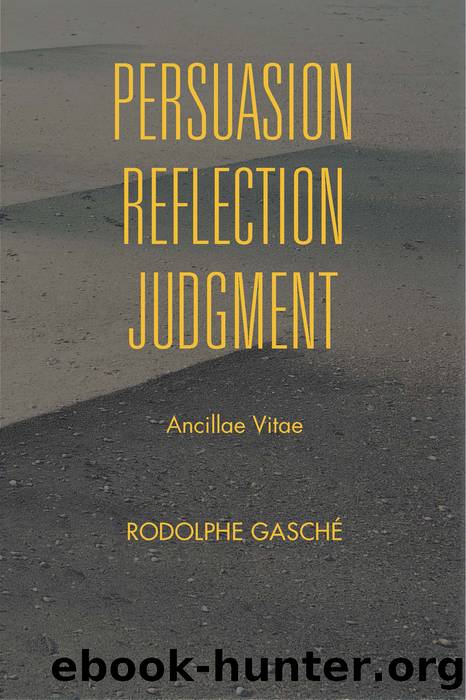
Author:Rodolphe Gasché
Language: eng
Format: epub
Publisher: Indiana University Press
Published: 2017-06-14T16:00:00+00:00
PART III
JUDGMENT (ARENDT)
IN A LETTER from 1955, Hannah Arendt confides to Karl Jaspers that she intends to call a planned “book on political theories, ‘Amor Mundi.’”1 Several scholars, among them Elisabeth Young-Bruehl, have held that this book is none other than The Human Condition.2 Indeed, it was the first book to be published in the aftermath of the letter to Jaspers.3 As Ursula Ludz has convincingly pointed out, however, when Arendt spoke to Jaspers about the title in question, neither The Human Condition nor her Introduction into Politics were in progress at the time. Ludz, therefore, writes: “With ‘the book on political theories,’ Arendt referred to a complex of studies that gave rise, first, to the publication of The Human Condition (1958), followed by Between Past and Future (1961), and finally On Revolution (1963), and to which also the non-written ‘Introduction into Politics’ belongs.”4 This assessment not only seems to make sense historically; it also takes into consideration Arendt’s mounting interest in the political during that period. This interest and the emerging project of developing a new theory of politics coincide with the aftermath of the devastating events and extreme conditions that marked the first half of the twentieth century. As Arendt admits in the letter to Jaspers, she chose the title ‘Amor Mundi’ out of thankfulness for having finally, however belatedly, “begun to love the world.”5 Undoubtedly, the atrocities that characterize the first half of the twentieth century explain Arendt’s reservations regarding the world. But the reference to the love of the world in the context of her projected work on politics also shows that this love is inherently interconnected with the political or, more precisely, with her rediscovery of the political. The world to which she refers is primarily the public world, the world as the space of the political. The world is the space within which the political unfolds, and it is also the very objective of the political, that is, what the political intends to realize. Indeed, the world that the political presupposes might not yet be something fully established and might never even be a positive and certain reality. For it to become real, love might have to complete it. The world might require love of the world in order to be able to maintain itself as world. But Arendt’s love of the world might also be a love for something whose realization has not yet occurred. If the world is both the condition and the telic end of politics, then love for the world is a love for something that must be produced in the first place. To love the world, then, is a commitment to bringing it about and to securing the life that it alone makes possible.
But why ‘love’? As Young-Bruehl observes, Arendt wanted to call her projected book on political theory Amor Mundi because she rejected the philosophical tradition of contemptus mundi.6 Love of the world thus implies, from the start, a turn away from the philosophical tradition and a rehabilitation of the political as, not a part of philosophy, but a kind of alternative discourse distinct from it.
Download
This site does not store any files on its server. We only index and link to content provided by other sites. Please contact the content providers to delete copyright contents if any and email us, we'll remove relevant links or contents immediately.
| Anthropology | Archaeology |
| Philosophy | Politics & Government |
| Social Sciences | Sociology |
| Women's Studies |
The remains of the day by Kazuo Ishiguro(9094)
Tools of Titans by Timothy Ferriss(8501)
Giovanni's Room by James Baldwin(7441)
The Black Swan by Nassim Nicholas Taleb(7200)
Inner Engineering: A Yogi's Guide to Joy by Sadhguru(6839)
The Way of Zen by Alan W. Watts(6674)
The Power of Now: A Guide to Spiritual Enlightenment by Eckhart Tolle(5856)
Asking the Right Questions: A Guide to Critical Thinking by M. Neil Browne & Stuart M. Keeley(5838)
The Six Wives Of Henry VIII (WOMEN IN HISTORY) by Fraser Antonia(5560)
Astrophysics for People in a Hurry by Neil DeGrasse Tyson(5227)
Housekeeping by Marilynne Robinson(4507)
Double Down (Diary of a Wimpy Kid Book 11) by Jeff Kinney(4339)
12 Rules for Life by Jordan B. Peterson(4333)
Ikigai by Héctor García & Francesc Miralles(4313)
The Ethical Slut by Janet W. Hardy(4311)
Skin in the Game by Nassim Nicholas Taleb(4311)
The Art of Happiness by The Dalai Lama(4170)
Skin in the Game: Hidden Asymmetries in Daily Life by Nassim Nicholas Taleb(4053)
Walking by Henry David Thoreau(4004)
