Personal Autonomy and Social Oppression: Philosophical Perspectives (Routledge Studies in Contemporary Philosophy) by Marina A. L. Oshana
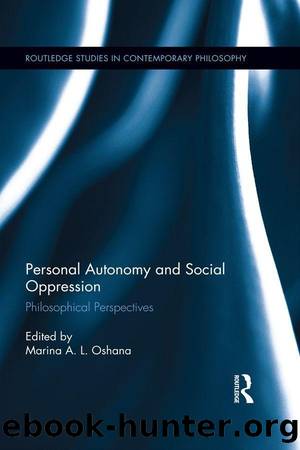
Author:Marina A. L. Oshana [Oshana, Marina A. L.]
Language: eng
Format: epub
ISBN: 9781135036089
Publisher: Taylor and Francis
Published: 2014-11-12T21:00:00+00:00
4. Psychological Freedom
I argued in the previous section that Oshanaâs view is underinclusive because it does not provide an account of the apparent impairments of autonomy in agents like Williams who have practical control over their daily routines yet whose wills are often constrained by distorted self-conceptions that are due to oppressive scripts. In this section, I propose that distorted self-conceptions undermine autonomy because they are impairments of psychological freedom. Oppressive social scripts are âinternalizedâ or manifest themselves in the psychologies of members of oppressed groups in a way that is analogous to standard impediments to psychological freedom. Like pathological and agent-related impediments, social scripts interfere with the agentâs freedom to will otherwise. I first explain that it is the interrelation between the social and the psychological that is left out of Oshanaâs account and that is responsible for the impairment of psychological freedom in Williamsâs example. I then develop the argument that oppressive scripts undermine psychological freedom.
Although I have suggested that Oshanaâs theory is underinclusive, it is more common to argue that it is overinclusive. For instance, Robert Noggle claims that, although Oshanaâs account seems an apt explanation of certain intuitions, there are others that seem to run counter to it. On her account, constraining external conditions ipso facto undermine autonomy. But consider figures such as Rosa Parks, Martin Luther King Jr., or Nelson Mandela. These figures articulated and acted on life-projects that were dedicated to resistance to the oppression to which they were subjected. Noggle suggests that they provide counterexamples to Oshanaâs view. He claims that their status as resistors indicates that they are engaged in self-rule despite the external impediments to which they were subjected (Noggle 2011).
I do not believe that Noggleâs objection is decisive. The intuition that a life of resistance is an autonomous life assumes that when one authentically constitutes oneself as a resistor, this is sufficient for autonomy. However, assuming for the sake of argument that authenticity is a necessary condition of autonomy, there is reason to think that it is not sufficient. Even theorists who propose that authenticity is the core of autonomy introduce additional conditions. For Friedman, self-reflective affirmation is necessary but not sufficient for autonomy; she adds that self-reflection âmust be relatively unimpeded by conditions, such as coercion, deception and manipulationâ (Friedman 2003, p. 14). Similarly, Christman claims that autonomy can be undermined if the agentâs reflection is distorted in some way, for instance, by âconstriction, pathology or manipulationâ or âbeing denied minimal education and exposure to alternativesâ (Christman 2009, pp. 147, 155). Although it is not fully clear on these theories how these additional conditions are to be spelled out, and in particular whether spelling them out would require the introduction of moral criteria,9 it is possible that people subject to apartheid or Jim Crow laws would not meet these additional conditions. Thus, even on these standard authenticity theories, the autonomy of agents living under institutions of subordination could be called into question.
Noggleâs objection does bring to light a feature
Download
This site does not store any files on its server. We only index and link to content provided by other sites. Please contact the content providers to delete copyright contents if any and email us, we'll remove relevant links or contents immediately.
| Anthropology | Archaeology |
| Philosophy | Politics & Government |
| Social Sciences | Sociology |
| Women's Studies |
The remains of the day by Kazuo Ishiguro(9130)
Tools of Titans by Timothy Ferriss(8535)
Giovanni's Room by James Baldwin(7478)
The Black Swan by Nassim Nicholas Taleb(7229)
Inner Engineering: A Yogi's Guide to Joy by Sadhguru(6856)
The Way of Zen by Alan W. Watts(6698)
The Power of Now: A Guide to Spiritual Enlightenment by Eckhart Tolle(5886)
Asking the Right Questions: A Guide to Critical Thinking by M. Neil Browne & Stuart M. Keeley(5860)
The Six Wives Of Henry VIII (WOMEN IN HISTORY) by Fraser Antonia(5581)
Astrophysics for People in a Hurry by Neil DeGrasse Tyson(5249)
Housekeeping by Marilynne Robinson(4525)
Double Down (Diary of a Wimpy Kid Book 11) by Jeff Kinney(4359)
12 Rules for Life by Jordan B. Peterson(4357)
Ikigai by Héctor García & Francesc Miralles(4349)
Skin in the Game by Nassim Nicholas Taleb(4337)
The Ethical Slut by Janet W. Hardy(4326)
The Art of Happiness by The Dalai Lama(4196)
Skin in the Game: Hidden Asymmetries in Daily Life by Nassim Nicholas Taleb(4079)
Walking by Henry David Thoreau(4036)
