Oxford Companion to Philosophy by Honderich Ted;
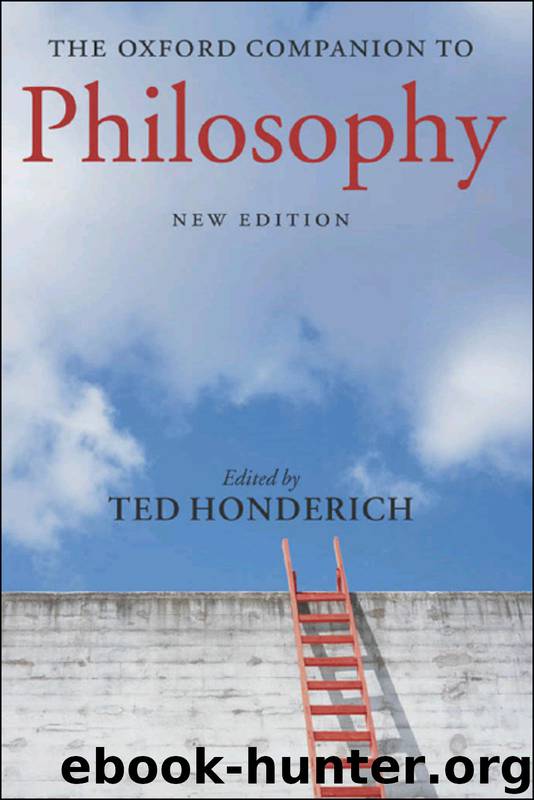
Author:Honderich, Ted;
Language: eng
Format: epub
Publisher: Oxford University Press, UK
Published: 2005-04-14T04:00:00+00:00
(1) Every X is a Y and a Z.
No Y is a W.
Therefore no X is a W.
(Thus for the first, X = fifty-pence piece, Y = large coin, Z = seven-sided object, W = thing that this machine will take.) This form (1) is an argument schema; it has schematic letters in it, and it becomes an argument when we translate the letters into phrases. Moreover, every argument got from the schema in this way is valid: the conclusion (after ‘Therefore’) does follow from the premisses (the sentences before ‘Therefore’). So we call (1) a valid argument schema.
Likewise some statements are true purely by virtue of their form and hence are logically valid. We can write down a statement schema to show the form, for example:
If p and q then p.
Here the schematic letters p, q have to be translated into clauses; but whatever clauses we use, the resulting sentence must be true. Such a schema is logically valid; we can regard it as a valid argument schema with no pre-misses.
What does it mean to say that a particular argument, expressed in English, has a particular argument schema as its form? Unfortunately this question has no exact answer. As we saw in the examples above, the words in an argument can be rearranged or paraphrased to bring out the form. Words can be replaced by synonyms too; an argument doesn’t become invalid because it says ‘gramo-phone’ at one point and ‘record-player’ at another. For the last 100 years or more, it has been usual to split logic into an exact part which deals with precisely defined argument schemas, and a looser part which has to do with translating arguments into their logical *form.
This looser part has been very influential in philosophy. One doctrine—we may call it the logical form doctrine— states that every proposition or sentence has a logical form, and the logical forms of arguments consist of the logical forms of the sentences occurring in them. In the early years of the century Russell and Wittgenstein put forward this doctrine in a way which led to the programme of *analytic philosophy: analysing a proposition was regarded as uncovering its logical form. Chomsky has argued that each sentence of a natural language has a structure which can be analysed at several levels, and one of these levels is called LF for logical form—roughly speaking, this level carries the meaning of the sentence. However, Chomsky’s reasons for this linguistic analysis have nothing to do with the forms of valid arguments, though his analysis does use devices from logic, such as quantifiers and variables. One can hope for a general linguistic theory which gives each natural-language sentence a logical form that explains its meaning and also satisfies the logical form doctrine; logicians such as Montague and his student Kamp have made important suggestions in this direction, but the goal is still a long way off.
Let us turn to the more exact part of logic. Experience shows that in valid argument schemas
Download
This site does not store any files on its server. We only index and link to content provided by other sites. Please contact the content providers to delete copyright contents if any and email us, we'll remove relevant links or contents immediately.
| Anthropology | Archaeology |
| Philosophy | Politics & Government |
| Social Sciences | Sociology |
| Women's Studies |
The remains of the day by Kazuo Ishiguro(8969)
Tools of Titans by Timothy Ferriss(8363)
Giovanni's Room by James Baldwin(7320)
The Black Swan by Nassim Nicholas Taleb(7105)
Inner Engineering: A Yogi's Guide to Joy by Sadhguru(6785)
The Way of Zen by Alan W. Watts(6600)
Asking the Right Questions: A Guide to Critical Thinking by M. Neil Browne & Stuart M. Keeley(5757)
The Power of Now: A Guide to Spiritual Enlightenment by Eckhart Tolle(5746)
The Six Wives Of Henry VIII (WOMEN IN HISTORY) by Fraser Antonia(5496)
Astrophysics for People in a Hurry by Neil DeGrasse Tyson(5181)
Housekeeping by Marilynne Robinson(4436)
12 Rules for Life by Jordan B. Peterson(4299)
Double Down (Diary of a Wimpy Kid Book 11) by Jeff Kinney(4259)
The Ethical Slut by Janet W. Hardy(4241)
Ikigai by Héctor García & Francesc Miralles(4240)
Skin in the Game by Nassim Nicholas Taleb(4235)
The Art of Happiness by The Dalai Lama(4125)
Skin in the Game: Hidden Asymmetries in Daily Life by Nassim Nicholas Taleb(3987)
Walking by Henry David Thoreau(3952)
