On Compromise and Rotten Compromises by Margalit Avishai;
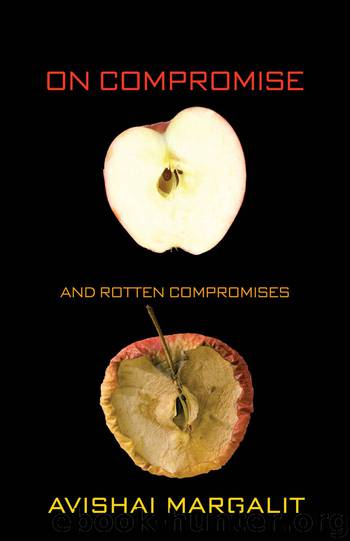
Author:Margalit, Avishai;
Language: eng
Format: epub
Publisher: Princeton University Press
“Come What May”
Whether to reach a compromise is left for us to decide. But what is not left to us, morally, is to decide whether to reach a rotten compromise. We face a stringent injunction: Thou shall not commit a rotten compromise, come what may.
But what is the force of the “come what may” clause?
It seems that the “come what may” clause is very strong, not just rhetorically, but also normatively. Normative Judaism recognizes injunctions specially designed for times of persecution. In such times, one is reduced to obeying the minimum required for moral (religious) life. According to Jewish law one should not give in to three imperatives, come what may: murder, incest, and idolatry. The “come what may” clause means that one should be ready to be killed rather than transgress the three requirements just mentioned. These are the Jewish imperatives for behavior under duress.
But what if an individual transgresses and kills an innocent to save his own life? Is he a murderer who should be punished by death? The right attitude toward a person who under duress kills an innocent to save his own life is subject to controversy. In Maimonides’ view, the issue is clear: one should not be punished by law. “It need not be said that he is not executed by a court of law even if he was forced to commit murder.”23
The idea is that although one is never justified in killing the innocent, even under duress, the circumstances are such that we can understand him. There is a normative expectation that one would obey the injunction and be killed rather than transgress. But there is an empirical observation that one may fail by finding the pressure too much to bear. The attitude is this: We understand. We do not justify and we do not even excuse, but we understand. We understand one’s failure, knowing that we might fail in similar circumstances. Hence it is not for us to punish the transgressor. At most, we are entitled to feel disappointed that the person did not resist, but we are not entitled to punish.
This complicated attitude of hoping for the best and expecting the worst could serve us well in how to react toward one who has made a rotten compromise. Understanding is less than excusing and forgiving. It is, however, based on an intense recognition of human frailty and vulnerability. For that, I turned to religious moral experience. It has an advantage over secular morality in that it recognizes human frailty as an essential element of morality. Indeed, the attitude I advocate with regard to rotten compromise is that making a rotten compromise as a passive partner cannot be justified—in the sense that I am committed to the “come what may” clause—but it may nonetheless be understood and even excused.
The “come what may” clause is caught between two conflicting positions. On the one hand, we recognize that cruelty and humiliation are fundamentally evil. Their avoidance is constitutive of the moral order itself, and so
Download
This site does not store any files on its server. We only index and link to content provided by other sites. Please contact the content providers to delete copyright contents if any and email us, we'll remove relevant links or contents immediately.
| Anthropology | Archaeology |
| Philosophy | Politics & Government |
| Social Sciences | Sociology |
| Women's Studies |
The remains of the day by Kazuo Ishiguro(9004)
Tools of Titans by Timothy Ferriss(8403)
Giovanni's Room by James Baldwin(7352)
The Black Swan by Nassim Nicholas Taleb(7137)
Inner Engineering: A Yogi's Guide to Joy by Sadhguru(6798)
The Way of Zen by Alan W. Watts(6621)
The Power of Now: A Guide to Spiritual Enlightenment by Eckhart Tolle(5788)
Asking the Right Questions: A Guide to Critical Thinking by M. Neil Browne & Stuart M. Keeley(5779)
The Six Wives Of Henry VIII (WOMEN IN HISTORY) by Fraser Antonia(5518)
Astrophysics for People in a Hurry by Neil DeGrasse Tyson(5195)
Housekeeping by Marilynne Robinson(4455)
12 Rules for Life by Jordan B. Peterson(4308)
Double Down (Diary of a Wimpy Kid Book 11) by Jeff Kinney(4277)
Ikigai by Héctor García & Francesc Miralles(4277)
The Ethical Slut by Janet W. Hardy(4261)
Skin in the Game by Nassim Nicholas Taleb(4256)
The Art of Happiness by The Dalai Lama(4132)
Skin in the Game: Hidden Asymmetries in Daily Life by Nassim Nicholas Taleb(4012)
Walking by Henry David Thoreau(3966)
