Number; The Language of Science by Tobias Dantzig
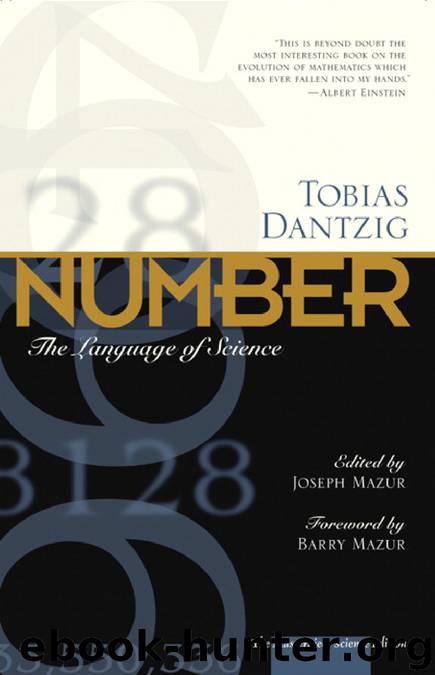
Author:Tobias Dantzig [Dantzig, Tobias]
Language: eng
Format: epub
Published: 2011-02-17T05:00:00+00:00
Dantzig_Ch_10.qxd 2/17/05 2:11 PM Page 195
The Domain of Number
195
It was surmised by Girard early in the seventeenth century
that what was true for equations of the first four degrees was
generally true; and in the middle of the eighteenth century
d’Alembert formulated it in the statement that any algebraic
equation must possess at least one solution real or complex. He,
however, was unable to prove this assertion rigorously, and in
spite of the efforts of many who followed him it remained a pos-
tulate for another fifty years.
This assertion recalls the other statement: any equation can
be solved by means of radicals. This, too, we saw, was considered
obvious by many mathematicians even in the days of Lagrange.
Yet the comparison is unfair: here the generalization was of the
type called incomplete induction, and the falsity of the proposition
only brought out in relief the danger of this method. Entirely
different is the intuition which led to d’Alembert’s postulate.
This intuition is reflected in all the proofs of this fundamental
theorem of algebra that have been given since the days of
d’Alembert; namely, d’Alembert’s, Euler’s, and Lagrange’s insuffi-
cient demonstrations; the proofs which Argand gave for it in 1806
and 1816; the four proofs by which the great Gauss established the
proposition; and all subsequent improvements on these latter.
Different though these proofs are in principle, they all possess
one feature in common. Somewhere, somehow,—sometimes
openly, sometimes implicitly—the idea of continuity is intro-
duced, an idea which is foreign to algebra, an idea which belongs
to the realm of analysis.
Let me explain this by a simple example. If we set Z = z 2 + 1
and z = x + iy, we obtain upon substitution Z = ( x 2 – y 2 + 1) +
i(2 xy). Now when x and y vary in a continuous manner and assume all possible values between –∞ and +∞, the expressions
within the parentheses will also assume all possible values
Download
This site does not store any files on its server. We only index and link to content provided by other sites. Please contact the content providers to delete copyright contents if any and email us, we'll remove relevant links or contents immediately.
Modelling of Convective Heat and Mass Transfer in Rotating Flows by Igor V. Shevchuk(6507)
Weapons of Math Destruction by Cathy O'Neil(6401)
Factfulness: Ten Reasons We're Wrong About the World – and Why Things Are Better Than You Think by Hans Rosling(4812)
A Mind For Numbers: How to Excel at Math and Science (Even If You Flunked Algebra) by Barbara Oakley(3357)
Descartes' Error by Antonio Damasio(3351)
Factfulness_Ten Reasons We're Wrong About the World_and Why Things Are Better Than You Think by Hans Rosling(3283)
TCP IP by Todd Lammle(3244)
Fooled by Randomness: The Hidden Role of Chance in Life and in the Markets by Nassim Nicholas Taleb(3189)
The Tyranny of Metrics by Jerry Z. Muller(3147)
Applied Predictive Modeling by Max Kuhn & Kjell Johnson(3130)
The Book of Numbers by Peter Bentley(3021)
The Great Unknown by Marcus du Sautoy(2746)
Once Upon an Algorithm by Martin Erwig(2703)
Easy Algebra Step-by-Step by Sandra Luna McCune(2686)
Lady Luck by Kristen Ashley(2626)
Police Exams Prep 2018-2019 by Kaplan Test Prep(2616)
Practical Guide To Principal Component Methods in R (Multivariate Analysis Book 2) by Alboukadel Kassambara(2589)
Linear Time-Invariant Systems, Behaviors and Modules by Ulrich Oberst & Martin Scheicher & Ingrid Scheicher(2462)
All Things Reconsidered by Bill Thompson III(2448)
