Nietzsche As Philosopher by Danto Arthur Coleman;
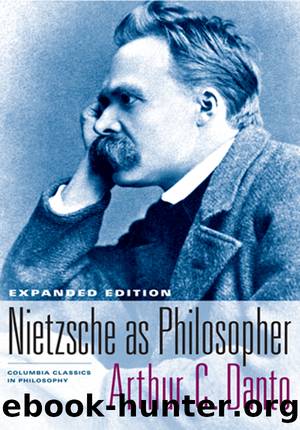
Author:Danto, Arthur Coleman;
Language: eng
Format: epub
Tags: PHI036000, Philosophy/Hermeneutics, PHI000000, Philosophy/General
Publisher: Lightning Source Inc. (Tier 3)
Published: 2005-02-22T16:00:00+00:00
V
If we are to find our way safely through the heartland of popular Nietzschean philosophy—his doctrine of master and slave morality, his references to cruelty, suffering, blond beasts, supermen, and the like—we must go equipped with some clear understanding of his theory of passions, however unclear in itself that theory may be.
We must first state the way in which Nietzsche sees us, even though this is familiar enough by now. Each of us is a cluster of drives and appetites and passions, and whatever we do or think is to be explained with reference to these drives. They give us our momentum and direction. Of these, however, few are identified in language or come to consciousness at all. We are likely to give false accounts of those that do, connecting them up with one another (as the prisoners did with the shadows in Plato’s famous cave) rather than relating them to the seething undersurface of the mind. Conscious of little, and often wrong about that of which we are conscious, we have scant understanding of what we are or why we act. Insofar as we may speak of our reality, or what we really are, this will be the bundle of passions of which we consist. To some extent this becomes systematically clear only in connection with the Will-to-Power theory; but Nietzsche is making the assumption that “Nothing is ‘given’ as real other than the world of our passions and drives; and that we can ascend or descend to no different ‘reality’ than the reality of these drives.”48 The extent to which Nietzsche quite literally means this—that nothing else is real—will, I hope, become plain by the end of this study.
Two further assumptions must now be made. The first is that each individual is endowed with more or less the same set of drives, but the drives will vary in intensity from individual to individual. In some they may be weak to the point of inappetency; and in others they may be strong to the point of obsessiveness. The second is that nothing, short of killing or maiming an individual, may be done to increase or decrease the strength of these passions. We must understand this assumption, however poorly characterized, as some sort of conservational principle. A given drive D of a given strength S will manifest itself in different ways depending upon the different social circumstances in which the individual, whose drive it is, happens to have been raised, and relative to the morality which prevails in that society. Consider a man who has a strong sexual drive. In certain circumstances he will be able to exercise this drive almost as freely as he might wish; for example, if he owns a harem, or is a member of a conquering army with free access to the women of the vanquished force, or lives in a Bohemian society with relaxed standards of sexual conduct. Now imagine this person in an extremely puritanical situation, where extreme sanctions are attached to sexual action.
Download
This site does not store any files on its server. We only index and link to content provided by other sites. Please contact the content providers to delete copyright contents if any and email us, we'll remove relevant links or contents immediately.
| Anthropology | Archaeology |
| Philosophy | Politics & Government |
| Social Sciences | Sociology |
| Women's Studies |
The remains of the day by Kazuo Ishiguro(9220)
Tools of Titans by Timothy Ferriss(8593)
Giovanni's Room by James Baldwin(7543)
The Black Swan by Nassim Nicholas Taleb(7274)
Inner Engineering: A Yogi's Guide to Joy by Sadhguru(6889)
The Way of Zen by Alan W. Watts(6732)
The Power of Now: A Guide to Spiritual Enlightenment by Eckhart Tolle(5918)
Asking the Right Questions: A Guide to Critical Thinking by M. Neil Browne & Stuart M. Keeley(5895)
The Six Wives Of Henry VIII (WOMEN IN HISTORY) by Fraser Antonia(5608)
Astrophysics for People in a Hurry by Neil DeGrasse Tyson(5276)
Housekeeping by Marilynne Robinson(4580)
Double Down (Diary of a Wimpy Kid Book 11) by Jeff Kinney(4407)
Ikigai by Héctor García & Francesc Miralles(4388)
Skin in the Game by Nassim Nicholas Taleb(4381)
12 Rules for Life by Jordan B. Peterson(4376)
The Ethical Slut by Janet W. Hardy(4348)
The Art of Happiness by The Dalai Lama(4232)
Skin in the Game: Hidden Asymmetries in Daily Life by Nassim Nicholas Taleb(4124)
Walking by Henry David Thoreau(4075)
