Nietzsche and Sociology by Karzai Anas;
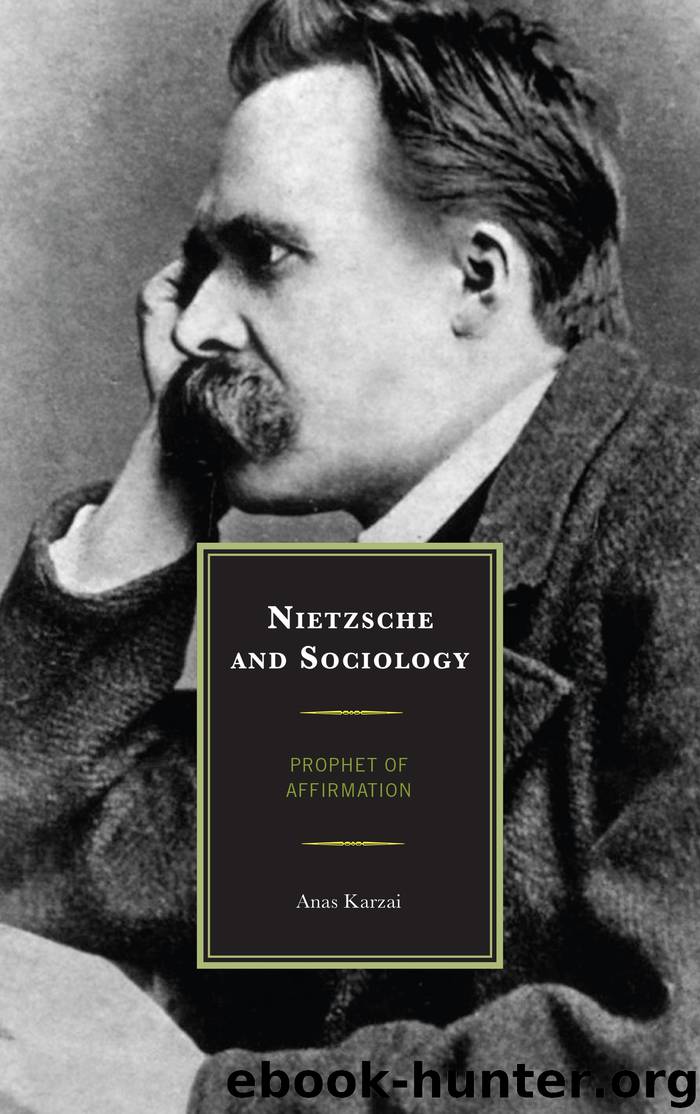
Author:Karzai, Anas;
Language: eng
Format: epub
Tags: undefined
Publisher: Rowman & Littlefield Publishing
Published: 2012-03-06T16:00:00+00:00
All in all, Nietzsche saw positivism’s rendition of the appearance of reality as a metaphysical construct, one that denied the meaning of our sense experience of everyday life.
However, for Durkheim, positivism was the undoing of domination and was therefore a method of reformation and transformation. However, contrary to Durkheim, Ben Agger has argued: “Positivism transforms history into ontology, [with its] bureaucratic divisions of labor, patriarchal family, religion, possessive individualism compensated by accumulation and de-sublimation, [and] the inauthenticities of late capitalism that recycle desire and profit by stating it” (Agger 1989, 16).
Durkheim’s sociology was an alliance between Catholicism and rational scientific procedures. Unlike Nietzsche’s “sovereign individual” who commanded and created, Durkheim’s moral subject was forced, through mechanical solidarity, to resign to the industrial order of things. He was merely a functional member, and his utility was to show loyalty to the commonality, following public opinion as a base for social knowledge.
Durkheim’s positivist sociology used scientific methodologies to perceive and construct the human environment. It imposed sets of categories on the world we live in. His objective in the Rules was to make sociology a particular science—a science that sought to explain and treat the social world as objectively and as independently as possible, divorced from the influence of the individual’s subjective faculty. Any science of society had “several paths leading to a given goal, and a choice must therefore be made between them. Now if science cannot assist us in choosing the best goal, how can it indicate the best path to follow to arrive at a goal?” (Durkheim [1893] 1982, 86; emphasis added).
The conflict between the normal and the pathological, the sane and the insane, was not a hypothesis for Durkheim, but a proposition that laid claim to the objective findings or the measured results of his best goal. There could be rules for distinguishing normal and pathological. His distinction between these two concepts would adhere to the grammatical rules of language, imposed on the concepts and on the usefulness and utility of the social meaning of these concepts. What was needed for objectively determining this distinction was to radically separate and identify the two qualities in terms of the role played by adaptation to the normative structure of society, that is, to the shared moral values of the collective. If adaptation to the normative order of social structure did not come in the form of integration, then a scientist, according to Durkheim, was able to know the distinction between normal and the pathological, between the successfully integrated people in society and the anomic, the social outcasts. “In any case, we should need to be informed of the principle to decide whether one particular mode of adaptation is more ‘perfect’ than another” (Durkheim [1893] 1982, 88).
Durkheim’s functionalism was not concerned with questioning the conditions through which these categories themselves first emerged. For example, Durkheim’s Rules did not question the concepts of utility and purpose in individual motivation. In fact, his scientific language allowed for imposing identity onto all social phenomena.
Download
This site does not store any files on its server. We only index and link to content provided by other sites. Please contact the content providers to delete copyright contents if any and email us, we'll remove relevant links or contents immediately.
| Anthropology | Archaeology |
| Philosophy | Politics & Government |
| Social Sciences | Sociology |
| Women's Studies |
The remains of the day by Kazuo Ishiguro(9112)
Tools of Titans by Timothy Ferriss(8519)
Giovanni's Room by James Baldwin(7462)
The Black Swan by Nassim Nicholas Taleb(7218)
Inner Engineering: A Yogi's Guide to Joy by Sadhguru(6847)
The Way of Zen by Alan W. Watts(6689)
The Power of Now: A Guide to Spiritual Enlightenment by Eckhart Tolle(5874)
Asking the Right Questions: A Guide to Critical Thinking by M. Neil Browne & Stuart M. Keeley(5852)
The Six Wives Of Henry VIII (WOMEN IN HISTORY) by Fraser Antonia(5569)
Astrophysics for People in a Hurry by Neil DeGrasse Tyson(5241)
Housekeeping by Marilynne Robinson(4520)
Double Down (Diary of a Wimpy Kid Book 11) by Jeff Kinney(4354)
12 Rules for Life by Jordan B. Peterson(4351)
Ikigai by Héctor García & Francesc Miralles(4335)
Skin in the Game by Nassim Nicholas Taleb(4324)
The Ethical Slut by Janet W. Hardy(4315)
The Art of Happiness by The Dalai Lama(4184)
Skin in the Game: Hidden Asymmetries in Daily Life by Nassim Nicholas Taleb(4069)
Walking by Henry David Thoreau(4028)
