Maine De Biran's 'Of Immediate Apperception' by Maine de Biran;Alessandra Aloisi;Marco Piazza;
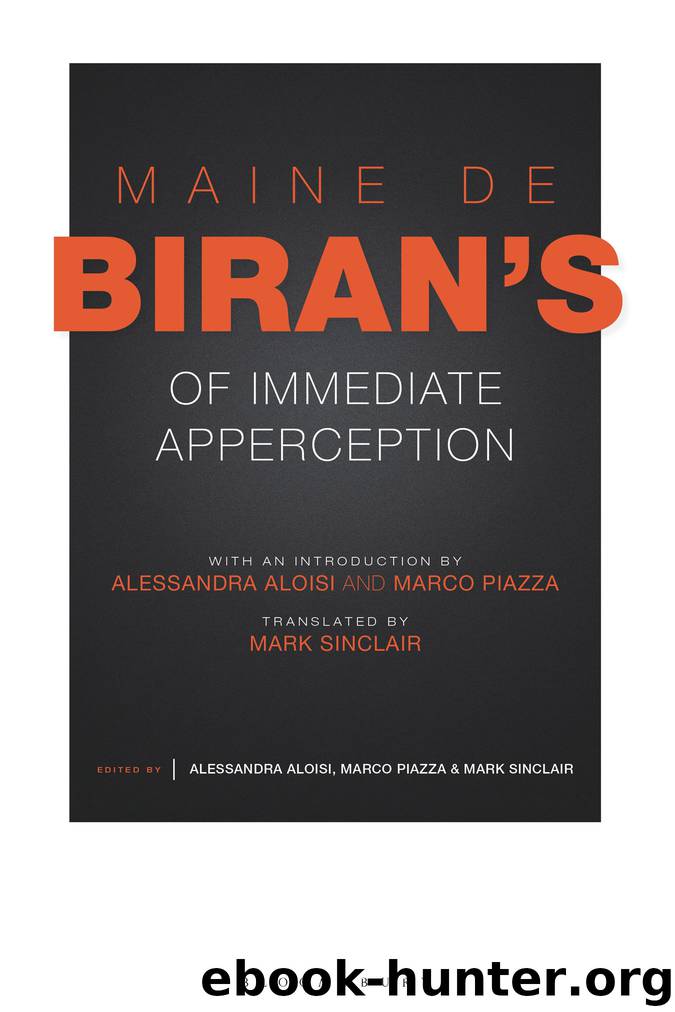
Author:Maine de Biran;Alessandra Aloisi;Marco Piazza;
Language: eng
Format: epub
ISBN: 9781350086210
Publisher: Bloomsbury UK
Published: 2019-11-14T00:00:00+00:00
§3
Hypothesis on the Origin of Personality and Internal Immediate Apperception
1.For as long as the brain or the organic centre (to which the physiologists attach immediately the motive impulsion) reacts on the impressions that provoke it and that come from the organs of interior life with which it is in a sympathetic relation, the instinctive movements produced by this reaction, remaining consequently unperceived by the individual person, which is not yet present, cannot in any sense be held to be voluntary.
For real knowledge, it is of little importance whether it is a vegetative, sensitive or thinking soul, a vital principle, or an organic centre that determines these blind movements! In any of these cases, it is merely a matter of a hypothesis, of a sign without an idea. It would perhaps be better to say, with Locke, that the soul does not yet act, since there is no will that is exercised, in concluding that there is a total absence of will from the absence of consciousness and apperception. One could also say that not only is this apperception not present in the organic movements, but also that the conditions for such a possible apperceptibility are not even present. In this way, we should note in passing, we could destroy an objection behind which the disciples of Stahl as well as Descartes can still hide.
2.At the point where the absolute and exclusive empire of instinct terminates, the affections weaken and the muscular resistance increases. The centre of motility begins spontaneous action by the vital energy developed in proportion to resistance, or even by a series of determinations that it might have contracted and the relations established between it and the mobile organs. And from this, muscular contractions result that are then felt or simply perceived. But up to that point, there is no willed effort, no genuine action.
3.Simple muscular sensation, becoming clearer to the degree that it is disengaged from the affective impressions that envelop it, is also distinctly transmitted to the common centre. The hyperorganic force, the soul – that it is necessary to admit here under the heading of noumenal or as an explicative, absolute, necessary cause, in considering it objectively in relation to the organic centre, as the physiologist considers this centre in relation to the motor nerves that it holds under its dependence – this soul, I say, notified and as if awakened26 by this first sensation, can consequently retain from it a sort of reproductive determination, comparable to the imperfect reminiscence that is still attached to the vague images of a dream, immediately after waking.
4.In virtue of the determination thus conceived, the soul will be able to repeat by itself and begin the right contractive action to bring about the muscular sensation. It will begin it, I say, in virtue of a principle of spontaneity (I do not quite say of freedom27) essential to it, and in the absence of a sensory cause of the excitation, whether external or internal, that could determine the organic and blind reaction of a centre of instinctive motility.
Download
This site does not store any files on its server. We only index and link to content provided by other sites. Please contact the content providers to delete copyright contents if any and email us, we'll remove relevant links or contents immediately.
| Anthropology | Archaeology |
| Philosophy | Politics & Government |
| Social Sciences | Sociology |
| Women's Studies |
The remains of the day by Kazuo Ishiguro(9120)
Tools of Titans by Timothy Ferriss(8531)
Giovanni's Room by James Baldwin(7477)
The Black Swan by Nassim Nicholas Taleb(7228)
Inner Engineering: A Yogi's Guide to Joy by Sadhguru(6856)
The Way of Zen by Alan W. Watts(6698)
The Power of Now: A Guide to Spiritual Enlightenment by Eckhart Tolle(5882)
Asking the Right Questions: A Guide to Critical Thinking by M. Neil Browne & Stuart M. Keeley(5858)
The Six Wives Of Henry VIII (WOMEN IN HISTORY) by Fraser Antonia(5574)
Astrophysics for People in a Hurry by Neil DeGrasse Tyson(5248)
Housekeeping by Marilynne Robinson(4524)
Double Down (Diary of a Wimpy Kid Book 11) by Jeff Kinney(4357)
12 Rules for Life by Jordan B. Peterson(4354)
Ikigai by Héctor García & Francesc Miralles(4347)
Skin in the Game by Nassim Nicholas Taleb(4335)
The Ethical Slut by Janet W. Hardy(4325)
The Art of Happiness by The Dalai Lama(4195)
Skin in the Game: Hidden Asymmetries in Daily Life by Nassim Nicholas Taleb(4074)
Walking by Henry David Thoreau(4036)
