Machiavelli and Epicureanism by Roecklein Robert J.;
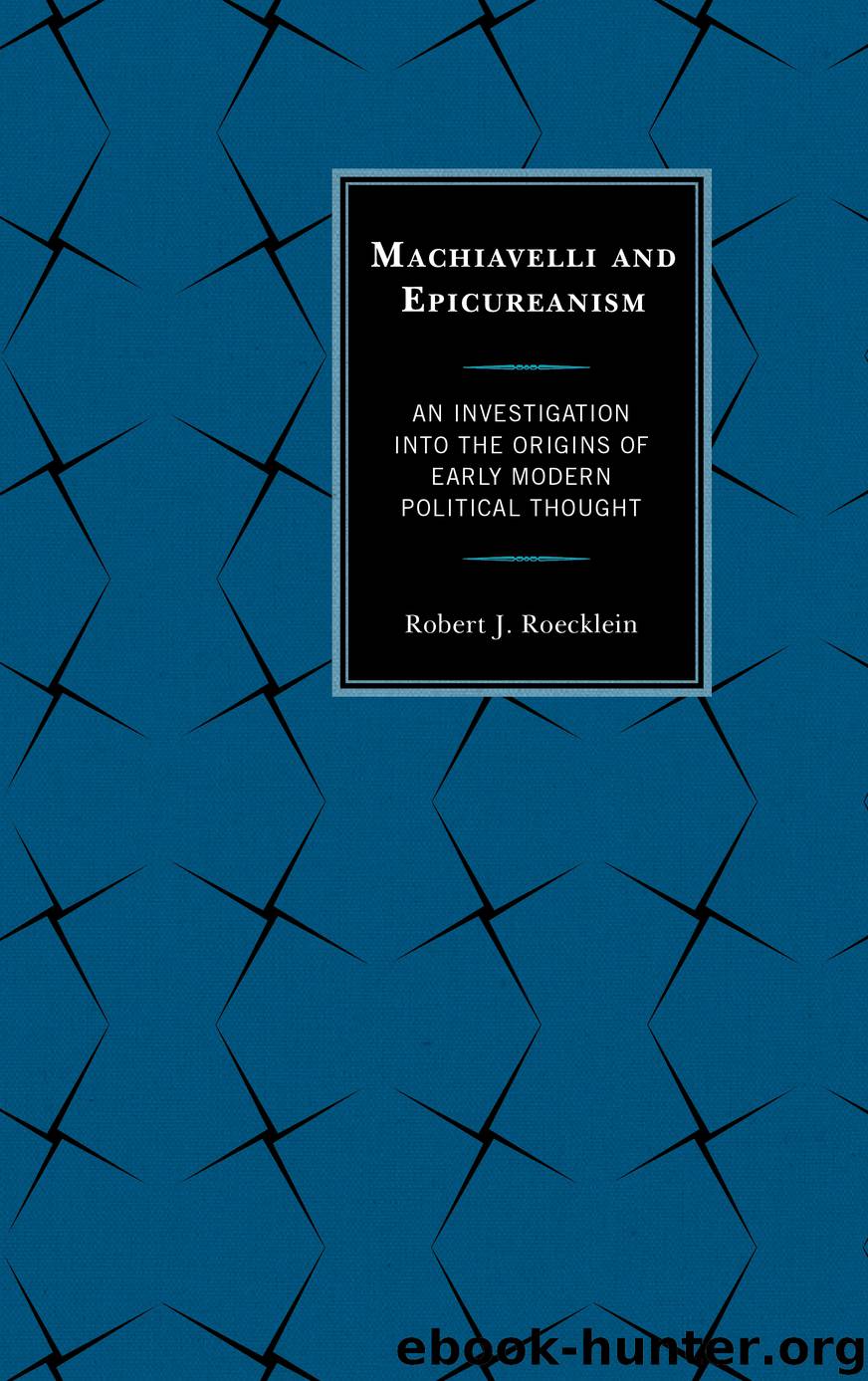
Author:Roecklein, Robert J.;
Language: eng
Format: epub
Tags: undefined
Publisher: Lexington Books
Published: 2012-02-28T16:00:00+00:00
Notes
1. For Plato’s views on Eros, one can consult book IX of the Republic. The many commentators who point to the Phaedrus and the Symposium as evidence of Plato’s beliefs on Eros have yet to adjust their interpretations to this towering statement in Plato’s most famous book. Homer shows the fickleness of Aphrodite’s passions all too well. Speaking to Helen, Aphrodite says: “wretched girl, do not tease me lest in anger I forsake you and grow to hate you as much as now I terribly love you; lest I encompass you in hard hate, caught between both sides, Danaans and Trojans alike, and you both perish” (Iliad 3.413). In the Odyssey, Helen talks to us candidly about the impact of Aphrodite on her affairs. “The rest of the Trojan women cried out shrill, but my heart was happy, my heart had changed by now and was for going back home again, and I grieved for the madness that Aphrodite had bestowed when she led me there from my own country, forsaking my own daughter, my bed chamber, and my husband, among who lacked no endowment of brain or beauty” (Od. 4.259). Cf. Anne Carson, Eros the Bittersweet. Princeton University Press, 1986, 9. Also A.S. Brown, “Aphrodite and the Pandora Complex.” Classical Quarterly 47(1997):38; and Ada Farber, “Segmentation of the Mother: Women in Greek Myth.” Psychoanalytic Review 62(1975):41-42. Also Elizabeth Asmis, “Lucretius’ Venus and Stoic Zeus.” Hermes 10(1982):466.
2. Scholars will rightly point out that Epicurus took pains to ensure that his own life would be celebrated in remembrance by his pupils and associates each year. Once again, however, the initiative belongs to the individual in the case of Epicurus. The annual celebrations of Epicurus’ life by his disciples is not so much focused on his life, as it is focused on his glory. Epicurus, that is, is celebrated as a god among men by his community; and to this extent, such a celebration is really not anchored in personal attachments.
3. “Things that we see have feelings consist of atoms that are devoid of feeling. Nor do things plainly known to us and manifest refute this or fight against it. Rather they take us by the hand and make us believe, that living things, as I say, are born from insentient atoms” (2.865). Philip De Lacy appears to be one true Epicurean believer. “Limit and Variation in Epicurean Philosophy.” Phoenix 23(1969):110.
4. Cf. Diskin Clay, “The Sources of Lucretius’ Inspiration.” In Monica Gale, editor. Oxford Readings in Classical Studies. Oxford University Press, 2007, 27, 31. Also James Nichols, Epicurean Political Philosophy: the De Rerum Natura of Lucretius. Ithaca: Cornell University Press, 1976, 19-20, 56.
5. Cf. E.J. Kenney. “The Texture of De Rerum Natura.” In Stuart Gillespie and Philip Hardie, editors. The Cambridge Companion to Lucretius. Cambridge University Press, 2007, 109-10. David Furley, “Lucretius and the History of Man,” in Companion to Lucretius, 163. Richard Minadeo, The Lyre of Science: Form and Meaning in Lucretius. Detroit: Wayne State University Press, 1969, 53. Charles Segal, Lucretius on Death and Anxiety: Poetry and Philosophy in De Rerum Natura.
Download
This site does not store any files on its server. We only index and link to content provided by other sites. Please contact the content providers to delete copyright contents if any and email us, we'll remove relevant links or contents immediately.
| Anthropology | Archaeology |
| Philosophy | Politics & Government |
| Social Sciences | Sociology |
| Women's Studies |
The remains of the day by Kazuo Ishiguro(9107)
Tools of Titans by Timothy Ferriss(8519)
Giovanni's Room by James Baldwin(7461)
The Black Swan by Nassim Nicholas Taleb(7218)
Inner Engineering: A Yogi's Guide to Joy by Sadhguru(6846)
The Way of Zen by Alan W. Watts(6689)
The Power of Now: A Guide to Spiritual Enlightenment by Eckhart Tolle(5874)
Asking the Right Questions: A Guide to Critical Thinking by M. Neil Browne & Stuart M. Keeley(5852)
The Six Wives Of Henry VIII (WOMEN IN HISTORY) by Fraser Antonia(5569)
Astrophysics for People in a Hurry by Neil DeGrasse Tyson(5241)
Housekeeping by Marilynne Robinson(4519)
Double Down (Diary of a Wimpy Kid Book 11) by Jeff Kinney(4354)
12 Rules for Life by Jordan B. Peterson(4350)
Ikigai by Héctor García & Francesc Miralles(4334)
Skin in the Game by Nassim Nicholas Taleb(4321)
The Ethical Slut by Janet W. Hardy(4315)
The Art of Happiness by The Dalai Lama(4184)
Skin in the Game: Hidden Asymmetries in Daily Life by Nassim Nicholas Taleb(4069)
Walking by Henry David Thoreau(4028)
