Linux Journal December 2018 by Linux Journal
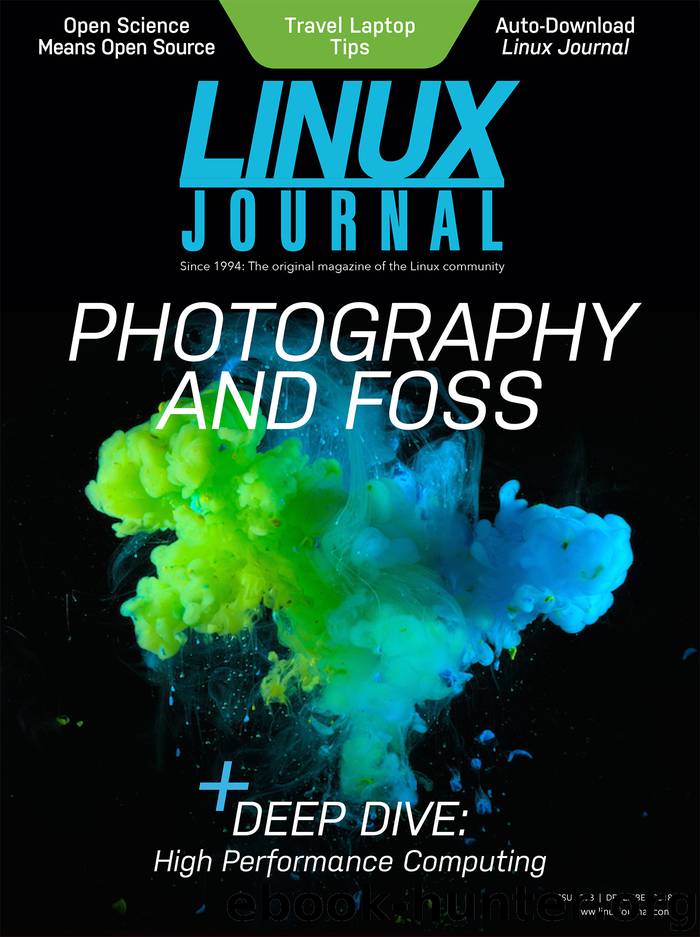
Author:Linux Journal
Language: eng
Format: mobi, epub
Tags: Linux
Publisher: Linux Journal LLC
Published: 2018-11-26T06:00:00+00:00
Linux and Supercomputers
As we sit here, in the year Two Thousand and Eighteen (better known as "the future, where the robots live"), our beloved Linux is the undisputed king of supercomputing. Of the top 500 supercomputers in the world, approximately zero of them don't run Linux (give or take...zero). By Bryan Lunduke
The most complicated, powerful computers in the world—performing the most intense processing tasks ever devised by man—all rely on Linux. This is an amazing feat for the little Free Software Kernel That Could, and one heck of a great bragging point for Linux enthusiasts and developers across the globe.
But it wasn't always this way.
In fact, Linux wasn't even a blip on the supercomputing radar until the late 1990s. And, it took another decade for Linux to gain the dominant position in the fabled "Top 500" list of most powerful computers on the planet.
A Long, Strange Road
To understand how we got to this mind-blowingly amazing place in computing history, we need to go back to the beginning of "big, powerful computers"—or at least, much closer to it: the early 1950s.
Tony Bennett and Perry Como ruled the airwaves, The Day The Earth Stood Still was in theaters, I Love Lucy made its television debut, and holy moly, does that feel like a long time ago.
In this time, which we've established was a long, long time ago, a gentleman named Seymour Cray—whom I assume commuted to work on his penny-farthing and rather enjoyed a rousing game of hoop and stick—designed a machine for the Armed Forces Security Agency, which, only a few years before (in 1949), was created to handle cryptographic and electronic intelligence activities for the United States military. This new agency needed a more powerful machine, and Cray was just the man (hoop and stick or not) to build it.
Download
This site does not store any files on its server. We only index and link to content provided by other sites. Please contact the content providers to delete copyright contents if any and email us, we'll remove relevant links or contents immediately.
The Mikado Method by Ola Ellnestam Daniel Brolund(27096)
Hello! Python by Anthony Briggs(25950)
Secrets of the JavaScript Ninja by John Resig Bear Bibeault(25287)
Kotlin in Action by Dmitry Jemerov(24397)
The Well-Grounded Java Developer by Benjamin J. Evans Martijn Verburg(23592)
Dependency Injection in .NET by Mark Seemann(23313)
OCA Java SE 8 Programmer I Certification Guide by Mala Gupta(21949)
Algorithms of the Intelligent Web by Haralambos Marmanis;Dmitry Babenko(20852)
Grails in Action by Glen Smith Peter Ledbrook(19870)
Adobe Camera Raw For Digital Photographers Only by Rob Sheppard(17074)
Sass and Compass in Action by Wynn Netherland Nathan Weizenbaum Chris Eppstein Brandon Mathis(16833)
Secrets of the JavaScript Ninja by John Resig & Bear Bibeault(14464)
Test-Driven iOS Development with Swift 4 by Dominik Hauser(12585)
Jquery UI in Action : Master the concepts Of Jquery UI: A Step By Step Approach by ANMOL GOYAL(11866)
A Developer's Guide to Building Resilient Cloud Applications with Azure by Hamida Rebai Trabelsi(10652)
Hit Refresh by Satya Nadella(9239)
The Kubernetes Operator Framework Book by Michael Dame(8588)
Exploring Deepfakes by Bryan Lyon and Matt Tora(8446)
Robo-Advisor with Python by Aki Ranin(8391)
