Illness: The Cry of the Flesh (The Art of Living) by Havi Carel
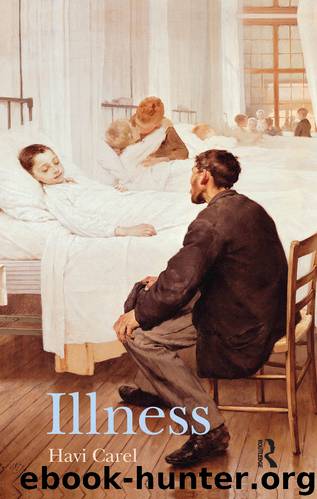
Author:Havi Carel [Carel, Havi]
Language: eng
Format: azw3
ISBN: 9781315487397
Publisher: Taylor and Francis
Published: 2016-09-16T16:00:00+00:00
BEING UNABLE TO BE
Heidegger characterizes human existence as "being able to be" (Seinkönnen). Human existence is characterized by its openness, potential, ability to become this or that thing. This underpins a powerful picture of human life: one can become what one wants (apart from certain physical and temporal limitations). If I wanted to be a polar explorer, I would have to train, build up my strength, learn to navigate and so on. Eventually, I would join a polar expedition and fulfil my plan, achieve my goal.
The plans and aims we have connect our present actions (for instance studying navigation) to a future view of ourselves as being able to do a particular thing (navigate to the North Pole). Present actions have meaning in virtue of being part of a project that is forward-looking, futural. I do something now in order to become something in the future. This definition of the human being is best understood by Heidegger's notion of projection. Projection means throwing oneself into a project, through which a human being's character and identity are enacted. If my project is being a teacher, I project myself accordingly by training to be a teacher, applying for teaching positions and so on. This, Heidegger claims, is the essence of human existence: the ability to be this or another thing, to assume a role as a teacher, a polar explorer and so on.
This view of the human being as becoming, as able to achieve her aims, as constantly changing according to the project she pursues, is appealing in many ways. It credits us with the freedom – and the responsibility – to become what we want, to shape ourselves and our lives in a way we find fulfilling: to transcend our present self with a future self that is more developed, more able. This progressive view of the person sees it as constantly changing, growing, developing. As Merleau-Ponty says, echoing Husserl's and Heidegger's approach, being in the world is not a matter of an "I think" but an "I can" (1962:137).
But what about the other part of life, the one in which we become gradually unable to do things, unable to be? What about decline and insufficiency? In the physical sense, this aspect of life is undoubtedly there. Someone may be an athlete for many years, but eventually her body declines and she is no longer able to be an athlete. Does Heidegger's definition exclude this important aspect of life, that of decline, inability, failure to be?
When ill or ageing, we become unable to do some things, perform particular roles and engage in certain activities. This poses a problem for Heidegger's definition because it shows it excludes important human situations. In some illnesses, especially mental and chronic illness, a person's ability to be, to exist, is radically changed and sometimes altogether curtailed. Certain projects must be discarded and sometimes, as in severe psychosis, the possibility of having a project at all becomes impossible. Could Heidegger's account allow radically differing abilities to count
Download
This site does not store any files on its server. We only index and link to content provided by other sites. Please contact the content providers to delete copyright contents if any and email us, we'll remove relevant links or contents immediately.
| Anthropology | Archaeology |
| Philosophy | Politics & Government |
| Social Sciences | Sociology |
| Women's Studies |
The remains of the day by Kazuo Ishiguro(8981)
Tools of Titans by Timothy Ferriss(8369)
Giovanni's Room by James Baldwin(7330)
The Black Swan by Nassim Nicholas Taleb(7111)
Inner Engineering: A Yogi's Guide to Joy by Sadhguru(6785)
The Way of Zen by Alan W. Watts(6601)
Asking the Right Questions: A Guide to Critical Thinking by M. Neil Browne & Stuart M. Keeley(5762)
The Power of Now: A Guide to Spiritual Enlightenment by Eckhart Tolle(5760)
The Six Wives Of Henry VIII (WOMEN IN HISTORY) by Fraser Antonia(5505)
Astrophysics for People in a Hurry by Neil DeGrasse Tyson(5182)
Housekeeping by Marilynne Robinson(4436)
12 Rules for Life by Jordan B. Peterson(4299)
Double Down (Diary of a Wimpy Kid Book 11) by Jeff Kinney(4261)
Ikigai by Héctor García & Francesc Miralles(4247)
The Ethical Slut by Janet W. Hardy(4243)
Skin in the Game by Nassim Nicholas Taleb(4239)
The Art of Happiness by The Dalai Lama(4125)
Skin in the Game: Hidden Asymmetries in Daily Life by Nassim Nicholas Taleb(3993)
Walking by Henry David Thoreau(3953)
