From the Cave to the Cross: The Cruciform Theology of George P. Grant and Simone Weil by Bradley Jersak
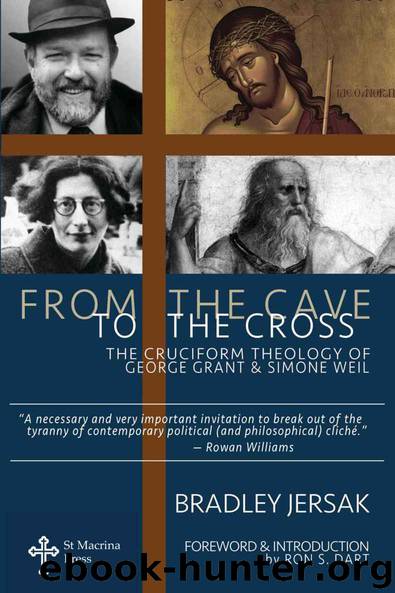
Author:Bradley Jersak [Jersak, Bradley]
Language: eng
Format: epub
Publisher: St Macrina Press
Published: 2015-09-23T22:00:00+00:00
These are immensely practical questions, for as Plato taught, our knowledge of reality effects how we live in the world as ethical citizens and just communities. To what degree do we enter and re-enter the lives of those people we try to help or teach? Or must we be so professional that we shun emotional involvement in our area of expertise or of those it impacts? When does objectivity cross over to psychopathology? Certainly we can become so involved that love seems to blind us to reality, but with Grant’s Plato, do we also see how the reverse can be far more dangerous religiously, ethically, and politically?
For example, in the Christian world, are violence-of-God texts ever to be studied and taught ‘objectively’ from sterile lecterns? Neither Weil nor Grant could do it. Love of people and experience of war enabled them to see these passages as jarring stories about real people, for real people. That is, love reveals reality in a way that objectivity cannot access. True, the Bible has been preached passionately to stir dangerous zeal in what amounted to lynch mobs, but that is not love. Is not reading about the slaughter and dismemberment of thousands coolly and without flinching just as dangerous? Do we imagine that our practice of religion and religious studies have no conditioning effect on how we see and treat people once we leave the university grounds or steepled building?
Here the Incarnation illustrates Plato. It informs us of ‘God’s model’ of knowing and being: according to the NT, God in Christ became part of the human problem. Christ does not moralize from outside Plato’s cave, but descends to share in our captivity. By and for love, God comes to know the human condition firsthand. Love incarnate sees to the heart of spiritual, psychological, and literal slavery, and thereby begins to unravel it. Even God can only know the fullness of what can be known by direct experience at the extremes of human experience—life and death—the Cross (Heb. 5:8). Grant shared in this seeing-knowing-loving through the Bermondsey trauma. This too is the why and wherefore of Weil’s year in the factories. Their incarnational knowledge is why they have lasting credibility for us. It is also why their Plato is a ‘contemplative pillar’—even a mystic—but in his this-worldly interest in justice, he returns to the cave.
4.3.2 Grant’s Heidegger: ‘Gelassenheit’ Grant’s resistance to Heidegger in part reflects his desire to make space for Heidegger’s voice, and his commitment to distinguishing what he could embrace from what he must discard. In their epistemology, Grant perceived a common meditative thread through Nietzsche’s ‘instinct,’ Heidegger’s ‘gelassenheit,’ and Weil’s ‘attention.’ Their common belief in suprarational knowledge served his critique of modernist objectivism.
i. Nietzschean segue Grant makes less use of Nietzsche’s ‘instinct’ because unlike Heidegger and Weil, the call to knowing-as-willing is so strong in Nietzsche. For Grant, Nietzsche is a romantic poet and preeminent harbinger of postmodernity. As much as Nietzsche reinforces his deconstruction of modernist epistemology, Grant rejects his form
Download
This site does not store any files on its server. We only index and link to content provided by other sites. Please contact the content providers to delete copyright contents if any and email us, we'll remove relevant links or contents immediately.
| Anthropology | Archaeology |
| Philosophy | Politics & Government |
| Social Sciences | Sociology |
| Women's Studies |
The remains of the day by Kazuo Ishiguro(8979)
Tools of Titans by Timothy Ferriss(8369)
Giovanni's Room by James Baldwin(7330)
The Black Swan by Nassim Nicholas Taleb(7110)
Inner Engineering: A Yogi's Guide to Joy by Sadhguru(6785)
The Way of Zen by Alan W. Watts(6601)
Asking the Right Questions: A Guide to Critical Thinking by M. Neil Browne & Stuart M. Keeley(5762)
The Power of Now: A Guide to Spiritual Enlightenment by Eckhart Tolle(5760)
The Six Wives Of Henry VIII (WOMEN IN HISTORY) by Fraser Antonia(5503)
Astrophysics for People in a Hurry by Neil DeGrasse Tyson(5182)
Housekeeping by Marilynne Robinson(4436)
12 Rules for Life by Jordan B. Peterson(4299)
Double Down (Diary of a Wimpy Kid Book 11) by Jeff Kinney(4261)
Ikigai by Héctor García & Francesc Miralles(4247)
The Ethical Slut by Janet W. Hardy(4242)
Skin in the Game by Nassim Nicholas Taleb(4239)
The Art of Happiness by The Dalai Lama(4125)
Skin in the Game: Hidden Asymmetries in Daily Life by Nassim Nicholas Taleb(3992)
Walking by Henry David Thoreau(3953)
