From Aristotle to Darwin and Back Again: A Journey in Final Causality, Species and Evolution by Etienne Gilson
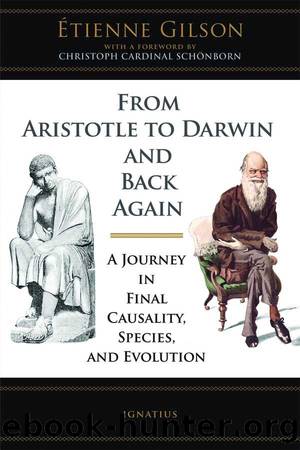
Author:Etienne Gilson [Gilson, Etienne]
Language: eng
Format: epub
Tags: Spiritual & Religion
ISBN: 9781681491950
Publisher: Ignatius Press
Published: 2009-09-30T05:00:00+00:00
V. The Limits of Mechanism
WHILE FINALISM survived, mechanism came upon unexpected difficulties. In the game that has been played for twenty-five centuries between these adversaries, the stakes are not equal. Rare are those mechanists who admit that there may be teleology in nature, but exceedingly rareâif they have ever existedâare those finalists who deny mechanism and its natural function in natural beings. It could be shown that thus have things stood since Aristotle. He never denied that the mechanism of Empedocles was true, but he reproached him with presenting it as a total explanation of reality in the order of living beings, and contrary to Empedocles he insisted upon the presence of the âendâ in living beings. Normally, mechanism excludes finalism, but finalism does not exclude mechanism. On the contrary, it necessarily implicates it.
It suffices to refer the reader to Aristotle once more in order to convince him of this. According to him âthere are two modes of causation, and. . . both of these must, so far as possible, be taken into account in explaining the works of nature, or. . . at any rate an attempt must be made to include them both; and. . . those who fail in this tell us in reality nothing about natureâ.1 what Aristotle wishes to show is that the final cause, which is the primary cause of the whole operation, âconstitutes the nature of an animal much more than does its matterâ. A couch, insofar as it is precisely a couch, is first of all an object contrived so that one could stretch out there so as to rest. Secondarily it is a thing of wood, of metal, or even of fabric and roping. This appears so evident to Aristotle that he does not succeed in persuading himself that the partisans of purely mechanical explanations have ever been able to blind themselves to this fact: âEven Empedocles hits upon this; and following the guidance of fact, finds himself constrained to speak of the ratio [o logos: the French has la raison] as constituting the essence and real nature of things.â2 More evident still, it is of the essence of finalism to take into consideration not only the end of generation but further the matter and the mechanical forces arranged in accordance with the end.
It is a question here, not of a concession agreed to by finalism, but of a necessity. Volumes could be filled by citing testimony to this fact. Since it is necessary to choose, we shall consult him who was in the eighteenth century the universally respected representative of finalism, a theologian whose work we know came later to be familiar to Charles Darwin: William Paley.3
The first lines of the Natural Theology are indicative of what is to come, for one comes across there the instrument [ce personnage] which was destined to play a leading role in the modern history of final causality, the watch. We know what use Voltaire had already made of the clock in his satire
Download
This site does not store any files on its server. We only index and link to content provided by other sites. Please contact the content providers to delete copyright contents if any and email us, we'll remove relevant links or contents immediately.
| Anthropology | Archaeology |
| Philosophy | Politics & Government |
| Social Sciences | Sociology |
| Women's Studies |
The remains of the day by Kazuo Ishiguro(9115)
Tools of Titans by Timothy Ferriss(8527)
Giovanni's Room by James Baldwin(7467)
The Black Swan by Nassim Nicholas Taleb(7221)
Inner Engineering: A Yogi's Guide to Joy by Sadhguru(6852)
The Way of Zen by Alan W. Watts(6694)
The Power of Now: A Guide to Spiritual Enlightenment by Eckhart Tolle(5878)
Asking the Right Questions: A Guide to Critical Thinking by M. Neil Browne & Stuart M. Keeley(5856)
The Six Wives Of Henry VIII (WOMEN IN HISTORY) by Fraser Antonia(5571)
Astrophysics for People in a Hurry by Neil DeGrasse Tyson(5244)
Housekeeping by Marilynne Robinson(4522)
Double Down (Diary of a Wimpy Kid Book 11) by Jeff Kinney(4356)
12 Rules for Life by Jordan B. Peterson(4353)
Ikigai by Héctor García & Francesc Miralles(4339)
Skin in the Game by Nassim Nicholas Taleb(4330)
The Ethical Slut by Janet W. Hardy(4321)
The Art of Happiness by The Dalai Lama(4186)
Skin in the Game: Hidden Asymmetries in Daily Life by Nassim Nicholas Taleb(4070)
Walking by Henry David Thoreau(4031)
