Fractional Trigonometry: with Applications to Fractional Differential Equations and Science by Lorenzo Carl F.; Hartley Tom T.; & Tom T. Hartley
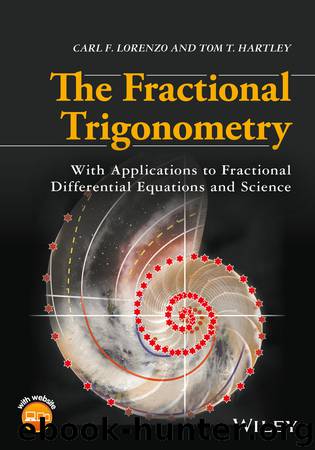
Author:Lorenzo, Carl F.; Hartley, Tom T.; & Tom T. Hartley
Language: eng
Format: epub
Publisher: John Wiley & Sons, Incorporated
Published: 2016-11-01T00:00:00+00:00
Introduction to Applications
The primary and by far the most important application of the fractional exponential and fractional trigonometric functions is the solution of linear fractional differential equations. In Chapter 12, these functions were used for the solution of linear commensurate-order fractional differential equations with constant coefficients. Analytical tools for such differential equations with unrepeated roots, repeated real roots, and repeated complex roots were presented.
Spiral behavior occurs in many natural phenomena. Galactic spirals, sea shells, whirlpools, and weather patterns are only a few such occurrences seen in the sciences. We have seen numerous examples of fractional spirals as the result of our development of the fractional trigonometries. It is natural to ask if and how the fractional spirals and associated fractional differential equations might apply to these scientific areas. Our goal is to show the application potential to such areas and not necessarily the solution to detailed problems.
Specific areas to be considered in Chapters 13–19 are fractional oscillators, morphology of sea shells, in particular the Nautilus pompilius, hurricanes, and low-pressure system cloud morphology, morphological classification of spiral and ring galaxies, tornado profiles, and whirlpool morphology. While in most cases these potential application areas provide spatial definition of the phenomena, it is expected that the development of compatible cylindrical fractional field equations, considered briefly in Chapter 20, will allow full definition and possible temporal solution. There is much to be done in the development of the fractional trigonometry; Chapter 20 presents some related challenges.
Download
This site does not store any files on its server. We only index and link to content provided by other sites. Please contact the content providers to delete copyright contents if any and email us, we'll remove relevant links or contents immediately.
Modelling of Convective Heat and Mass Transfer in Rotating Flows by Igor V. Shevchuk(6510)
Weapons of Math Destruction by Cathy O'Neil(6412)
Factfulness: Ten Reasons We're Wrong About the World – and Why Things Are Better Than You Think by Hans Rosling(4817)
A Mind For Numbers: How to Excel at Math and Science (Even If You Flunked Algebra) by Barbara Oakley(3370)
Descartes' Error by Antonio Damasio(3356)
Factfulness_Ten Reasons We're Wrong About the World_and Why Things Are Better Than You Think by Hans Rosling(3288)
TCP IP by Todd Lammle(3253)
Fooled by Randomness: The Hidden Role of Chance in Life and in the Markets by Nassim Nicholas Taleb(3194)
The Tyranny of Metrics by Jerry Z. Muller(3157)
Applied Predictive Modeling by Max Kuhn & Kjell Johnson(3132)
The Book of Numbers by Peter Bentley(3028)
The Great Unknown by Marcus du Sautoy(2752)
Once Upon an Algorithm by Martin Erwig(2704)
Easy Algebra Step-by-Step by Sandra Luna McCune(2690)
Lady Luck by Kristen Ashley(2631)
Police Exams Prep 2018-2019 by Kaplan Test Prep(2618)
Practical Guide To Principal Component Methods in R (Multivariate Analysis Book 2) by Alboukadel Kassambara(2592)
Linear Time-Invariant Systems, Behaviors and Modules by Ulrich Oberst & Martin Scheicher & Ingrid Scheicher(2462)
All Things Reconsidered by Bill Thompson III(2450)
