Donald Davidson by Glüer Kathrin;
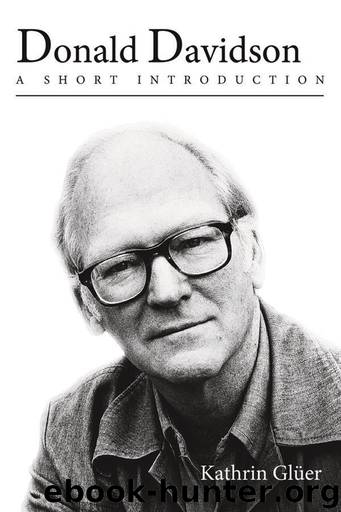
Author:Glüer, Kathrin;
Language: eng
Format: epub
Publisher: Oxford University Press
Published: 2011-01-15T00:00:00+00:00
4.2 Reasons are Causes
According to Davidson, two different relations are required to account for the full force of (true) reasons explanations: a logical relation and a causal relation. These relations, however, obtain on different levels or, more precisely, they take different kinds of relata. In general, logical relations hold between propositions or interpreted sentences. The logical relation we are concerned with here—between reasons and actions—thus must be understood as holding between the propositions or contents that are the agent’s reasons and his action as described, or conceptualized, a certain way.3
Causal relations, on the other hand, Davidson construes as holding directly between events, independently of how these events are described or conceptualized. According to Davidson, such causal relations obtain between the beliefs and desires of an agent and her actions. And there is nothing special about these causal relations; what we are dealing with is ‘common and garden’ causality between ordinary events in the world. Speaking of reasons, of beliefs, desires, and action is, according to Davidson, simply a particular way of describing certain of these ordinary events. Actions, for instance, are events that can also be described as bodily movements. Categorizing such a movement as, for instance, eating a piece of chocolate amounts to subsuming it under a particular type: a type of action. Correspondingly, beliefs and desires, or rather their formation, can be construed as mental events. The relevant causal relation then is supposed to hold directly between event tokens—irrespective of how these events are typed, that is, described or conceptualized. This distinction between ‘event tokens’ and their descriptions provides the key to the Davidsonian attempt at reconciling the two modes of explanation that otherwise might appear incompatible: reasons explanation and causal explanation. To see that they can be reconciled, Davidson submits, we need to understand that one of them holds on the level of description while the other holds between description independent events. In what follows, we shall have a closer look at both levels, starting with the descriptions.
Download
This site does not store any files on its server. We only index and link to content provided by other sites. Please contact the content providers to delete copyright contents if any and email us, we'll remove relevant links or contents immediately.
| Anthropology | Archaeology |
| Philosophy | Politics & Government |
| Social Sciences | Sociology |
| Women's Studies |
The remains of the day by Kazuo Ishiguro(9006)
Tools of Titans by Timothy Ferriss(8404)
Giovanni's Room by James Baldwin(7356)
The Black Swan by Nassim Nicholas Taleb(7137)
Inner Engineering: A Yogi's Guide to Joy by Sadhguru(6801)
The Way of Zen by Alan W. Watts(6621)
The Power of Now: A Guide to Spiritual Enlightenment by Eckhart Tolle(5791)
Asking the Right Questions: A Guide to Critical Thinking by M. Neil Browne & Stuart M. Keeley(5779)
The Six Wives Of Henry VIII (WOMEN IN HISTORY) by Fraser Antonia(5520)
Astrophysics for People in a Hurry by Neil DeGrasse Tyson(5196)
Housekeeping by Marilynne Robinson(4456)
12 Rules for Life by Jordan B. Peterson(4315)
Ikigai by Héctor García & Francesc Miralles(4280)
Double Down (Diary of a Wimpy Kid Book 11) by Jeff Kinney(4278)
The Ethical Slut by Janet W. Hardy(4264)
Skin in the Game by Nassim Nicholas Taleb(4258)
The Art of Happiness by The Dalai Lama(4133)
Skin in the Game: Hidden Asymmetries in Daily Life by Nassim Nicholas Taleb(4013)
Walking by Henry David Thoreau(3970)
