Deleuzian Concepts by Patton Paul;
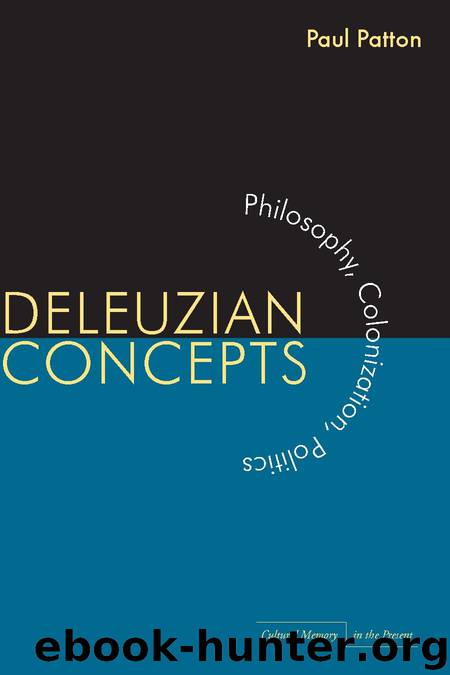
Author:Patton, Paul;
Language: eng
Format: epub
Publisher: Stanford University Press
Published: 2011-07-29T04:00:00+00:00
Becoming-Minor and Becoming-Animal
In A Thousand Plateaus, Deleuze and Guattari develop a version of their ontology of becoming in the form of a theory of multiplicities or machinic assemblages. Ultimately, these assemblages or abstract machines are a kind of open or evolving multiplicity that is itself a process of becoming other. It is not surprising that multiplicities constantly transform into one another, “since becoming and multiplicity are the same thing” (MP 305, 249). The ontological priority of becoming in this machinic metaphysics is reflected in the fact that assemblages are defined not by their forms of conservation but by their forms of modification or metamorphosis, by their “cutting edges of deterritorialization” (MP 112, 88). In these terms, they argue that individuals no less than societies are defined by their lines of flight or deterritorialization. They mean that there is no person and no society that is not conserving or maintaining itself on one level, while simultaneously being transformed into something else on another level. In other words, fundamental shifts in personal and social identity happen all the time. Sometimes these happen by degrees, but sometimes fundamental changes occur through the sudden eruption of events that inaugurate a new field of personal, social, or affective possibilities. These are turning points in individual lives or in history, after which some things will never be the same as before. They are examples, Deleuze suggests, of “a becoming breaking through into history” (P 209, 153: see above, Chapter 4, p. 89; Chapter 5, pp. 109–110).
The sense in which Deleuze and Guattari regard their philosophy as political relates to their concern with the processes of becoming by means of which majoritarian social and political identities are transformed. In What Is Philosophy? they distinguish two kinds of becoming. The first, which is common in certain classes of sensible objects, involves “the action by which something or someone continues to become other (while continuing to be what it is)” (QP 168, 177). This kind of becoming is confined to the actual and is more or less what Derrida understands by the process of iteration, namely incremental transformation in the course of repetition of the same. The second kind of becoming involves movement beyond the actual toward the virtual. Philosophy and literature are political in the sense that they are concerned with this kind of becoming, the kind that liberates the individual from the confines of a particular identity and opens up the possibility of transformation. In this sense, to become “is not to attain a form (identification, imitation, Mimesis) but to find a zone of proximity, indiscernibility, or indifferentiation where one can no longer be distinguished from a woman, an animal, or a molecule” (CC xx, 1). Whereas Derrida tends to confine himself to analyses of the structure of iterability in various fields, or to analyses of the “to-come” that remains an immanent condition of the possibility and impossibility of change, Deleuze and Guattari describe a series of more specific ways in which individuals and groups become other.
In Plateau 10, “1730: Becoming-Intense, Becoming-Animal, Becoming-Imperceptible .
Download
This site does not store any files on its server. We only index and link to content provided by other sites. Please contact the content providers to delete copyright contents if any and email us, we'll remove relevant links or contents immediately.
| Anthropology | Archaeology |
| Philosophy | Politics & Government |
| Social Sciences | Sociology |
| Women's Studies |
The remains of the day by Kazuo Ishiguro(8999)
Tools of Titans by Timothy Ferriss(8396)
Giovanni's Room by James Baldwin(7346)
The Black Swan by Nassim Nicholas Taleb(7129)
Inner Engineering: A Yogi's Guide to Joy by Sadhguru(6796)
The Way of Zen by Alan W. Watts(6614)
The Power of Now: A Guide to Spiritual Enlightenment by Eckhart Tolle(5781)
Asking the Right Questions: A Guide to Critical Thinking by M. Neil Browne & Stuart M. Keeley(5775)
The Six Wives Of Henry VIII (WOMEN IN HISTORY) by Fraser Antonia(5515)
Astrophysics for People in a Hurry by Neil DeGrasse Tyson(5190)
Housekeeping by Marilynne Robinson(4447)
12 Rules for Life by Jordan B. Peterson(4304)
Ikigai by Héctor García & Francesc Miralles(4274)
Double Down (Diary of a Wimpy Kid Book 11) by Jeff Kinney(4272)
The Ethical Slut by Janet W. Hardy(4253)
Skin in the Game by Nassim Nicholas Taleb(4248)
The Art of Happiness by The Dalai Lama(4130)
Skin in the Game: Hidden Asymmetries in Daily Life by Nassim Nicholas Taleb(4007)
Walking by Henry David Thoreau(3962)
