David Hume and the Problem of Other Minds by Waldow Anik.;
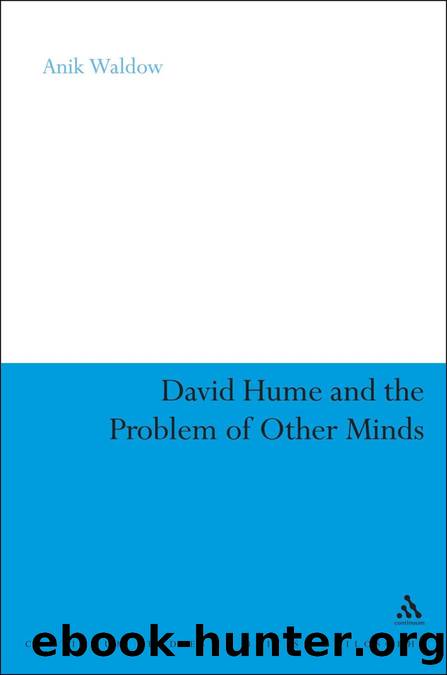
Author:Waldow, Anik.;
Language: eng
Format: epub
ISBN: 9781441151407
Publisher: Bloomsbury UK
Published: 2019-11-23T00:00:00+00:00
2.6 Humeâs Concept of Mind
At the end of this chapter, several remarks about the perspective involved in the conception of mind as a complex idea, consisting of behavioural and mental aspects, shall be added. When Hume describes the mechanism of sympathy, he places the subject in a world that is inhabited by other subjects. From the very beginning it is thus assumed that there are other mind and the only thing that Hume ventures to explain are the cognitive channels through which the conception of other minds proceeds. Here, as we have seen, the perception of behaviour plays a crucial part. According to the interpretation suggested above, it is required that we perceive another to behave in relevantly similar ways to ourselves. This is because only then are we in a position to relate these impressions to our own case and to ascribe mental causes to the other, those mental causes that we know from the introspection of ourselves. Once this move has been made, we perceive the other to possess a mind similar to our own. With this approach the conception of the other remains closely related to our experience, that is, the experience that other persons behave in similar ways as we do. In this sense one can say that the conception of others as persons with minds that are similar to our own is not the mere product of our fantasy. We do not imagine the other from within the solitude of our own thoughts, we conceive of minds as being similar to our own because there are perceivable events in the world telling us that others behave in a way that seems to involve mind.
This outcome certainly may surprise. Hume the sceptic has often been understood to construe mind, by Cartesian tradition, as the inner of a sole subject that is cut off from all ties with the world. If this were Humeâs perspective, his concept of mind would obviously fail to qualify as general. In isolation from the world, one can retreat only to oneâs own mind. Hence, all that could inform Humeâs concept of mind would be mental episodes; as a result, the conceptâs unity and generality would be endangered. As has been pointed out, the unity of the concept of mind depends on its ability to integrate behavioural aspects, because it is behaviour that functions as the common element in the application of the concept to ourselves and others. So, if the Humean concept of mind were composed solely of ideas of mental episodes, it would be difficult to show how the idea of our mind connects with ideas of minds that we conceive when perceiving third-person behaviour. The chances for a general concept of mind here fade, for a conceptâs generality is defined by its applicability to more than one individual; and if we apply another concept to ourselves than to other persons this condition cannot be met.
In the light of this, an approach that spares the Cartesian perspective, by concentrating on Humeâs discussion of sympathy, seems advantageous.
Download
This site does not store any files on its server. We only index and link to content provided by other sites. Please contact the content providers to delete copyright contents if any and email us, we'll remove relevant links or contents immediately.
| Anthropology | Archaeology |
| Philosophy | Politics & Government |
| Social Sciences | Sociology |
| Women's Studies |
The remains of the day by Kazuo Ishiguro(9104)
Tools of Titans by Timothy Ferriss(8512)
Giovanni's Room by James Baldwin(7452)
The Black Swan by Nassim Nicholas Taleb(7215)
Inner Engineering: A Yogi's Guide to Joy by Sadhguru(6843)
The Way of Zen by Alan W. Watts(6681)
The Power of Now: A Guide to Spiritual Enlightenment by Eckhart Tolle(5868)
Asking the Right Questions: A Guide to Critical Thinking by M. Neil Browne & Stuart M. Keeley(5848)
The Six Wives Of Henry VIII (WOMEN IN HISTORY) by Fraser Antonia(5569)
Astrophysics for People in a Hurry by Neil DeGrasse Tyson(5241)
Housekeeping by Marilynne Robinson(4515)
Double Down (Diary of a Wimpy Kid Book 11) by Jeff Kinney(4350)
12 Rules for Life by Jordan B. Peterson(4345)
Ikigai by Héctor García & Francesc Miralles(4326)
Skin in the Game by Nassim Nicholas Taleb(4317)
The Ethical Slut by Janet W. Hardy(4314)
The Art of Happiness by The Dalai Lama(4181)
Skin in the Game: Hidden Asymmetries in Daily Life by Nassim Nicholas Taleb(4063)
Walking by Henry David Thoreau(4024)
