Continue: The Boss Fight Books Anthology by Boss Fight Books
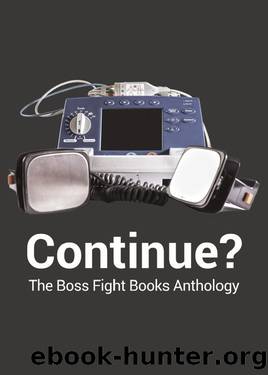
Author:Boss Fight Books [Books, Boss Fight]
Language: eng
Format: epub
Tags: criticism, Matt Bell, and Rachel B. Glaser, nonfiction, NES, Mike Meginnis, Salvatore Pane, Jill of the Jungle, Tevis Thompson, Rebekah Frumkin, memoir, gaming, videogame, game history, Kentucky Route Zero, Nintendo, David LeGault, Dragon's Lair, The Walking Dead, The Legend of Zelda, Castlevania, Brian Oliu, Mike Lars White, Anna Anthropy, Leisure Suit Larry, Mega Man, Plants vs. Zombies, video game, NBA Jam, Action Max, history
Publisher: Boss Fight Books
Published: 2015-01-15T05:00:00+00:00
Three Video Games That Feel Horribly Like Life
Ken Baumann
I
While my cats were coming down off ketamine, I finished The Walking Dead: Season One. Kubrick, gray and white, and Bosch, black and white, repeatedly banged their faces into the wire mesh of their kennels as I tried to ignore them by enacting catastrophic human mistake after catastrophic human mistake in this fucking game about zombies. Iâll back up a bit: I bought The Walking Dead game after reading some positive reviews. It was described as well written and emotionally affective, and I feel emotionally affected by a video game about as often as Iâm emotionally affected by a bowel movement. So: rarely. But I bought the praise and bought the game, then played the first section a few days before getting our two cats neutered. Something strange happened. I played through the first two hours feeling like I had not made a single good decision. I told my wife, semi-jokingly saying, âThis game feels like life.â Aviva defaults into a sturdy hatred for all games, no matter their configuration, but my reaction intrigued her. As I progressed through the dystopian Georgian nightmare, Aviva watched. She was drawn in. The game transcended its gameness for both of us. Later, after a main character is suddenly shotâpoint blank; no foreshadowing; a video game death that was so arbitrary that it felt sacredâI caught myself reconsidering one of the in-game conversation choices leading up to the shooting. I was driving our cats to the vet, and the sun was lighting the smog up like a filament bulb, and I was thinking, âShould I have said something different to X back there? Could I have saved Y?â I was deeply anxious. The game continued, its horrors mounted. I regretted my decision to forbid myself from replaying sections; I wanted to bumble through the game irrevocably, like life. The game kept developing this sheen of awful realityâyou panic over decisions that ultimately donât matter, your intentions are misinterpreted, trivial details take on undue emotional intensities, you fuck up, you forget, you give up, you mourn. The game ended, and my cats finally fell asleep, and I sat with this feeling of hollow certainty, underscored by a more evil ambiguityâIâve lived through the experience, but did I really save anything?
II
Again, an enthusiastic review lead me to play Spec Ops: The Line. I was wary of the game to begin withâfirst person shooters make me feel fried, as if some hidden nub that keeps me socially operative gets cored out by a few hours of tapping buttons and killing brown avatars. The genreâs got a lot of problems, in other words, all of which are obvious. But the review promised that this game is different. I ran through the story in a few long boutsâI struggle to play video games less than three hours at a timeâand by the time the credits rolled, I vowed to never play another military FPS again. Spec Ops installed an ethical dilemma in me that, while small, still has an effect on my daily life.
Download
This site does not store any files on its server. We only index and link to content provided by other sites. Please contact the content providers to delete copyright contents if any and email us, we'll remove relevant links or contents immediately.
The Mikado Method by Ola Ellnestam Daniel Brolund(26285)
Hello! Python by Anthony Briggs(25211)
Secrets of the JavaScript Ninja by John Resig Bear Bibeault(24438)
Kotlin in Action by Dmitry Jemerov(23529)
The Well-Grounded Java Developer by Benjamin J. Evans Martijn Verburg(22871)
Dependency Injection in .NET by Mark Seemann(22660)
OCA Java SE 8 Programmer I Certification Guide by Mala Gupta(21422)
Algorithms of the Intelligent Web by Haralambos Marmanis;Dmitry Babenko(20265)
Grails in Action by Glen Smith Peter Ledbrook(19334)
Adobe Camera Raw For Digital Photographers Only by Rob Sheppard(17049)
Sass and Compass in Action by Wynn Netherland Nathan Weizenbaum Chris Eppstein Brandon Mathis(16362)
Secrets of the JavaScript Ninja by John Resig & Bear Bibeault(14073)
Test-Driven iOS Development with Swift 4 by Dominik Hauser(12248)
Jquery UI in Action : Master the concepts Of Jquery UI: A Step By Step Approach by ANMOL GOYAL(11526)
A Developer's Guide to Building Resilient Cloud Applications with Azure by Hamida Rebai Trabelsi(10638)
Hit Refresh by Satya Nadella(9216)
The Kubernetes Operator Framework Book by Michael Dame(8574)
Exploring Deepfakes by Bryan Lyon and Matt Tora(8425)
Robo-Advisor with Python by Aki Ranin(8370)
