Buddhist Feminisms and Femininities by Karma Lekshe Tsomo;
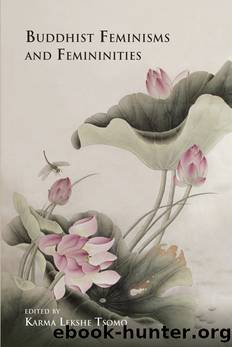
Author:Karma Lekshe Tsomo;
Language: eng
Format: epub
Publisher: State University of New York Press
Published: 2018-11-14T16:00:00+00:00
The Question of a Gendered Buddhist Modernism
The turn of the twentieth century was a time of global encounter and exploration. Fueled by the technologies of the industrial revolution and exploitation of colonial resources and labor, the networks of travel and commerce that spread globally transmitted ideas and philosophies as much as commodities of empire. In addition to ideologies of exploitation, this period also brought about critical discussions of liberation and freedom in political, racial, and economic terms in the formation of trans-imperial intellectual communities.6 Two of the key discussions that circulated within these communities were the roles of women and religion in society. Enlightenment ideals espoused that women should be equal to men, and allowed access to independence in the forms of education, livelihood, wealth, and political suffrage. Similarly, religious freedom was seen as a key idea, and the self-critique of colonial ideologies and acceptance of the Orientalist-constructed âmystic Eastâ facilitated the broad acceptance of a number of non-Judeo-Christian religious traditions. While the nontheism of Buddhism bewildered some intellectuals, other of its elements were seen as particularly conducive to global projects and definitions of modernity.7 As David McMahan has written, much of what is popular about Buddhism today in the public sphere is its popular representation as:
⦠a religion whose most important elements are meditation, rigorous philosophical analysis, and an ethic of compassion combined with a highly empirical psychoanalytical science that encourages reliance on individual experience. It discourages blindly following authority and dogma, has little place for superstition, magic, image worship, and gods, and is largely compatible with the findings of modern science and liberal democratic values.8
This form of âBuddhist modernism,â as he has termed it, is by no means new. Multiple projects by multiple intellectual and cultural communities have in turn colluded and competed to construct Buddhist modernisms over the past two hundred years. A number of these parties have used discourses about equality as their central focus. Despite these constructions, however, the treatment of gender as a category of Buddhist modernism has remained underdeveloped. The early links between the intellectual communities mentioned above, who were interested in religious freedom and womenâs rights, respectively, have often been concealed within other projects. In the case of Buddhism, in the past two decades a number of scholars have discussed connections between Buddhist and feminist ideologies,9 but as Jean Byrne has recently argued, there still remains much to be debated and explored to demonstrate the viability of Buddhism as a system compatible with feminism, particularly due to the realities of its institutions on the ground in patriarchal societies.10 Concerns over cultural appropriation and structural inequalities within feminism have arisen that need to be addressed to create fully a representative and inclusive feminism, as well as to consider whether feminism is the most appropriate discourse for discussing issues of gender equality in different Buddhist communities.11
The study of Buddhist modernism has often ignored these questions, which is surprising as Buddhist modernists were concerned with social justice issues, including education, class equality, and democracy. However,
Download
This site does not store any files on its server. We only index and link to content provided by other sites. Please contact the content providers to delete copyright contents if any and email us, we'll remove relevant links or contents immediately.
| Anthropology | Archaeology |
| Philosophy | Politics & Government |
| Social Sciences | Sociology |
| Women's Studies |
The remains of the day by Kazuo Ishiguro(9113)
Tools of Titans by Timothy Ferriss(8522)
Giovanni's Room by James Baldwin(7464)
The Black Swan by Nassim Nicholas Taleb(7221)
Inner Engineering: A Yogi's Guide to Joy by Sadhguru(6849)
The Way of Zen by Alan W. Watts(6693)
The Power of Now: A Guide to Spiritual Enlightenment by Eckhart Tolle(5877)
Asking the Right Questions: A Guide to Critical Thinking by M. Neil Browne & Stuart M. Keeley(5855)
The Six Wives Of Henry VIII (WOMEN IN HISTORY) by Fraser Antonia(5571)
Astrophysics for People in a Hurry by Neil DeGrasse Tyson(5243)
Housekeeping by Marilynne Robinson(4521)
Double Down (Diary of a Wimpy Kid Book 11) by Jeff Kinney(4354)
12 Rules for Life by Jordan B. Peterson(4353)
Ikigai by Héctor García & Francesc Miralles(4338)
Skin in the Game by Nassim Nicholas Taleb(4330)
The Ethical Slut by Janet W. Hardy(4321)
The Art of Happiness by The Dalai Lama(4185)
Skin in the Game: Hidden Asymmetries in Daily Life by Nassim Nicholas Taleb(4070)
Walking by Henry David Thoreau(4031)
