Bentham and the Arts by Anthony Julius;Malcolm Quinn;Philip Schofield;
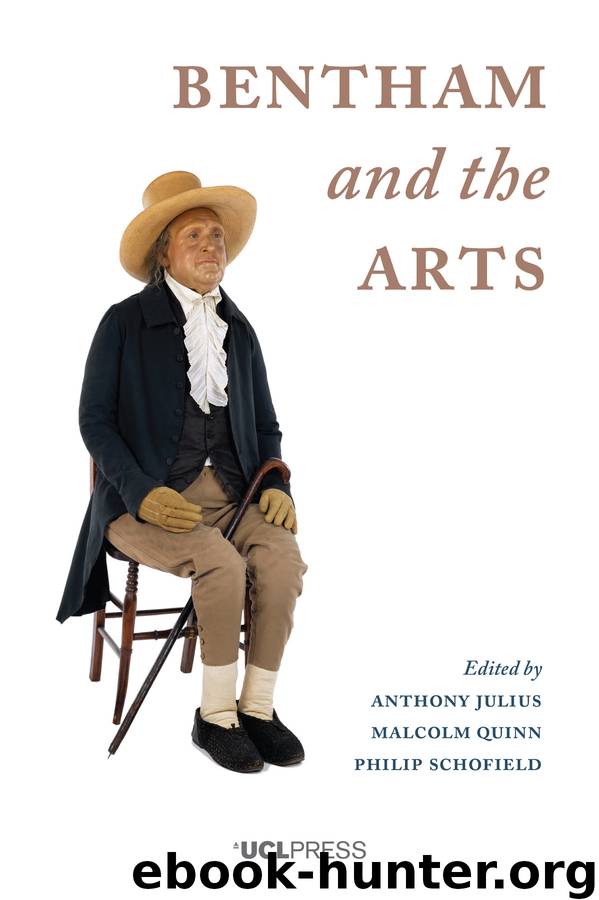
Author:Anthony Julius;Malcolm Quinn;Philip Schofield;
Language: eng
Format: epub
Publisher: Book Network Int'l Limited trading as NBN International (NBNi)
Published: 2020-07-17T16:00:00+00:00
Hume’s conventionalism
The polarization Mill perceived in contemporary thought between those who prioritize questions of ‘truth’ and those who emphasize issues of ‘meaning’ has its roots in Hume’s conventionalist treatment of language. Although Hume did not produce a fully developed theory of language, he made a number of remarks and observations on the subject, and his interest in the way that customs shape human nature drew him towards an account of language as social and conventional. One of the more celebrated of his comments arrives at the end of Section 2 of An Enquiry Concerning Human Understanding (1748). Here, Hume notes that one of the reasons why people are often hoodwinked by philosophical jargon is that they too readily assume that well-established and familiar terms have definite meanings attached to them in the form of determinate ideas. However, since all ideas are, by their very nature, faint and languid, and impressions and sensations are strong and vivid, Hume proposes that ‘[w]hen we entertain … any suspicion that a philosophical term is employed without any meaning or idea (as is but too frequent), we need but enquire, from what impression is that supposed idea derived? And if it be impossible to assign any, this will serve to confirm our suspicion.’4 The semantic thesis implied by this statement is what M.A. Box, borrowing a term from Jonathan Bennett, classes as ‘meaning-empiricism’, that is, the thesis ‘that meaning can be determined by demanding the birth certification in experience of an idea’.5 Hume’s suggestion that the meanings of terms must be cashed out into the currency of sense-experience, and that by ‘bringing ideas into so clear a light we may reasonably hope to remove all dispute’, would have far-reaching repercussions. It would ultimately inspire attempts by logical positivists in the early twentieth century to establish sensation (through various forms of verification principle) as the semantic index of scientific and philosophical discourse, an ambition crystallized in A.J. Ayer’s declaration that ‘[i]t is the philosopher’s business to give a correct definition of material things in terms of sensations.’6 Despite this legacy, Hume himself remained doubtful about the possibility of providing ‘correct’ definitions of things purely in terms of sense-experience. Indeed, he finally denies that meaning must ultimately rest upon non-linguistic entities, regardless of whether these entities are understood to be intellectual essences or the raw data of sensation. For Hume, language is best understood as a set of conventions determined by and within social contexts.
To support this claim, Hume appeals to Berkeley’s argument regarding the formation of abstract ideas. One of the paradoxes thrown up by Locke’s corpuscularian epistemology was the notion of an idea that was simultaneously particular and general, encompassing the qualities of the members of the class it represented while being, in Locke’s words, ‘all and none of these at once’. Since general ideas lack corresponding particular objects, they remain ‘Fictions and Contrivances of the Mind’, and, therefore, Locke acknowledges, ‘marks of our Imperfection’.7 Berkeley had attempted to overcome the empirical problem of how
Download
This site does not store any files on its server. We only index and link to content provided by other sites. Please contact the content providers to delete copyright contents if any and email us, we'll remove relevant links or contents immediately.
| Anthropology | Archaeology |
| Philosophy | Politics & Government |
| Social Sciences | Sociology |
| Women's Studies |
The remains of the day by Kazuo Ishiguro(9228)
Tools of Titans by Timothy Ferriss(8605)
Giovanni's Room by James Baldwin(7572)
The Black Swan by Nassim Nicholas Taleb(7280)
Inner Engineering: A Yogi's Guide to Joy by Sadhguru(6905)
The Way of Zen by Alan W. Watts(6735)
The Power of Now: A Guide to Spiritual Enlightenment by Eckhart Tolle(5930)
Asking the Right Questions: A Guide to Critical Thinking by M. Neil Browne & Stuart M. Keeley(5901)
The Six Wives Of Henry VIII (WOMEN IN HISTORY) by Fraser Antonia(5613)
Astrophysics for People in a Hurry by Neil DeGrasse Tyson(5280)
Housekeeping by Marilynne Robinson(4603)
Double Down (Diary of a Wimpy Kid Book 11) by Jeff Kinney(4411)
Ikigai by Héctor García & Francesc Miralles(4395)
Skin in the Game by Nassim Nicholas Taleb(4393)
12 Rules for Life by Jordan B. Peterson(4387)
The Ethical Slut by Janet W. Hardy(4352)
The Art of Happiness by The Dalai Lama(4239)
Skin in the Game: Hidden Asymmetries in Daily Life by Nassim Nicholas Taleb(4129)
Walking by Henry David Thoreau(4082)
