Asians in Colorado by William Wei
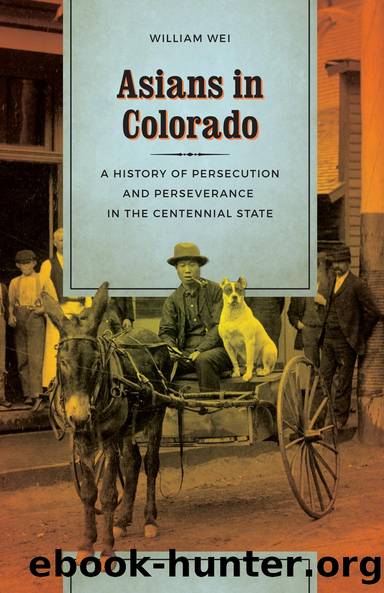
Author:William Wei [Wei, William]
Language: eng
Format: epub
ISBN: 9780295743653
Barnesnoble:
Publisher: University of Washington Press
Published: 2018-03-01T00:00:00+00:00
A MATTER OF NATIONAL SECURITY
In the early twentieth century, the specter of a global race war, anticipated by Mackinderâs geopolitics, cast a shadow on Americaâs relations with Asia. The worry was that Japanese militarists were moving to assemble an Asian empire to challenge Western interests. If the Japanese succeeded in mobilizing Chinaâs millions for this purpose, the West faced a real threat. The New York Times reported that Japanese agents were distributing tracts and disseminating the idea that Asia should be for Asians, asserting that no European power had rights in Asian territories or to trade with Asian countries.24
In assessing Japanese ambitions, the United States felt that much hung on the outcome of the Russo-Japanese War. It was said that Russia was fighting for all of Europe, while Japan was fighting for all of Asia. If Japan became a world power, there would be little to prevent it from emulating the expansionist West. As the well-known writer Jack London put it, âJust as the West was engaged in an adventure to expand its power around the world, what would prevent the Japanese and Chinese peoples from having similar dreams of wealth and conquest?â25 Londonâs story âThe Unparalleled Invasionâ (1910) portrays such a scenario. Set in the future, the story tells how America counters an imminent threat in 1976 by introducing a plague germ into China to exterminate all the Chineseâthis is the âunparalleled invasion.â26 Londonâs grim fantasy about the use of biological weapons of mass destruction as a military tactic is especially chilling because it comes only a few years before World War I and the use of chemical weapons.
After Japanâs victory in the Russo-Japanese War, attitudes toward Japanese Americans shifted subtly. Japanophobes such as Californiaâs Senator Phelan began to argue that, because Japan now represented a military danger to the country, it was necessary to establish large army garrisons in Americaâs Pacific possessions.27 Inasmuch as Japanese immigrants were an extension of that threat, they should be excluded from the country for reasons of national security. Meanwhile, the American labor movement continued to play the race card to advance its agenda but packaged it differently for public consumption.
Labor leaders sought to take advantage of the growing unease about Japanâs military might to heighten worries about Japanese workers as an economic threat. They claimed that Japanese in Japan and Japanese in America were all of a pieceâtheir first allegiance was to the Japanese emperor. Labor leaders emphasized the potential risk that such a population posed to the nation, repeating the charge made by the Asiatic Exclusion League that Japanese would serve as a fifth column in any future war with Japan (see chapter 5). This groundless allegation resurfaced before, during, and after the 1941 attack on the Pearl Harbor naval base in Hawaii, with disastrous consequences for Japanese Americans.
The hardening of views about Japanese in Colorado in the aftermath of the Russo-Japanese War is suggested by the narrowing of the range of public opinions expressed by local contributors to a workersâ forum in the RMN.
Download
This site does not store any files on its server. We only index and link to content provided by other sites. Please contact the content providers to delete copyright contents if any and email us, we'll remove relevant links or contents immediately.
| Americas | African Americans |
| Civil War | Colonial Period |
| Immigrants | Revolution & Founding |
| State & Local |
The Innovators: How a Group of Hackers, Geniuses, and Geeks Created the Digital Revolution by Walter Isaacson(3465)
In Cold Blood by Truman Capote(3433)
Steve Jobs by Walter Isaacson(2945)
All the President's Men by Carl Bernstein & Bob Woodward(2408)
And the Band Played On by Randy Shilts(2266)
Lonely Planet New York City by Lonely Planet(2259)
The Room Where It Happened by John Bolton;(2197)
Being George Washington by Beck Glenn(2193)
The Poisoner's Handbook by Deborah Blum(2178)
The Innovators by Walter Isaacson(2148)
The Murder of Marilyn Monroe by Jay Margolis(2136)
Lincoln by David Herbert Donald(2028)
A Colony in a Nation by Chris Hayes(1964)
Under the Banner of Heaven: A Story of Violent Faith by Jon Krakauer(1842)
Dirt by Bill Buford(1732)
Amelia Earhart by Doris L. Rich(1720)
The Unsettlers by Mark Sundeen(1719)
Zeitoun by Dave Eggers(1698)
Birdmen by Lawrence Goldstone(1690)
